
Charleston, South Carolina
Quartzite Countertops in Charleston, SC
Quartzite is sandstone that heat and pressure turned into a dense rock made mostly of quartz, so it can look like marble while being harder than glass and unbothered by lemon juice. Stonhaus Design fabricates and installs quartzite countertops for kitchens, islands and baths around Charleston, SC, from slabs you pick in person at our North Charleston showroom.
Google rating: 5.0 from six reviews, as read on September 22, 2026.
Showroom
North Charleston, SC
Hours
Mon–Fri, 8 am – 5 pm
Direct Line
+1 (843) 284-7866
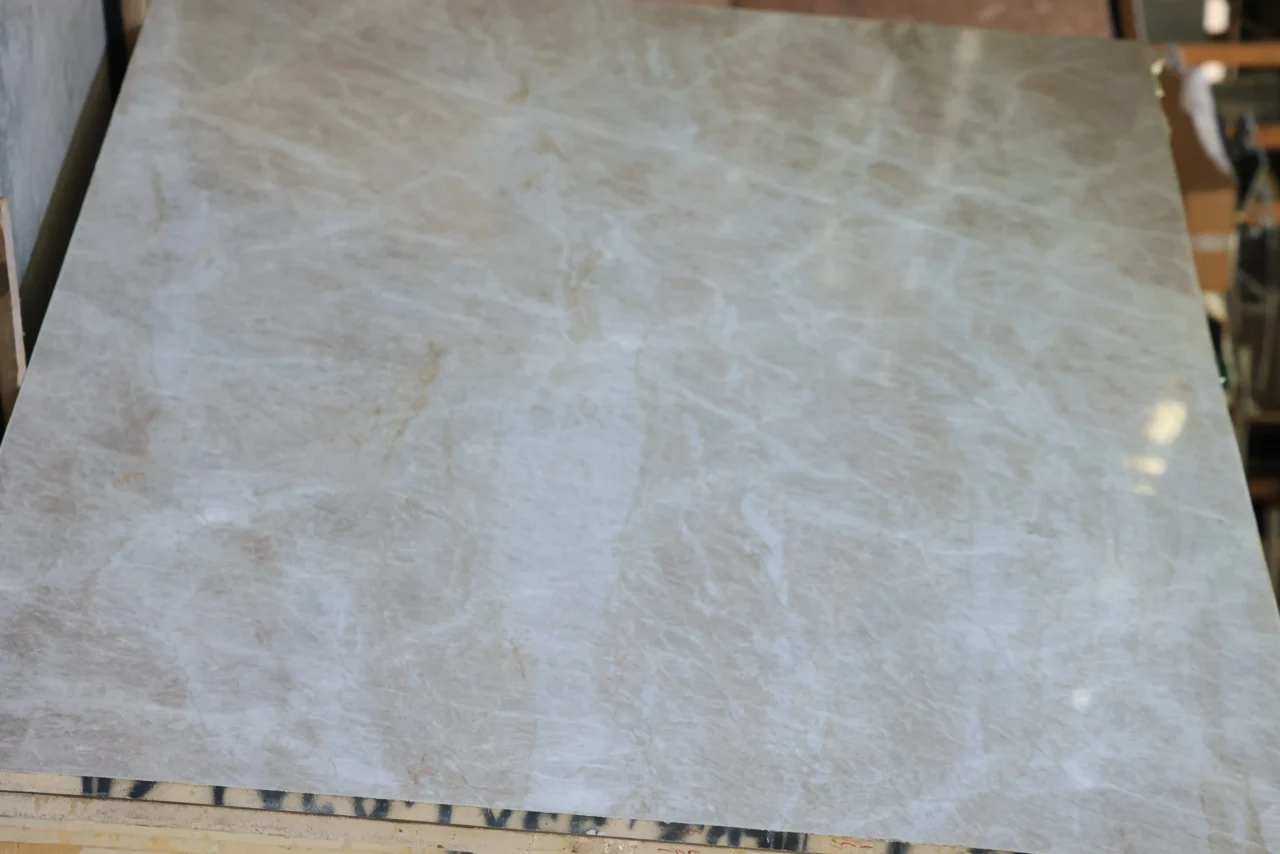
Real quartzite passes two kitchen-table tests
The name on a slab is not proof. The Natural Stone Institute (NSI) says quartzite is commonly mislabeled, and that marble or dolomitic marble is sometimes sold under the quartzite name. Those stones behave differently in a kitchen, which explains most of the conflicting stories you read online.
Two properties give the real thing away, and you can check both on an offcut of the slab you are considering:
- Glass test. Quartz sits at 7 on the Mohs scale, harder than glass and a knife blade. Drag a sharp corner of the offcut across a glass tile or bottle. Quartzite scratches the glass. If it doesn't, NSI's rule applies: a stone labeled quartzite that turns out soft was mislabeled.
- Acid test. Leave a little lemon juice or vinegar on the polished face for about 15 minutes, as NSI suggests, then rinse. NSI is direct about it: quartzite will not etch from those acids, so a dull mark means the stone is something else.
Use the offcut of the slab you will buy, not a showroom chip of a different lot. If you are still deciding whether this stone belongs in your kitchen at all, read whether quartzite is good for kitchen countertops.
The quartzites photographed on our materials pages
Each stone below has its own page on our site, and every one of those pages asks you to select your slab in person. With quartzite that matters, because two slabs sold under one name can differ a lot in color and movement.
| Stone | How our material page describes it | Where it tends to fit |
|---|---|---|
| Taj Mahal quartzite | Creamy, champagne-toned background with soft beige, gold and pale grey veining | Warm kitchens, white cabinetry, wood and aged brass |
| Mont Blanc quartzite | Clean white with gentle grey, charcoal and occasional lilac veining | Kitchens that want the airy look of white marble |
| Sea Pearl quartzite | Cool grey to soft sage, fine veining, a faint shimmer | Quiet, coastal palettes: shiplap, weathered wood, soft blues |
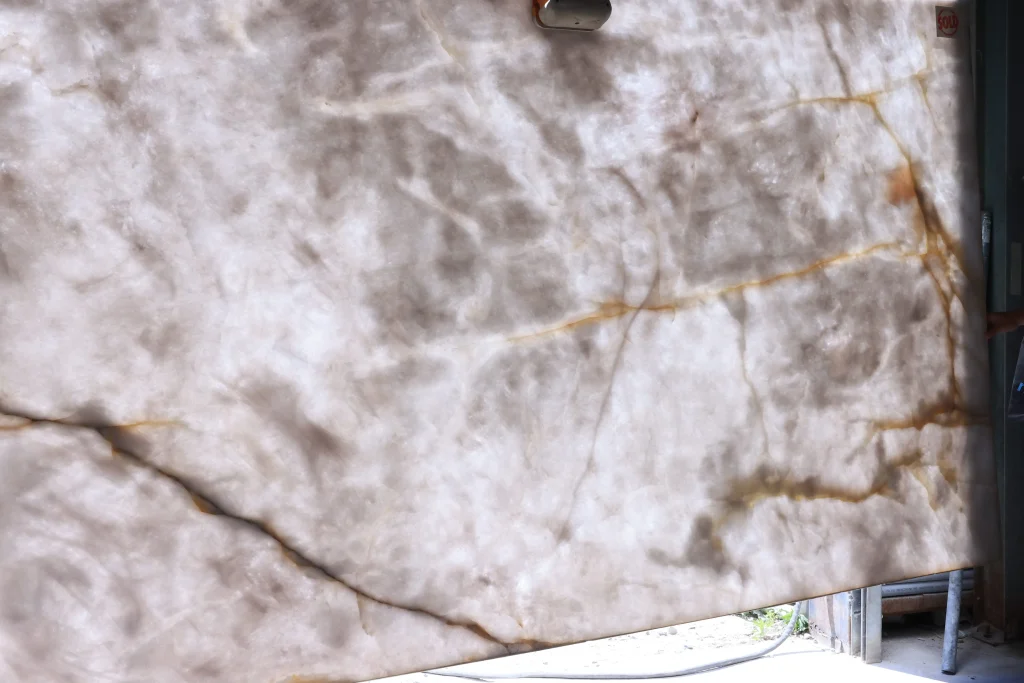
| Crystallo quartzite | Semi-translucent body with amber and gold veins; can be backlit | Showpiece islands, bars and feature walls |
| Sequoia Brown quartzite | Strong linear bands of charcoal, taupe and brown | Long runs and bookmatched countertops |

Sun and weather: where quartzite earns its keep
An outdoor kitchen on the piazza or a bar on a screened porch takes a lot of Lowcountry sun.
NSI notes that harsh weather and UV light won't affect natural quartzite, and that it works outdoors as well as in. The same article reports that slabs of engineered stone left outside turned yellow, because the resin in them reacts to sunlight.
That is the main practical split for Charleston homes. For an indoor kitchen where you want one even color from end to end, engineered surfaces are a fair option, and our page on quartz countertops in Charleston covers them. For the full side-by-side, see quartzite vs quartz.
From slab viewing to installed top
- Tell us about the space. Call or use the form with the room, rough sizes and timeline. Our site commits to a reply within 24 hours.
- Choose the slab in North Charleston. You compare full slabs, not small samples, with a stone specialist guiding the choice.
- Templating and cutting. We measure the cabinets, settle the edge profile and finish, then cut and polish the pieces in our shop.
- Installation. Tops are set and scribed to the cabinets, the way our project pages describe each job.
Two decisions shape quartzite more than anything else: where the seams fall and which part of the slab lands on the island. Our notes on choosing a quartzite island slab walk through that. When you are ready, ask for a quartzite consultation.
Living with it: cleaning, sealing and hot pans
NSI's care guide compares quartzite to granite: wipe with a gentle cleanser, water and a soft cloth, clean up spills quickly, and use coasters, trivets and cooling racks. One expert in that guide adds a reason to use a cutting board that has nothing to do with the stone: quartzite is hard enough to dull your knives.
Sealing depends on the slab. Some quartzites are dense enough to skip it; more porous ones benefit from a good sealer. NSI's simple check is the area around the sink: if the stone darkens there after water sits, it is absorbing and should be sealed.
We don't sell resealing as a separate service, but our guide to sealing marble and quartzite explains the routine, and this piece covers how quartzite handles heat.
What moves the price of a quartzite top
We don't publish prices, because stone costs change and a number on a web page goes stale. These are the things that move a quartzite quote up or down:
- The stone itself. Rarity counts: our Crystallo page lists it among the most expensive natural stones, while other quartzites sit lower.
- How many slabs the layout needs, which depends on square footage and on matching veins across pieces.
- Bookmatching or continuous veining on an island or a waterfall end.
- Edge profile, thickness and the number of cutouts for sinks and cooktops.
- Removal of the old tops and how easy it is to carry slabs into the house.
A sketch with rough dimensions and the stone you like is enough to start. Request a quartzite quote.
When we'll point you elsewhere
We fabricate and install new tops. We don't repair chips in existing countertops, refinish worn surfaces or sell sealing as a stand-alone service. And if you want a surface with no natural variation at all, quartzite will frustrate you: no two slabs match, which is the point of it.
Questions Charleston buyers ask about this stone
What is a quartzite countertop made of?
Minerals and nothing else. NSI describes quartzite as entirely natural, with the mineral quartz as its main ingredient; small amounts of other minerals create the colors.
What is the downside of quartzite?
Mislabeling is the biggest risk, which is why the two tests above matter. Beyond that, porous varieties need sealing, slabs vary from one to the next, and the hardness that makes it tough also dulls knives.
Can I use disinfecting wipes on it?
For daily cleaning, NSI recommends a gentle cleanser and water. If you use wipes, read the label for stone-safe use; one stone-care expert quoted by NSI notes that improper cleaners are among the things that break down a sealer.
Is it more expensive than granite?
It depends on the two stones being compared. Both span wide ranges, and rare quartzites sit at the top. Our page on granite countertops in Charleston covers that side.
Where to see the slabs
Stonhaus Design, 7389 Industry Dr, North Charleston, SC 29418. Phone (843) 284-7866 · [email protected].
We work with homeowners and design professionals in Charleston and the surrounding Lowcountry. Schedule a time to see quartzite slabs.