
Choosing stone should feel exciting, not like a guessing game. But many homeowners and even seasoned design professionals walk into a showroom and see the same thing at first – rows of beautiful slabs and not much clarity on what separates a good selection experience from a costly mistake.
If you are comparing options for a kitchen, bathroom, fireplace, or feature wall, the showroom matters more than people think. It is not just where you pick a color. It is where you learn whether the supplier can guide the project properly, fabricate with precision, and help you avoid surprises once the material leaves the slab rack.
What to look for in a stone showroom
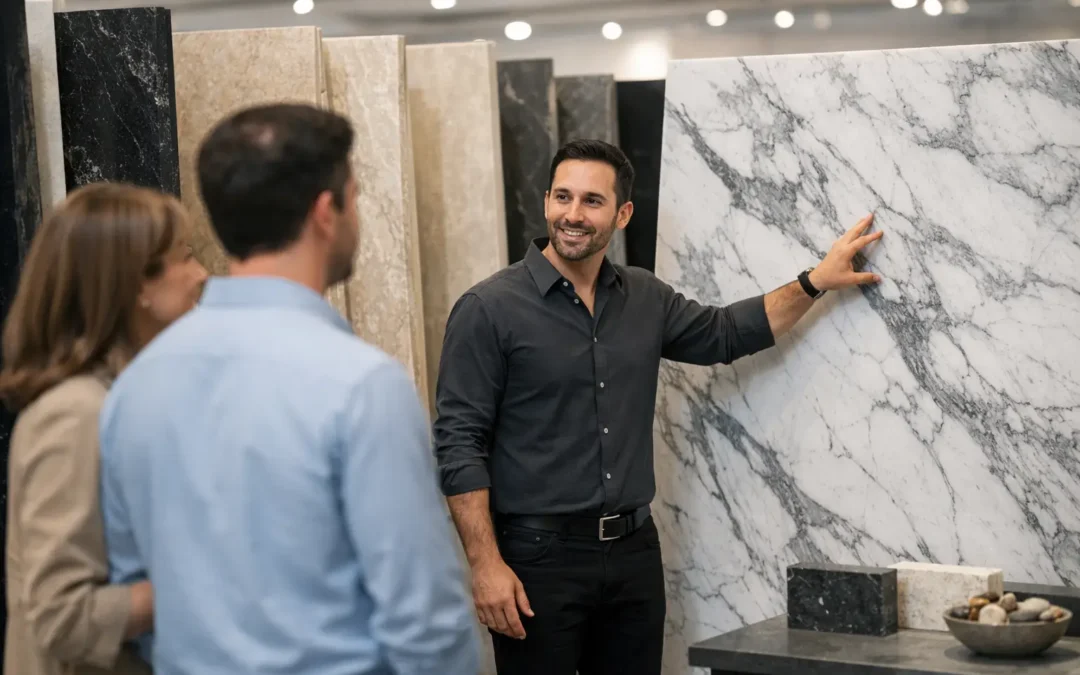
The first thing to look for is whether the showroom helps you evaluate stone in a real-world way. That means seeing full slabs or large samples whenever possible, not relying only on small chips. A sample can suggest tone, but it rarely tells the whole story about movement, veining, variation, or how dramatic a surface will feel across a large island or vanity.
Lighting also matters. Stone can shift noticeably between bright natural light, warm interior light, and task lighting. A strong showroom makes it easier to assess that difference and talk through where the material will be installed. Marble that feels soft and elegant in a powder room may behave very differently in a busy kitchen, and a quartzite that looks subtle on a rack may become the focal point of the entire room once installed.
You should also pay attention to how the materials are presented. A curated showroom is usually a better sign than an overwhelming one. A large inventory is valuable, but only if it is organized in a way that helps you compare options by use, performance, finish, and design style. If every slab is treated as interchangeable, the guidance often stops at appearance. That is where poor decisions begin.
Look beyond the slab itself
A beautiful stone is only part of a successful project. The next question is whether the showroom team can explain how that material will perform in your specific application.
Granite, marble, quartzite, quartz, and exotic stones all have different strengths and trade-offs. Some clients come in convinced they want marble everywhere, then realize they would be frustrated by etching in a heavily used kitchen. Others assume quartzite and quartz are basically the same because the names sound similar. A good showroom clears that up quickly and without pressure.
The right team should be able to explain stain resistance, heat tolerance, maintenance expectations, edge options, finish choices, and where each material tends to work best. That advice should feel honest, not sales-driven. Sometimes the best recommendation is not the most expensive slab. Sometimes it is the one that fits the lifestyle of the household, the design intent, and the tolerance for upkeep.
That is especially important for high-impact spaces. A waterfall island, full-height backsplash, or bookmatched feature wall demands more than a pretty slab. It requires planning around pattern flow, seam placement, and fabrication capability. If the showroom conversation stays surface-level, it is worth asking deeper questions.
What to look for in a stone showroom team
Expert guidance is one of the clearest signs of a premium showroom. You should be able to ask practical questions and get direct answers.
For example, if you ask how a slab will hold up in a family kitchen, the answer should go beyond “it is durable.” You want context. Will it etch? Does it need sealing? How often? Is leathered better than polished for this use? Will a dramatic vein complicate sink cutouts or seam placement? Can the slab support the overhang you want, or will it need reinforcement?
Good guidance also includes knowing when to slow a decision down. If a material is stunning but risky for the way you live, a trustworthy showroom will say so. That kind of honesty protects both the project and the relationship.
For designers, architects, and builders, this matters even more. Your showroom partner should understand schedules, specification accuracy, and the importance of consistency across multiple selections. They should be able to support both the design vision and the technical side of execution.
Fabrication matters as much as selection
One of the biggest differences between an average showroom and a strong one is what happens after the slab is chosen. If selection and fabrication are disconnected, details can get lost. Measurements, edge profiles, finish expectations, seam planning, and install coordination all become more vulnerable to miscommunication.
A showroom that is backed by its own fabrication capability or tightly integrated fabrication process usually offers more control from start to finish. That does not just help with quality. It helps with accountability.
Ask how templating is handled, how slabs are laid out for approval, and who manages cut precision. Ask whether the team walks you through edge options and where seams are likely to fall. If you are selecting a heavily veined marble or quartzite, slab layout review is especially important. The material may be natural and inherently varied, but the planning should still feel exact.
This is one area where premium service shows up clearly. Precision is not only about machinery. It is about communication, review, and making sure the final installation reflects what the client thought they were buying.
Pay attention to sourcing and quality control
Not all stone inventories are equal, even when the labels sound familiar. Two white marbles can perform differently. Two quartzites from different lots can vary in density, color balance, and movement. Even engineered surfaces can differ in finish quality and consistency.
That is why sourcing matters. A showroom with a thoughtful, global supply network often has access to a stronger range of materials and better quality control. More importantly, they should be able to speak to why a given slab is in the showroom in the first place.
Was it selected for design character, durability, rarity, or suitability for certain applications? Can they help match the material to the demands of the room? Can they explain the difference between a statement stone and a safer specification?
For homeowners, this creates confidence. For trade professionals, it reduces risk. In both cases, curated sourcing tends to lead to better outcomes than simply choosing from whatever happens to be available.
The showroom should make decisions easier
A good stone showroom does not overwhelm you with options and leave you to sort it out alone. It helps narrow decisions with clarity.
That might mean comparing warm versus cool whites for a kitchen remodel, reviewing honed versus polished finishes for a bath, or deciding whether a bold quartzite is worth the added visual impact in an open-plan space. It might also mean steering you away from a material that looks perfect on day one but will not suit the way the room is actually used.
The process should feel organized. You should understand what happens after selection, how long fabrication may take, when measurements happen, and what approvals are required before production begins. If those steps are vague, delays and disappointment become more likely.
This is where a showroom earns trust. Not by saying yes to everything, but by making the path forward easier to understand.
A few practical questions to ask before you choose
If you are visiting showrooms and comparing partners, a few questions can reveal a lot. Ask whether you can view full slabs. Ask who handles fabrication and installation coordination. Ask how they help clients evaluate maintenance and performance, not just appearance. Ask what happens if a slab has natural variation that affects the layout. And ask how early they recommend selecting stone in the project timeline.
The answers should be clear, specific, and consistent. If they feel rushed or overly vague, that usually carries into the rest of the project.
At Stonhaus Design, that is why the showroom experience is built around both curation and execution – helping clients choose with confidence, then carrying that choice through measurement, cutting, and final fabrication with the same level of care.
The best showroom is not the one with the most slabs on display. It is the one that helps you see the material honestly, understand the trade-offs, and move from inspiration to installation without second-guessing every step. When that happens, the stone does more than look beautiful in the showroom. It looks right in your home for years to come.