Polished marble is ground with progressively finer abrasives until it reflects light, which deepens the color and sharpens the veining. Honed marble stops before the shine: the surface is smooth and matte, the color reads a little lighter and the veins look softer.
The stone underneath is identical. A honed top is no harder and no more acid-proof than a polished one. What the finish changes is how much everyday wear you notice, how glare behaves in the room and how well a floor grips under wet feet.
The table below sets the two side by side, and the rest of this guide shows how to check them yourself on real samples before a slab is cut.
Side by side: what each finish changes
| Polished | Honed | |
|---|---|---|
| Surface | Glossy, mirror-like; reflects lamps and windows | Smooth and flat, with little or no reflection |
| Color and veining | Deeper color, crisper veins | Slightly lighter color, softer contrast |
| Etch marks from acids | Read as dull spots against the shine | Still happen, but blend into the matte surface |
| Small scratches and wear | Catch the light at low angles | Less visible, because there is no gloss to interrupt |
| Glare under pendants or sun | Can be strong on white marble | Minimal |
| Grip as a wet floor | Slippery | Better slip resistance on many stones |
| Stains and sealing | Decided by the slab, so test it | Decided by the slab, so test it |
| Refinishing, per one restorer | About every two to three years | About every three to five years |
Where the table comes from: the finish descriptions follow Selecting the Ideal Stone Finish, a 2024 guide on the Natural Stone Institute’s site.
The refinishing intervals are one restoration specialist’s estimate, quoted in the institute’s article on caring for marble countertops. Treat them as a rough guide, since use and expectations vary from one kitchen to the next.
Both finishes are easier to judge on a full slab than on a chip. You can see marble and the other natural stone slabs in our showroom at full size before you decide.
Why acid marks stand out on a polished top
Marble is made mostly of calcite, a form of calcium carbonate, and calcium carbonate reacts with acids. Lemon juice, wine, tomato and vinegar dissolve a thin layer of the surface and leave a dull patch called an etch. The mark is a change in the stone itself, not residue sitting on it, so scrubbing does nothing.
On a mirror finish, that dull patch breaks the reflection, and you notice it whenever light crosses the counter at a low angle.
On a honed top the surface is already matte, so the same mark tends to disappear into it. Karin Kirk, a geologist who writes for the Natural Stone Institute, notes that polished slabs typically show more noticeable etching than honed or leathered ones.
Honing hides etching; it does not prevent it. A honed counter etches just as readily, and a sealer stops neither finish from reacting with acid.
If you would rather see no etch marks at all, the finish is the wrong lever and the stone choice is the one to revisit. The daily habits that keep both finishes looking their best are laid out in a separate piece on keeping marble free of stains and etch marks.
How each finish changes the look of white marble
Polish saturates color the way a wet stone looks richer than a dry one. On a white marble with bold gray veins, a polished surface reads crisp and formal, and the veins look darker. Honing pulls the color back a step and softens the contrast, which suits kitchens that lean warm, rustic or old-world.
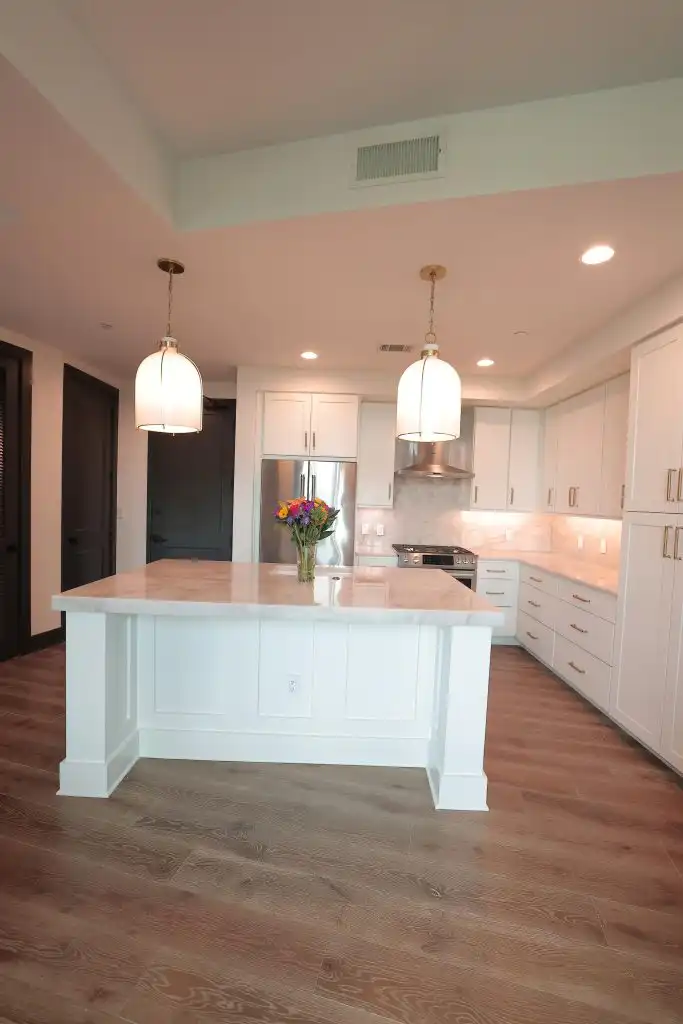
Light in the room matters as much as the stone. Under a row of pendants, or across from a big window, a polished white top mirrors every fixture. A honed top spreads that light instead of bouncing it back. If your kitchen gets hard afternoon sun, look at both finishes at that time of day before you decide.
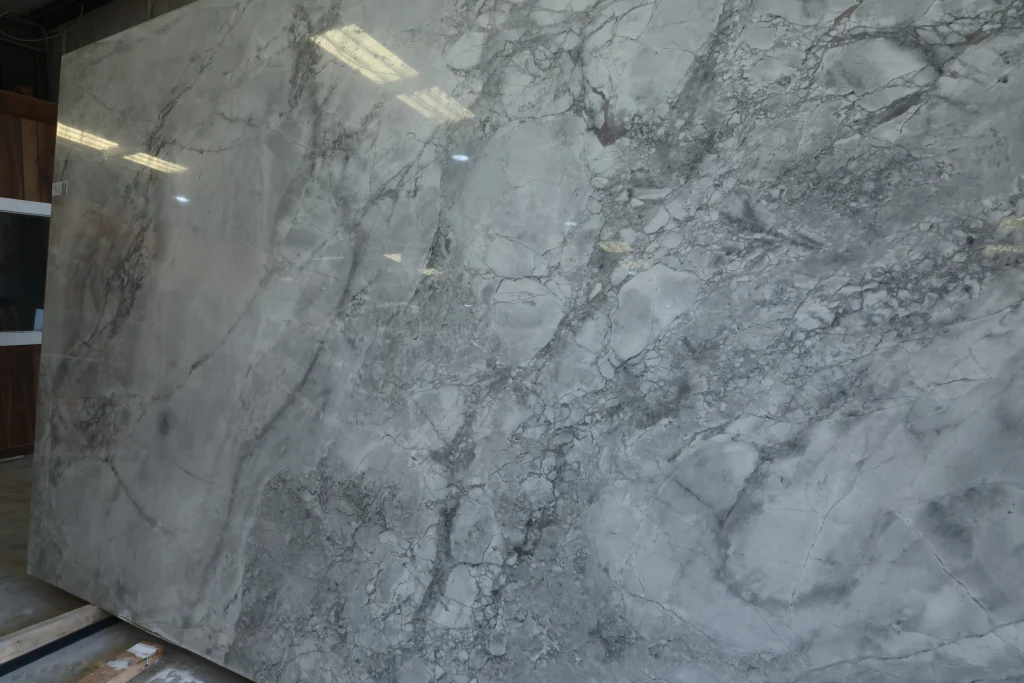
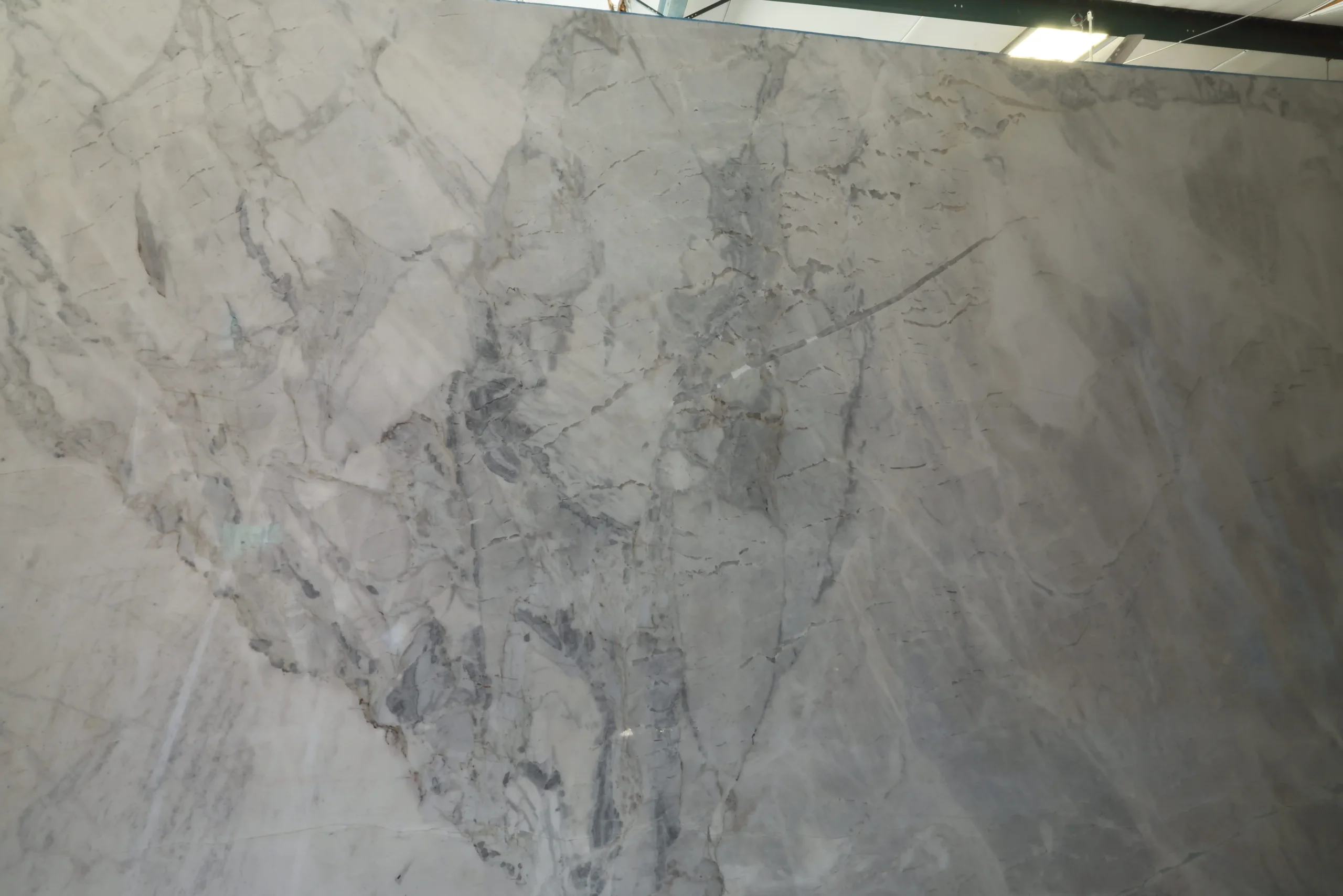
The slab in this photo, from our warehouse, has a polished face: you can read the ceiling lights in it. That reflection is what gives polished stone its depth, and it is also why a dull spot is so easy to find on it later.
Compare two samples in the showroom before the slab is cut
Photos flatten the difference between finishes. The surest way to choose is to hold a polished and a honed piece of the same marble, or of two very close ones, and run a few simple checks.
Kirk describes customers arriving at showrooms with lemon slices and glass tiles, and adds that such tests need the blessing of the sales staff. That rule applies here too.
| Check | How to do it | What polished usually shows | What honed usually shows |
|---|---|---|---|
| Glare | Tilt both samples under one lamp, then near a window | A sharp reflection of the light | A soft, even sheen |
| Veining | Look from across a room, then up close | Darker, crisper veins | Softer contrast |
| Acid | A few drops of lemon juice or vinegar for 5 to 10 minutes, wipe, then look at a low angle | A dull patch that stands out | A mark that is harder to spot |
| Water | A few drops for 10 to 15 minutes, wipe, let the surface air-dry | A darker spot means that piece of stone absorbs water, whatever its finish | |
Do the acid and water checks on samples only, never on an installed counter or on a slab you have not bought, and only with permission. The method follows Kirk’s guide to testing stone yourself. She points out that sealer has no effect on the acid result, so even a sealed sample tells you the truth about etching.
Bring a cabinet door or a paint chip along, too. Finish changes how a stone sits next to everything else, and a short list of things worth checking on a showroom visit keeps that trip productive.
Kitchen, bath or floor: where each finish fits
- A kitchen where someone cooks with citrus, wine and tomato every day: honed, if you want marks to fade into the surface; polished, if you accept etching as patina or plan to have it refinished now and then.
- A baking station, bar or lightly used island: either finish works, and polished keeps the depth of the veining.
- A bathroom vanity: polished is common here, with trays under toiletries and cleaners, since some of them are acidic.
- Bathroom and shower floors: honed. The finish guide cited above notes that a honed surface can increase slip resistance underfoot on many stones.
- A fireplace surround or feature wall: polished, since acids rarely reach it.
Mixing is allowed. A designer quoted by the Natural Stone Institute paired honed floors and shower niches with polished stone walls in the same bathroom. If the bathroom question is really about marble against an engineered surface, our comparison of marble and quartz for bathrooms picks up from there.
Quartzite plays by different rules. Real quartzite is not etched by lemon or vinegar, so choosing its finish comes down to glare and look rather than etch marks; that comparison deserves its own guide. And if you are still deciding whether marble belongs in your kitchen at all, start with marble’s trade-offs in a working kitchen.
Does a honed finish cost more?
There is no single answer, because the finish is one line in a quote shaped by bigger things: the marble itself, how many slabs the layout needs, the edge profile, sink and cooktop cutouts, thickness and access to the house.
A designer told the Natural Stone Institute that polished countertops are the norm in the United States, so a honed surface may need to be ordered or added as a step for the slab you like. Ask how that stone is available before you fall for one finish.
Can you switch finishes later?
Yes. A stone restoration professional can hone a polished top down to matte, or bring a honed one up to a shine, working through progressively finer abrasives. A restorer quoted in the institute’s marble care article says each refinish removes only a minor amount of material, so marble can be refinished many times.
It is restoration work, and it takes skill to keep the sheen even across a whole run of counters.
Which finish, in if-then terms
- If etch marks would bother you but you still want marble, choose honed.
- If you want the deepest color and the crispest veins, and can live with dull spots or periodic refinishing, choose polished.
- If the stone goes on a floor or in a shower, choose honed for grip.
- If it is a fireplace or a wall, polished costs you almost nothing in wear.
Two samples and ten minutes under the right light usually settle it. Book a showroom visit to see the marble you are considering at full size, and ask whether it comes in both finishes.