Here is the twist most people miss: the countertop sold as “quartz” holds far more of the mineral quartz than granite does. Engineered quartz can be up to 93% quartz by weight, bound with resin and pigment, while granite averages about a quarter quartz, mixed with feldspar and mica.
That resin is the real difference. In practice, granite handles heat, sun and harsh scrubbing better, while engineered quartz gives you an even color with no sealing. Which one suits you depends on how you cook, where the counter sits and how much variation you want to see.
Two different products, not two grades of the same stone
Granite is quarried. The Minerals Education Coalition describes it as an igneous rock that cooled slowly underground, which is why its mineral grains are large enough to see without a magnifier. Every slab is cut from a block, so no two are alike.
The “about a quarter quartz” figure describes granite in the geologist’s sense. In the stone trade, the Natural Stone Institute explains, “granite” covers a wider family of igneous rocks plus gneiss and schist, so a dark stone such as Absolute Black is sold as granite while being a different rock with similar countertop behavior.
Engineered quartz is manufactured. The Natural Stone Institute explains that it is made from quartz particles bonded with resin, pigments and other ingredients, pressed in slab-shaped molds. The often-quoted 93% quartz figure is a maximum, measured by weight; actual content varies by brand and color.
The standards treat them as separate things, too. ASTM C615, the specification for granite dimension stone, explicitly excludes molded or artificially aggregated products. So “quartz vs. granite” is really a choice between a natural stone and a composite.
A side-by-side test, result by result
Few comparisons online show data. One that does is a 2019 test by geologist Karin Kirk, published on the Natural Stone Institute’s consumer site, which put two granites (Absolute Black and Thunder White) next to two engineered quartz samples (Caesarstone Eggshell and Sequel Pure Black). Our table pulls out the results that matter in a kitchen.
| What was tested | Granite samples | Engineered quartz samples |
|---|---|---|
| Composition | Natural rock, about 25% quartz plus feldspar and mica (Minerals Education Coalition) | Quartz particles in resin, up to 93% quartz by weight (Natural Stone Institute) |
| Hardness (Mohs picks) | Between 6 and 7 | Eggshell slightly softer than granite; Pure Black below 6 |
| Vinegar and dilute acid, 30 minutes | No visible effect | No visible effect |
| Turmeric and food dye, 2 hours | Dark granite unmarked; light granite showed faint marks that faded within a day | Light quartz stained; the food dye mark persisted |
| Hot, oily cast-iron skillet (about 570 °F, 10 minutes) | Light granite: slight stain, gone in 24 hours. Dark granite: very subtle darkening | Light quartz: stain that faded over several days. Black quartz: permanent hazy patch |
| 30 seconds with a feldspar-based scouring powder | Unaffected | Hazy, dulled areas on both samples |
| Sealing | Most granites need it; some dark ones barely absorb | Not needed; the resin keeps absorption very low |
A fair reading of this table: two samples per material is a small set, and the Natural Stone Institute promotes natural stone. The author says she did not pre-screen the samples. Treat the results as a picture of how each material tends to behave, then try the same simple tests on samples of the exact colors you are considering.
Heat from pans, ovens and slow cookers
Granite is the more forgiving surface for a cook who moves fast. The Natural Stone Institute’s pros-and-cons guide says it will not melt or blister, and that a pan can go from the oven onto the stone. It still advises a trivet under appliances that run hot for hours, such as a slow cooker.
With engineered quartz, the resin sets the limit. The 2019 test notes that quartz manufacturers specifically warn against setting hot pans directly on their surfaces. If you already use trivets out of habit, that rule costs you little; if you don’t, it matters. For the details, see our answer to the question is quartz heat resistant.
Stains, sealing and everyday cleaning
Quartz wins on routine. Its resin binder leaves very little room for liquids to soak in, so there is nothing to seal. The Natural Stone Institute is careful to add that engineered surfaces are not immune to staining, chipping, scratching or heat damage, and that abrasive cleaners can dull them.
Granite needs a sealer on most varieties, and how much depends on the stone. Experts quoted by the institute say Absolute Black may need little or none, while some lighter granites take several coats.
Their home check: leave a little hot water on the surface for 10 to 20 minutes. If the stone darkens, it is still absorbing and is due for sealer.
Daily care is simple for both: a neutral cleaner made for the surface and a soft cloth. Skip scouring powders on quartz; the test above shows what they do to the finish.
Sun, porches and outdoor kitchens
This is the clearest split between the two. The Natural Stone Institute’s writer left several engineered quartz slabs outside for a few months and watched the resin turn yellow in the sunlight. Caesarstone, for its part, sells a separate, UV-resistant Outdoor Collection rather than recommending its standard line for exposed spots.
Granite has no resin to fade. For a counter on a sunny piazza, a pass-through window or a grilling station, natural stone is the safer starting point, with the color and finish chosen for the heat of the surface.
Pattern, seams and telling them apart at a glance
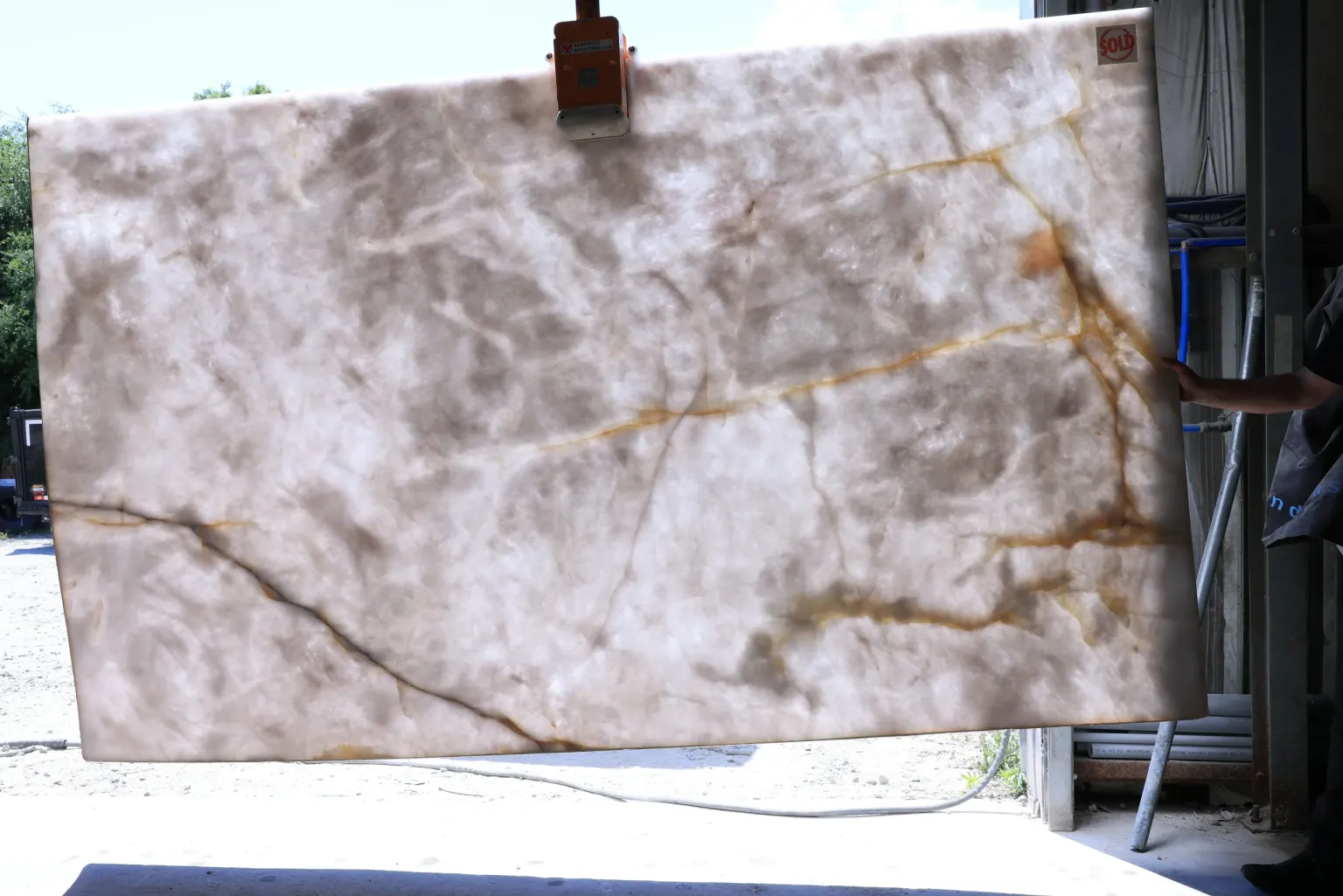
Quartz is made to repeat. If you want the same color from one end of a long run to the other, that consistency is the point. Granite varies from slab to slab and even within one slab, which is why we ask clients to pick the actual slabs in person.
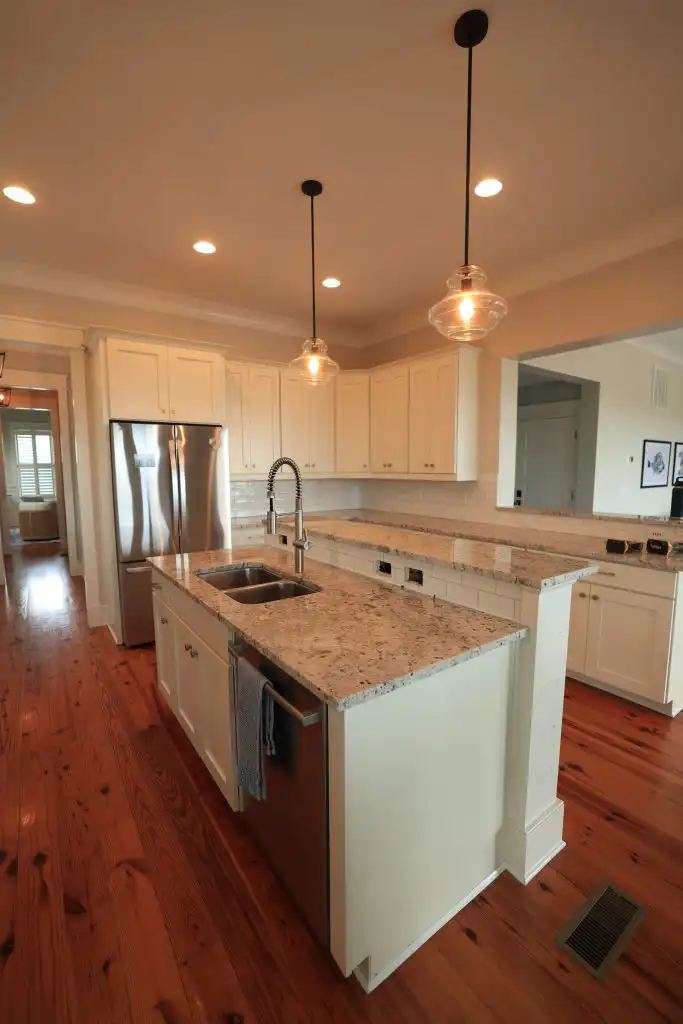
Not sure what is already in your kitchen? Look closely at the surface and the edge. Granite shows distinct mineral grains in mixed colors, because those crystals grew slowly as the rock cooled. Quartz tends to look uniform, with flecks or veins that repeat.
On either material, where the joints fall changes the look, so read our notes on stone slab seam placement before approving a layout.
A related question we hear: is Taj Mahal quartz or quartzite? It is a quartzite, a natural stone, and the Natural Stone Institute counts it among the tightly bonded ones. See our Taj Mahal quartzite page, and for that separate comparison, our guide to quartzite vs quartz.
Chips, scratches and repairs
Both surfaces are hard, but neither is indestructible. The NSI’s granite guide says chips and cracks are rare, that the edge of an undermount sink cutout is the usual spot, often after a heavy pan knocks it, and that a professional can typically fill a chip with color-matched epoxy. Cutting directly on granite mostly dulls your knives.
Engineered quartz is also tough, though the institute notes it is not immune to chipping or scratching, and in the 2019 test a glossy black quartz showed scratches from the #6 hardness pick. On either material, a slightly eased edge and a cutting board are the cheapest protection.
Why some homeowners are hearing that quartz is “on the decline”
The pressure on engineered quartz is mostly about the people who cut it. The Canadian Centre for Occupational Health and Safety (CCOHS) notes that engineered stone can contain 90 to 97% silica, compared with less than 45% in granite, and that cutting, grinding and polishing it releases fine silica dust that can cause serious lung disease.
Australia went furthest: since July 1, 2024, it has banned the manufacture, supply, processing and installation of engineered stone benchtops and slabs, according to the same CCOHS summary.
The concern there is dust in fabrication shops and on job sites, not a finished counter sitting in your kitchen. Natural stone also produces silica dust when cut, so any fabricator should control it.
Which one fits your kitchen
Most decisions come down to four habits: how you treat hot pans, whether the counter sees sun, whether you want variation or uniformity, and how you feel about occasional sealing.
Lean toward granite if…
- pans and baking sheets often land on the counter straight from the stove or oven;
- the counter sits in strong sun, on a porch or outdoors;
- you want a one-of-a-kind slab and you are happy to choose it in person;
- someone in the house reaches for scouring powder.
Lean toward quartz if…
- you want the same color and pattern across a long run or several rooms;
- you would rather never think about sealer;
- trivets already live next to your stove;
- the counter is indoors, away from direct sun for most of the day.
We fabricate and install both at our shop in North Charleston. If granite is leading, compare granite slabs in Charleston in person; if you are leaning the other way, see how we handle quartz countertops in Charleston, including the spots where we would steer you away from it.
What changes the quote for either material
We don’t publish prices, because they move with the material and the job. For granite, the specific stone matters most, from common colors to rare ones, along with how many slabs the layout needs to keep the pattern consistent. For quartz, the brand, collection and color drive it.
For both, the square footage, thickness, edge profile, sink and cooktop cutouts, backsplash height and removal of old tops all change the number. If resale is part of the decision, our look at the best countertops for resale value covers what buyers expect.
Before you commit, borrow the method from the test: put a drop of cooking oil, a smear of turmeric paste and a coffee ring on a sample of each finalist, wait, wipe and compare. Ten minutes of that tells you more about your own kitchen than any spec sheet.