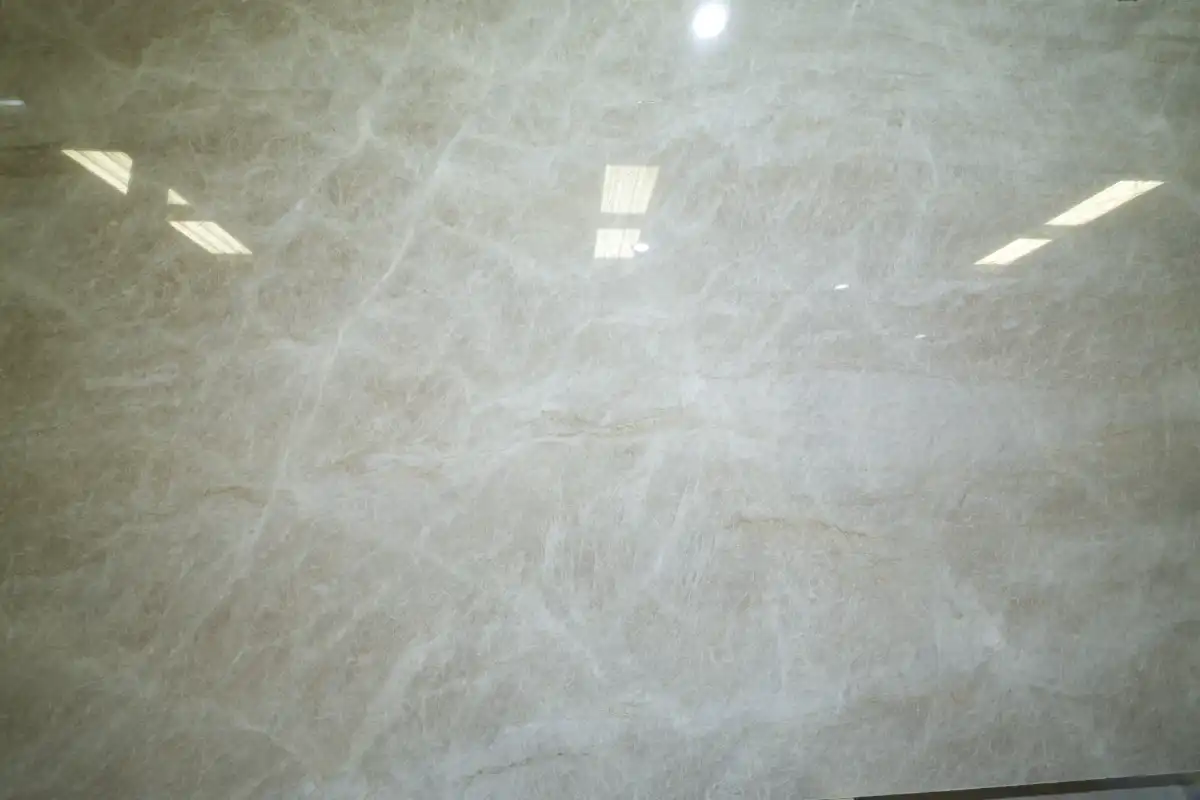
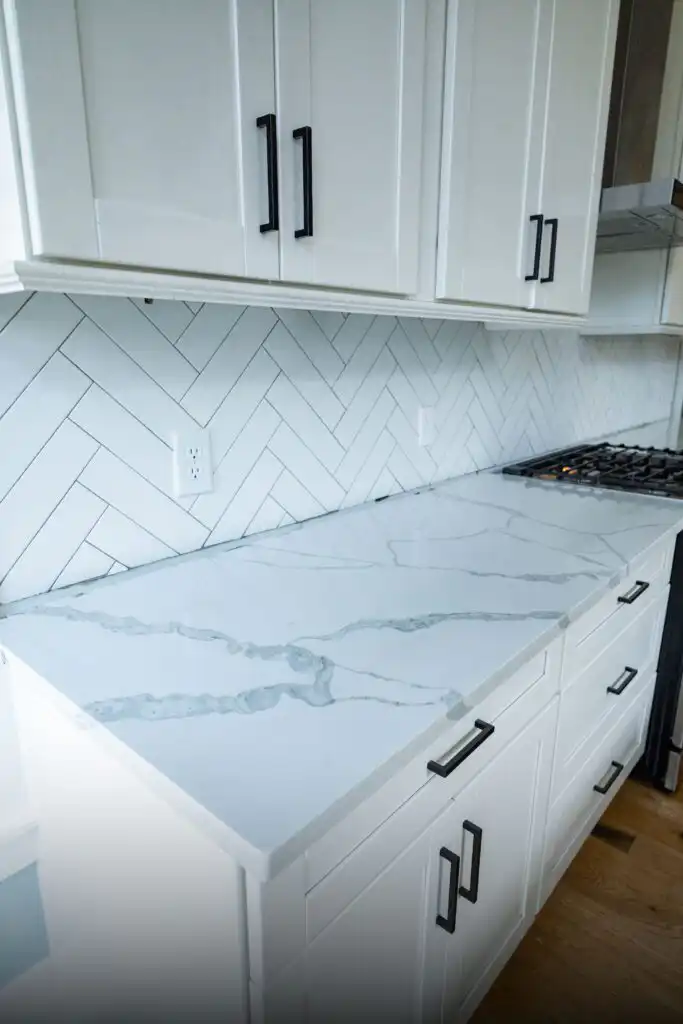
Six of the eight stones on our materials page are listed as quartzites. So when clients compare porcelain with quartzite, they are usually weighing a manufactured slab against the kind of stone we show the most.
The short answer: quartzite is natural rock, mostly quartz, cut from a quarry block, so its pattern runs through the slab and no two slabs match. A porcelain slab is a fired ceramic that absorbs almost no water, and on most slabs the stone look is a surface decoration.
Pick quartzite for real stone depth, full edge options and a surface that can be refinished. Pick porcelain for zero sealing, strong sun and a pattern you can reorder.
What the standards say each material is
Porcelain has a technical definition. Industry standards define porcelain tile as an impervious tile with a water absorption of 0.5% or less, measured by the ASTM C373 test (Tile Council of North America).
Large panels and slabs fall under ANSI A137.3, which sets strength criteria by thickness and lists countertop use for several thickness classes (TCNA, ANSI A137.3).
Countertop slabs are large and thin: Atlas Plan lists its slabs in 6, 12 and 20 mm thicknesses, and Laminam says its range runs from 3 mm to 2 cm, in sizes up to 1620 by 3240 mm (Atlas Plan, Laminam).
For kitchen tops, Laminam points to its 12 mm and 20 mm versions, which carry a fiberglass mat bonded to the back (Laminam sizes).
Quartzite has one too. ASTM C616, the specification for quartz-based dimension stone, sorts these stones by their free silica content into sandstone, quartzitic sandstone and quartzite (ASTM International). Quartz, the mineral that makes up most of the stone, rates 7 on the Mohs hardness scale (Minerals Education Coalition).
One caution: some slabs sold as quartzite are really marble or dolomite, which are softer and react to acids. Our article on fake quartzite shows how to check a sample before you buy.
Side by side in a working kitchen
The table compares true quartzite with a standard porcelain slab. Our quartzite ratings come from our own material listings; porcelain ratings come from the manufacturers named above.
| What you care about | Quartzite | Porcelain slab |
|---|---|---|
| What it is | Natural stone, mostly quartz | Fired ceramic made from clays and minerals |
| Pattern | Runs through the whole slab; every slab is different | Usually a surface decoration; some lines are made through-body; a design can be reordered |
| Stains and liquids | Varies by slab; our quartzites are listed as low porosity with periodic sealing | Described by manufacturers as non-porous; no sealing |
| Lemon, wine, vinegar | True quartzite resists etching | Manufacturers list resistance to acids |
| Hot pans | Our listings rate heat resistance as excellent; trivets still advised | Rated for direct heat and sudden temperature changes |
| Scratches | Very high in our listings; quartz rates 7 on the Mohs scale | Dense, hard surface |
| Edges | Full thickness takes a wide range of profiles | Thin slabs limit profiles; the edge shows the body unless the slab is through-body |
| Direct sun | Several of our quartzites list outdoor use | Manufacturers state the surface stays unchanged under UV |
| Repairs | Can be honed and repolished; small chips can be filled | Hard to repair without the fix showing |
Printed pattern or stone all the way through
This is the difference you can see. In quartzite, the veins and color are the rock itself, so a cut edge, a sink cutout or a chip shows the same stone as the face. The Crystallo slab detail below shows amber veins crossing a translucent body; our Crystallo quartzite page notes the stone can even be backlit.
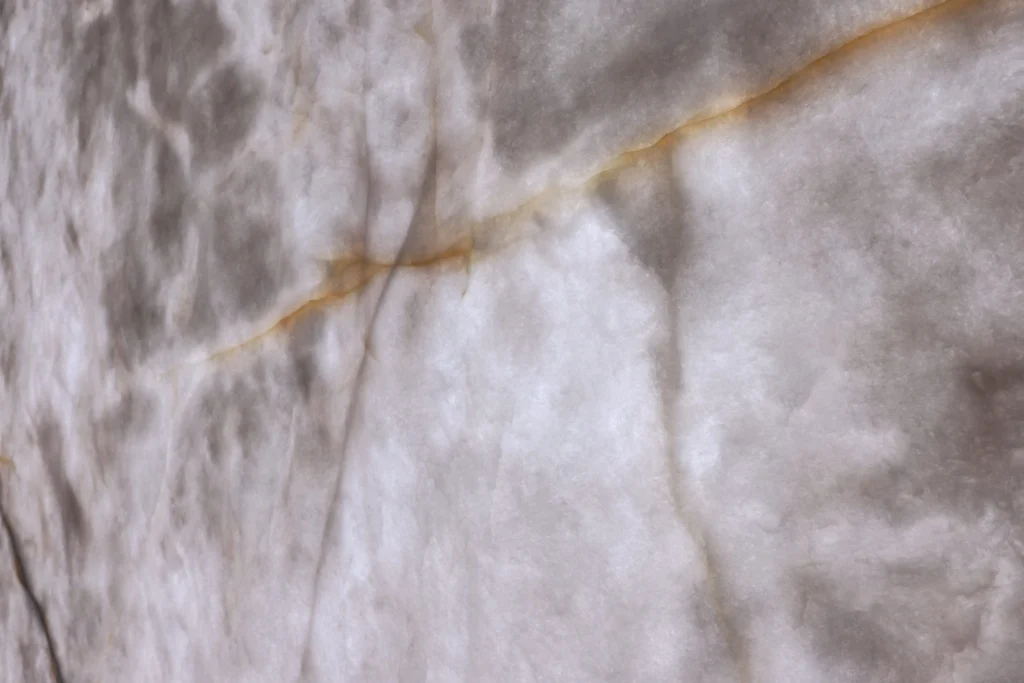
Crystallo quartzite from our collection: the vein and the cloudy depth belong to the stone, not to a print layer.
Standard porcelain slabs carry the design on the surface.
Manufacturers have started making through-body versions: Atlas Plan describes its Natura-Vein Tech as reproducing the vein pattern through the full thickness of 20 mm slabs, and its Natura-Body Tech as carrying the stone look across surface and body (Natura-Vein Tech, Natura-Body Tech). If you are looking at porcelain, ask which kind it is.
Edges, seams and sink cutouts
A full-thickness quartzite slab can take most edge profiles, from a simple eased edge to an ogee; our guide to countertop edge profiles shows the options. Undermount sink cutouts are polished in the same stone.
With porcelain, ask the fabricator which profiles they cut on the thickness you are considering, and what the sink cutout edge will look like. On a surface-decorated slab, that cut edge shows the body color.
Edges and corners are also the most exposed part of a thin slab, so ask how they are finished and how a chip would be handled.
Seams behave differently too. With quartzite, the veining has to be laid out so it flows across the joint. With porcelain, a repeating design makes matching more predictable, but the pattern can also look repeated across a long run.
Cleaning quartzite: wipes, glass cleaner and what to use instead
For daily cleaning, the Natural Stone Institute recommends a neutral cleaner, stone soap or a mild dishwashing liquid with warm water. It warns that products with lemon, vinegar or other acids may dull or etch calcareous stones, that frequent use of ammonia may eventually dull some stones, and that ammonia and bleach must never be mixed (NSI care guidelines).
So, can you use disinfecting wipes or glass cleaner on quartzite? True quartzite is not a calcareous stone, so an occasional wipe will not etch it.
A slab that turns out to be dolomitic marble will react, though, so read the label of any disinfecting wipe or glass cleaner you plan to use every day and choose a stone-safe product.
The Institute also suggests a simple sign for resealing: if the stone darkens around the sink from water, a sealer may be needed (NSI on quartzite care).
Porcelain is less fussy. Laminam’s FAQ recommends water, a neutral detergent and a microfiber cloth for daily cleaning, and the brand describes its worktops as resistant to coffee, wine, oil and acid stains (Laminam). Follow your slab maker’s care sheet for anything stronger.
When porcelain is the smarter pick
- You never want to think about sealing.
- The counter is outdoors in full sun, where manufacturers rate porcelain as UV-stable.
- You want a very thin profile, or the same surface on walls and furniture.
- You need a pattern you can order again later, for an addition or a second kitchen.
Our published collection is natural stone and quartz, so we look at porcelain from the quartzite side. If porcelain fits your list better, it is a sound material; choose an experienced fabricator for it.
When quartzite is worth it
- A one-of-a-kind slab matters to you, with depth that changes with the light.
- The design calls for a thick, shaped edge or a mitered waterfall in real stone.
- The surface should be one that can be honed, repolished and repaired over decades.
- You accept a simple sealing routine; our sealing guide explains the water test.
If you are also weighing engineered quartz, our comparison of quartzite versus quartz covers that choice.
Comparing them in person
Neither material has a fixed price. For both, the quote depends on the specific slab, its thickness, how many slabs the layout needs, the edge profile, sink and cooktop cutouts, and fabrication time; we do not publish prices because they change with the slab and the job.
Bring a porcelain sample to our North Charleston showroom and hold it next to full quartzite slabs. The difference in depth is easiest to judge side by side, under the same light. Start by browsing our quartzite countertops in Charleston, then book a visit and we will walk you through the slabs in stock.
Sources and method: this comparison was prepared by our team at Stonhaus Design. Porcelain facts come from the Tile Council of North America and the slab makers named above; quartzite facts come from ASTM, the Natural Stone Institute and our own material listings. The photo shows a slab from our collection.