Choose a granite color in a fixed order. Start with what you cannot easily change, your cabinets and your floor, and use them to narrow the field to two or three slabs. Then let the room’s light and your tolerance for wiping pick the winner. Pattern comes last.
Make the final call in front of a full slab, not a palm-sized sample. The order matters because each step removes options. Starting from a favorite slab name and working backward is how people end up repainting cabinets or living with a counter that fights the floor.
First branch: what is already fixed in the room
Write down what is staying: cabinet color, floor, backsplash tile if it is already bought, and appliance finish. Granite will sit between the cabinets and the floor, so those two set the frame.
If neither is chosen yet, pick the cabinets after the stone. There are far more paint colors than granite colors, so it is easier to match paint to a slab than to find a slab that matches paint.
If your cabinets are white or a light paint
You are choosing between contrast and blend. A gray, black or deep brown granite draws a clear line between cabinet and counter. A cream or light gray granite keeps the room soft and lets the backsplash or hardware carry the accent.
Hold the door sample against each slab and check the undertone. A creamy white door looks dingy next to a cold blue-gray stone, and a bright white door can make a yellow-cream stone read as beige.
If your cabinets are wood
Wood already brings color and grain, usually with orange, red or yellow undertones. Granites with a calm, neutral base tend to sit well next to it, because the wood keeps the movement.
A busy, multi-colored granite next to a strongly grained wood gives the eye two patterns to sort out. Compare the slab against the actual door finish, since stains shift a lot under different light.
If your cabinets are dark or a saturated color
Navy, green, charcoal and black cabinets usually ask for a lighter counter so the work surface does not disappear. If you love dark on dark, plan the lighting with it: under-cabinet lights make a dark counter usable at night.
Lighter or darker than the floor?
No rule says the counter must be lighter or darker than the floor; what matters is that floor, cabinets and counter do not all share the same value. When all three are mid-tone, the room flattens and edges disappear.
A quick check: photograph your floor, cabinet and granite samples side by side, then switch the photo to black and white on your phone. If the three blur into one gray, change one of them.
Let the light in the room decide between two finalists
The same slab can look cream in one room and gray in another. North-facing windows give cooler, steady light. West-facing rooms turn warm and strong in the late afternoon. After dark, warm-white or cool-white bulbs shift the stone again.
That is why a sample that looked right in a store can look wrong at home. When you are down to two candidates, take a sample of each home. Look at them in the morning, late afternoon and at night, laid flat where the counter will be, because a counter is seen from above.

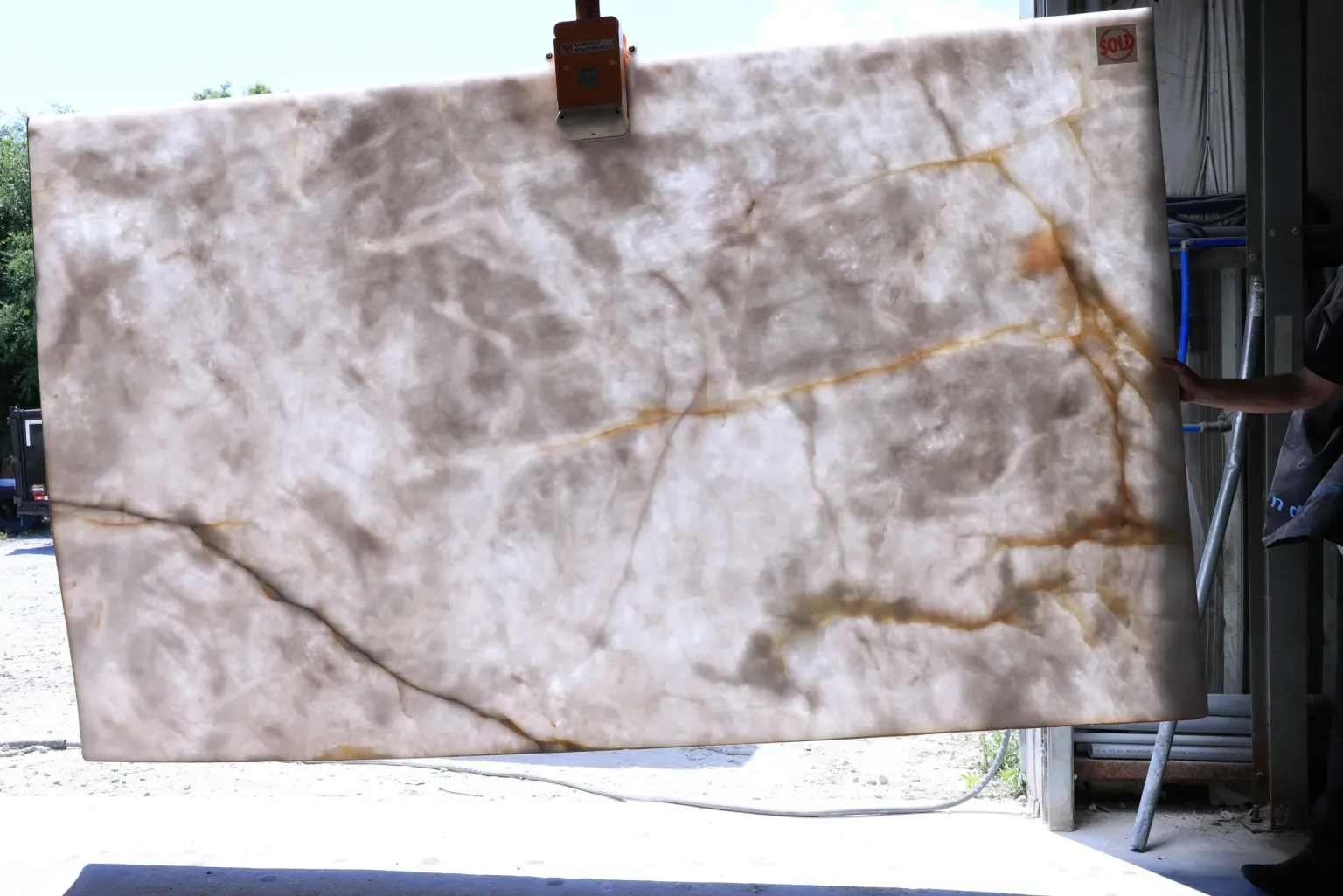
A full slab from our collection on display. At this scale you see how color and veining shift across the stone, which a small sample cannot show. The same check applies to any granite.
How much cleaning each color asks of you
Color changes what you notice day to day. Very dark, solid-looking stone shows dust, water spots, crumbs and hand marks. Our own listing for the darkest stone on our materials page, Black Forest Marble Cosmic, notes that it shows fingerprints and smudges more than light stones.
Light, plain backgrounds hide dust but make a fresh coffee ring easy to spot until you wipe it. Mid-tone granites with speckle or movement are the most forgiving, because small marks blend into the pattern. For a family kitchen with daily cooking, weigh this step as heavily as the look.
Speckled, flowing or veined: picking the pattern
Granite patterns fall into three broad looks. Speckled granites have an even, grainy pattern that repeats across the slab, so seams hide easily and a small piece looks like the whole. Flowing granites have drifts of color that move across the slab.
Veined granites carry lines or bands, and those lines have to continue across a seam or the joint will show. The more movement a slab has, the more the layout matters, so ask where the seams will land before you approve it. Our guide to seam placement shows what to look for.
A large island or a waterfall end may need a pair of matched slabs, covered in our piece on bookmatched countertops. Edge thickness also changes how a pattern reads; see granite countertop thickness.
A note on names: when “granite” is not granite
Color names on granite are trade names, not geology. In the stone trade, “granite” covers a family of hard, crystalline stones, and not all of them are granite to a geologist.
The Natural Stone Institute gives an example: the stone traded as Antique Brown is what a geologist would call anorthosite (Natural Stone Institute). That is why our article on Absolute Black granite asks whether it is really granite.
In true granite, color comes from the minerals. According to the Minerals Education Coalition, feldspar brings pink or red, mica dark brown or black, quartz clear, pink, white or black, and amphibole black, and the color of a slab depends on how much of each it holds (Minerals Education Coalition).
The Natural Stone Institute adds that a typical granite slab is mostly feldspar (NSI).
Two quarries can sell different stones under similar names, and one block can shift in color from slab to slab. Choose the slab in front of you, not the name on the tag.
Showroom checklist to print
Print this list or save a screenshot before your visit. It turns the steps above into things to bring and things to check.
Bring with you
- A cabinet door, a painted sample board or the exact paint chip
- A floor sample or a clear daylight photo of the floor
- Backsplash tile, if it is already chosen
- Photos of the kitchen at different times of day
- A sketch with the counter runs and the island size
- The finish of your appliances and plumbing fixtures
Check before you approve a slab
- See the whole slab standing, not only a corner sample
- Hold your cabinet and floor samples against it, flat and upright
- Look at it under the showroom light and near daylight if possible
- Ask whether the slab you are looking at is the one that will be cut
- Ask where seams will fall on your layout
- Ask for a small sample to view at home for a few days
- Photograph the slab with your samples, in color and in black and white
Stonhaus Design keeps full slabs on display at our North Charleston showroom, so you can run this checklist against real stone rather than photos. Start with our page on granite countertops in Charleston, then book a visit and bring the list.
We will help you compare your finalists side by side before anything is templated.
Sources: mineral facts from the Minerals Education Coalition and the Natural Stone Institute; the note on dark stone from our own material listing. Written by the Stonhaus Design team in North Charleston.