Four of the quartzite pages on our site list the same line under Maintenance: “Low (periodic sealing)”. That small print is a fair summary of the whole answer.
Is quartzite good for kitchen countertops? Yes, for most kitchens. Real quartzite is harder than glass, isn’t etched by lemon juice or vinegar and takes kitchen heat in stride. The two conditions are that the slab is truly quartzite, and that it is sealed to match its porosity, which varies from stone to stone.
Those two conditions are where the work happens, so most of this guide is about them. To see the stones we work with, start with quartzite countertops in Charleston.
What makes quartzite work in a busy kitchen?
Hardness first. The Natural Stone Institute (NSI) notes that quartzite is harder than both glass and a knife blade, so everyday knives, pans and grit leave little trace. The flip side, as one stone professional in the NSI’s care guide puts it, is that it can dull your knives, so the cutting board stays.
Acids don’t etch it. The NSI is clear that true quartzite will not etch from lemon juice or vinegar, which is the main reason people who love the look of marble move to quartzite for a working kitchen.
Heat and sun don’t bother it. There is no resin in the stone, and the NSI says harsh weather and UV light won’t affect it, so it works on a sunny run by the window or an outdoor kitchen. Our answer on how quartzite handles heat covers hot pans and thermal shock.
Where does quartzite ask more of you?
- Testing before you buy. The NSI reports that quartzite is commonly mislabeled, with marble or dolomitic marble sometimes sold under the name. Those stones etch, so the label alone is not enough.
- Sealing, on some slabs. Dense quartzites need little; porous ones need a sealer and a reminder to renew it.
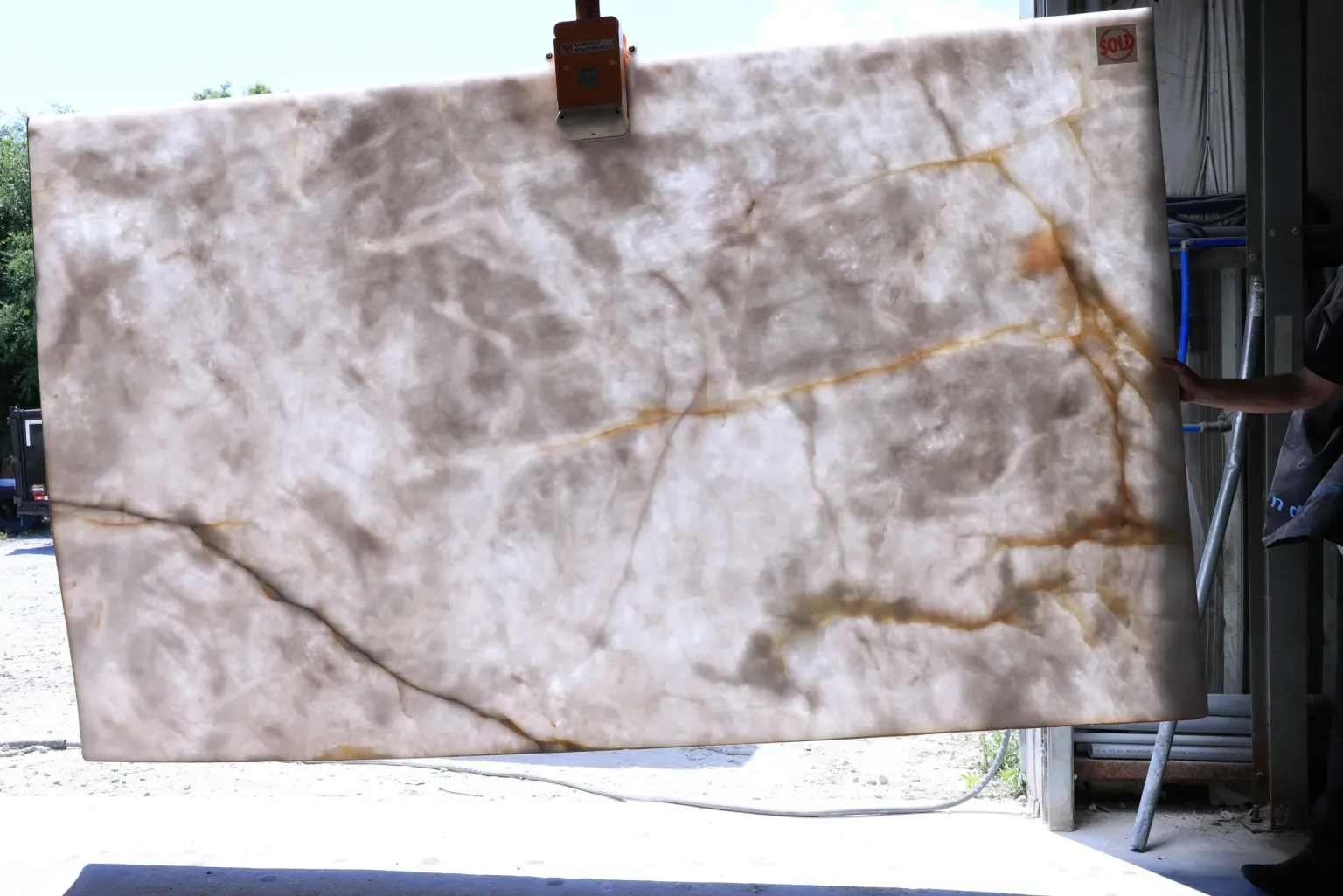
- Choosing the slab in person. No two match, and two slabs with the same name can differ a lot.
- Fabrication time. The NSI notes that hard quartzites take longer to cut and wear tools faster, which can add to fabrication.
Compared with engineered quartz, that is the trade: more character and heat tolerance, a little more homework. Our quartzite and quartz comparison lays the two side by side.
Does quartzite stain?
It can, depending on the slab. The NSI explains that quartzites range in porosity: highly metamorphosed ones such as Taj Mahal and Sea Pearl are tightly bonded, while White Macaubas and Calacatta Macaubas are more porous and benefit from a sealer.
So an oil or wine spill left overnight on a porous, unsealed slab can soak in, while on a dense one it mostly sits on top until you wipe it.
You can check before you buy. The NSI suggests standing one edge of an unsealed offcut in water for about 15 minutes and watching whether the water wicks up above the waterline. After installation, the area around the sink tells you: if the stone darkens there after water sits, it is absorbing and due for sealer.
The NSI also says the most common problem with quartzite is inadequate sealing, particularly along edges and cut surfaces. Our guide to sealing marble and quartzite covers products and timing. We don’t sell sealing as a separate service, so that guide is written for you to follow.
Does quartzite or granite stain more? It depends on the two stones, not the category: both families include dense and porous varieties. We compare them on scratches, chips and stains in a separate piece.
How should you clean it day to day?
The NSI compares quartzite care to granite care: wipe with a gentle cleanser, water and a soft cloth, and clean spills up quickly. Keep strong chemicals away: the NSI notes that strong acids, like those in rust stain removers, can etch even quartzite. The everyday “won’t etch” promise is about kitchen acids, not heavy-duty cleaners.
Which parts of the kitchen suit it?
Most of the kitchen, with a different habit in each zone. This table pairs every zone with what to watch and what to do.
| Zone | What to watch | What to do |
|---|---|---|
| Sink run | Standing water darkening a porous slab | Pick a dense slab or keep it sealed; wipe the area dry |
| Beside the cooktop and oven | Thermal shock at the cutout edges | Trivets for very hot pans; a board under appliances that run for hours |
| Prep and baking area | Dull knives, not a scratched counter | Always a cutting board; lemon and vinegar are fine on true quartzite |
| Coffee or wine bar | Colored spills sitting overnight | Seal porous slabs; wipe spills the same day |
| Island | Veins and seams on the largest piece | Choose which part of the slab lands on top, before cutting |
| Outdoor kitchen | Sun, rain and grill heat | Quartzite is UV-stable; pick a slab listed for outdoor use |
The island is where the slab choice matters most; our notes on choosing a slab for a kitchen island cover layout and seams. Many buyers also weigh quartzite against marble; the short version is that marble etches from kitchen acids and real quartzite doesn’t.
The mistake to avoid: buying the name instead of the slab
Louis Battista of New England Stone Technology, quoted by the NSI, puts it plainly: they get calls from homeowners who think their countertops are quartzite but find etch marks.
Before you sign, ask for an offcut of the exact slab and run three quick checks: does it scratch a glass tile, does lemon juice leave a dull mark after 15 minutes, and does a few drops of water darken it? Our article on fake quartzite walks through each one.
Then pick your quartzite slab in North Charleston, with a cabinet door in hand, and we’ll lay out the kitchen around it.