
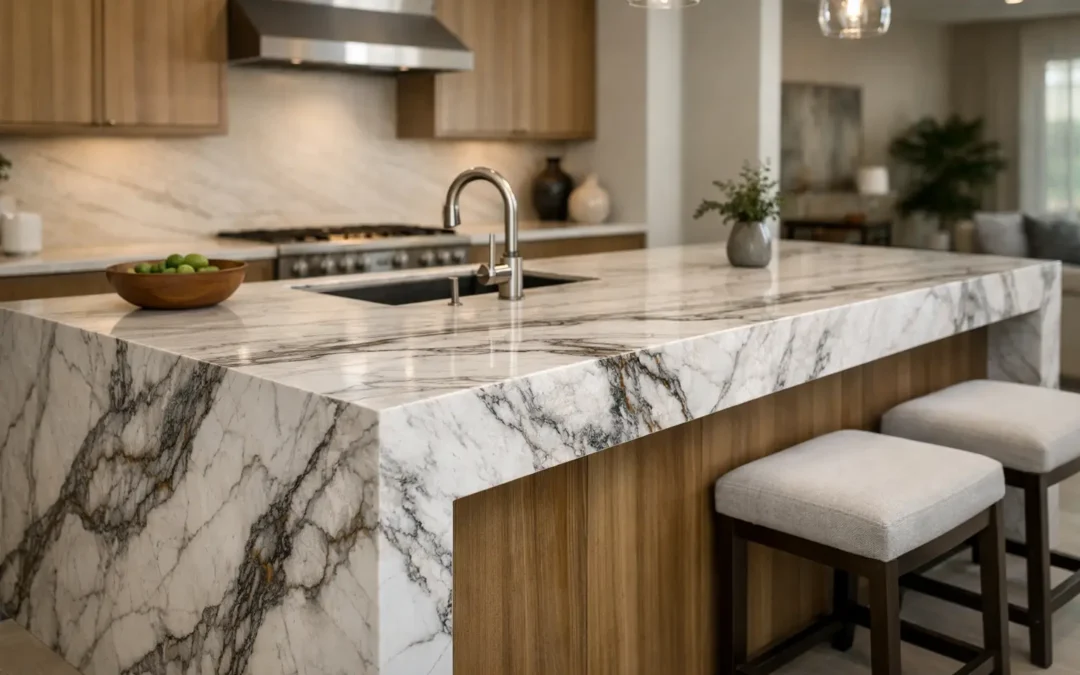
A waterfall island can make a kitchen feel custom in one move – but only if the stone works as hard as the design. The best stone for waterfall islands is not simply the prettiest slab in the showroom. It needs to hold up structurally, wrap edges cleanly, suit the scale of the room, and still look right from every angle once those vertical panels are installed.
That is where many decisions go sideways. A material can look stunning on a flat countertop sample and feel completely different when it runs down both sides of an island. Veining becomes more dramatic. Seams matter more. Thickness, finish, and fabrication quality all become part of the final look. If you want a result that feels polished rather than forced, the stone choice has to be made with the waterfall detail in mind from the start.
What makes the best stone for waterfall islands?
A waterfall island asks more from a slab than a standard countertop. Instead of showing one horizontal surface, it turns the stone into architecture. That means the material has to perform visually and technically.
Visually, the slab needs enough movement, depth, or texture to justify the feature. Some clients want bold veining that carries from the top down the sides. Others want a quieter, more monolithic appearance. Neither is wrong, but the stone should support the design intention rather than fight it.
Technically, the slab needs to fabricate well. Clean edges, good seam placement, and consistent color matter more on a waterfall edge because the eye travels vertically. Any mismatch tends to be more noticeable. Durability matters too, especially on the outside corners where daily traffic, stools, kids, and bags can lead to chips over time.
This is why there is no single right answer for every kitchen. The best choice depends on how you cook, how much maintenance you want, how bold you want the island to feel, and whether the project calls for natural stone or engineered material.
Quartzite is often the best stone for waterfall islands
If a client wants the look of natural movement with strong day-to-day performance, quartzite is often the first material worth considering. It has the visual drama many people want from a waterfall island, but in many cases offers better hardness and scratch resistance than marble.
Quartzite works especially well in open kitchens where the island is a focal point. Many slabs have long, directional veining that can be bookmatched or mitered to create a striking continuous effect. When selected carefully, it gives you that high-end statement without feeling trendy.
The trade-off is that not all quartzites behave the same. Some are denser and more forgiving. Others can have fissures, varied mineral content, or movement that requires experienced fabrication. This is why showroom selection matters. A good slab for a perimeter counter is not always the best slab for a waterfall application.
For clients who want luxury with durability, quartzite often lands in the sweet spot.
Granite is the practical premium choice
Granite remains one of the smartest options for waterfall islands if performance is the priority. It is durable, heat resistant, and available in a wide range of colors and patterns. In family kitchens or high-use homes, granite gives you confidence without asking for constant attention.
Design-wise, granite can go in two directions. Some selections are bold and expressive, with sweeping movement and strong contrast. Others are more grounded and uniform, which can create a clean architectural island without overwhelming the room. If the cabinetry, lighting, or backsplash already carries a lot of visual weight, a quieter granite can be the better call.
The main consideration is pattern flow. Some granites are heavily speckled or granular, which can make the waterfall detail feel less intentional than a slab with clearer movement. That does not make them a poor choice, but it does change the overall effect. If the goal is a dramatic vertical statement, not every granite will deliver it equally well.
Marble is beautiful, but it comes with honest trade-offs
There is a reason marble remains so desirable. Few materials match its softness of color, depth, and natural veining. On a waterfall island, marble can look exceptional – refined, sculptural, and unmistakably premium.
But marble is rarely the carefree option. It is more prone to etching, scratching, and staining than granite or many quartzites. In a kitchen used every day, that matters. For some homeowners, patina is part of the appeal. For others, it becomes a source of stress very quickly.
Marble tends to make the most sense when the client fully understands the maintenance story and still wants the material for its character. In a lower-use kitchen, a formal entertaining space, or a home where natural aging is appreciated, it can be exactly the right choice. In a busy family kitchen where every spill feels urgent, it may not be.
Quartz offers consistency and control
If you want a cleaner, more predictable look, quartz is a strong contender. It is engineered for consistency, low maintenance, and dependable performance. For waterfall islands, that consistency can be a real advantage because it simplifies seam matching and creates a more controlled finished appearance.
Quartz works especially well in contemporary kitchens where the island is meant to feel sleek rather than expressive. Solid colors, soft movement, and marble-look patterns can all translate nicely into a waterfall profile. It is also a practical option for clients who want less upkeep than many natural stones require.
The trade-off is authenticity of pattern. Some quartz designs are convincing and elegant. Others can repeat in ways that feel less natural when wrapped down a large island. That is why full slab viewing matters. A small sample may not tell you how the pattern will read across the top and both sides.
The stone pattern matters as much as the stone type
When clients ask for the best stone for waterfall islands, they are often really asking two questions at once. First, which material performs best? Second, which slab will look best once it is fabricated into this specific feature?
Pattern direction is a big part of that answer. A waterfall island usually looks most intentional when the veining appears to flow continuously from the countertop down the side panel. That requires careful slab planning and often precise miter fabrication. With bold materials, this can be the difference between a showpiece and a missed opportunity.
More subtle slabs can also work beautifully, especially if the goal is a quieter monolithic block. In those cases, consistency of tone and texture matters more than dramatic movement. The right answer depends on the room. A kitchen with warm wood cabinetry may benefit from calm stone that lets the millwork stand out. A simpler kitchen may need the island stone to bring the visual interest.
Fabrication quality can make or break the result
A waterfall island is one of those applications where the fabrication is impossible to separate from the material. Even the best slab will fall short if the edges are uneven, the seam is distracting, or the corner alignment is off.
Mitered edges are typically used to create the illusion of thicker stone and maintain visual continuity. Done well, they look sharp and refined. Done poorly, they are what everyone notices first. This is one reason homeowners and design professionals often prefer a partner who can guide material selection, measure accurately, and fabricate with precision under one roof.
At Stonhaus Design, this is exactly where the process becomes valuable. Choosing from curated slabs is only part of the job. The real success of a waterfall island comes from pairing the right material with the right fabrication plan.
How to choose confidently
Start with lifestyle before aesthetics. If you cook constantly, host often, or have a household that puts surfaces to work, durability should lead the decision. If the kitchen is more design-driven and lower impact day to day, you may have more freedom to prioritize character.
Then think about how bold the island should be. Do you want the stone to anchor the whole room, or support it quietly? That answer will narrow the field faster than scrolling through endless slab photos.
Finally, view the full slab and ask how it will be cut. This is the step that protects you from expensive disappointment. A waterfall island is not just about what the material is. It is about how that specific slab will look once the top, sides, seams, corners, and finish all come together.
For many kitchens, quartzite is the best balance of beauty and performance. For others, granite is the smartest long-term choice, marble is the right luxury statement, or quartz offers the cleanest path to a low-maintenance finish. The right material is the one that fits the design, the use of the space, and the quality of fabrication behind it.
A waterfall island should feel effortless when it is finished. The best way to get there is to choose a stone that still makes sense after the design excitement wears off and real life begins.