
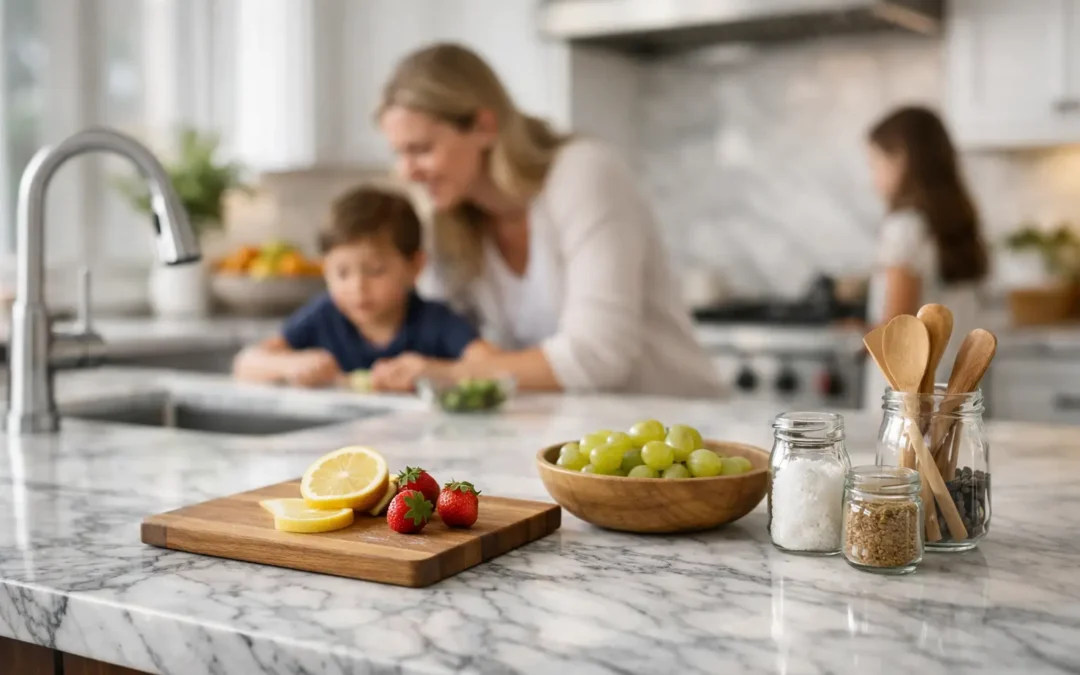
A lot of kitchen decisions sound simple until real life gets involved. You love the look of marble, but you also have kids making snacks, spills that sit too long, and a kitchen that gets used hard every day. So the real question is not just can marble work in family kitchens – it is whether marble fits the way your household actually lives.
The honest answer is yes, marble can work beautifully in a family kitchen. But it is not the right choice for every family, every layout, or every expectation. Marble is one of the most timeless and visually compelling surfaces you can bring into a kitchen, yet it asks for a different mindset than quartz or some quartzites. If you want a surface that stays pristine with very little effort, marble may feel demanding. If you value natural character and are comfortable with a surface that develops a lived-in patina, marble can be an excellent fit.
Can Marble Work in Family Kitchens With Heavy Use?
It can, but success depends on how you define heavy use. Marble is a natural stone, and compared with some other countertop materials, it is softer and more reactive. That means it can etch from acidic foods like lemon juice, vinegar, tomato sauce, and some cleaners. It can also scratch more easily than harder stones.
That does not mean it fails in busy homes. It means it changes. In many family kitchens, especially those designed with warmth and authenticity in mind, that evolution becomes part of the appeal. A honed marble island with subtle etching may still look elegant years later because the wear reads as natural rather than damaged. On the other hand, if every mark will bother you, marble may create frustration instead of satisfaction.
This is where guided material selection matters. The right slab, edge profile, finish, and application can make marble more practical than many homeowners expect.
What Marble Gives You That Other Surfaces Do Not
Marble has depth and movement that is difficult to replicate. The softness of the veining, the natural variation, and the light-reflective quality give kitchens a refined look without feeling overly polished. In a family kitchen, that matters more than people sometimes realize. The kitchen is not just a work zone. It is where people gather, talk, eat, and spend real time.
Marble also ages in a way that many clients find appealing. Rather than looking manufactured or flat, it develops character. In classic homes, coastal homes, and high-design remodels, that quality can support the entire feel of the space.
For designers and homeowners who want an authentic material with visual permanence, marble remains a strong choice. It has been used in hardworking spaces for generations. The key is making sure beauty and performance expectations are aligned before fabrication begins.
Where Marble Usually Works Best
Not every kitchen uses marble the same way, and that is often where better decisions happen. A full marble kitchen can be stunning, but it is not the only option.
Marble often works especially well on a baking station, an island with lighter prep use, a perimeter area away from the most acidic cooking activity, or as a statement backsplash. Some families choose marble for the island and another material for the main cooking run. That approach preserves the look people want while reducing wear in the highest-risk zones.
Finish matters too. Honed marble is often the more practical choice for family kitchens because it softens the appearance of etching and small scratches. Polished marble has a more reflective look, but etches tend to show more clearly against that shine. Neither is right or wrong. It comes down to the visual effect you want and your tolerance for natural change.
What Families Should Expect Day to Day
If you are considering marble, the best approach is to picture ordinary use, not showroom conditions. Kids leave orange juice rings. Someone cuts a lime for tacos. Olive oil splatters near the range. A wet lunchbox sits on the counter longer than it should.
Marble can handle daily life, but it benefits from quick cleanup and a little awareness. Sealing helps reduce staining, though it does not prevent etching. That distinction is important. People often assume sealing makes marble worry-free, and that is not how the material works.
A family that wipes spills reasonably quickly and uses cutting boards, trivets, and common-sense care can live very well with marble. A household that wants to leave messes until the end of the day may be better served by quartz or a dense quartzite.
This is less about perfection and more about fit. The goal is not to make your family behave like a showroom. The goal is to choose a surface that supports your normal routine.
Can Marble Work in Family Kitchens if You Have Young Kids?
Yes, especially if you go into the decision with clear expectations. Young kids do not automatically rule out marble. In fact, many active households choose it because they care just as much about a beautiful, high-end environment as they do about function.
What matters is your reaction to wear. If a faint etch from spilled lemonade will feel like a major problem, marble may not be the best investment for this stage of life. If you can treat minor marks as part of a natural material doing what natural materials do, then marble remains very much on the table.
It also helps to think beyond the countertop itself. Good kitchen design reduces risk. Dedicated prep zones, smart sink placement, quality fabrication, and thoughtful edge details all improve how a stone surface performs in real use. A well-planned marble installation will always serve a family better than a beautiful slab placed in the wrong layout.
When Another Material May Be the Better Choice
Sometimes the most honest recommendation is not marble. If your top priority is low maintenance, or if your kitchen sees nonstop cooking with lots of acidic ingredients, other surfaces may better match your needs.
Quartz offers excellent stain resistance and easy cleanup, though it does not have the same natural depth as marble. Quartzite can be a strong middle ground for clients who want natural stone with greater durability, but performance varies by specific material and should be reviewed slab by slab. Even granite may be a better fit for some family kitchens, depending on the visual direction and how the space is used.
This is why a curated showroom process is valuable. Photos online can help with inspiration, but they do not replace seeing materials in person, comparing finishes, and getting straightforward guidance about fabrication, maintenance, and long-term performance.
How to Make Marble a Smarter Choice
If you love marble and want to make it work, there are practical ways to improve the outcome. Choosing a honed finish is often the first step. Selecting a marble with movement can also help soften the visibility of minor wear compared with very clean, uniform slabs.
Application is just as important as material. Using marble on an island while placing a different surface in the main prep zone gives many families the best of both worlds. Integrating quality sealing, proper edge fabrication, and a layout that supports how your household cooks also goes a long way.
Most of all, work with a team that will be direct with you. Marble is not a product that should be sold on appearance alone. It should be selected with a full understanding of how it will be measured, fabricated, finished, and used. At Stonhaus Design, that consultative process is what helps clients choose confidently instead of guessing and hoping for the best.
The Best Marble Decision Is an Informed One
Marble is not too delicate for every family kitchen, and it is not the perfect answer for every home either. It sits in that important middle ground where design, maintenance, and lifestyle all need to be weighed together.
For some households, marble becomes the surface they love most because it gives the kitchen soul and authenticity. For others, a more forgiving material will create a better day-to-day experience with less stress. Both outcomes are valid.
The right choice usually comes down to one simple question: do you want a surface that stays more consistent, or one that tells the story of how your kitchen is actually used? If you know your answer, the material decision gets a lot clearer.