
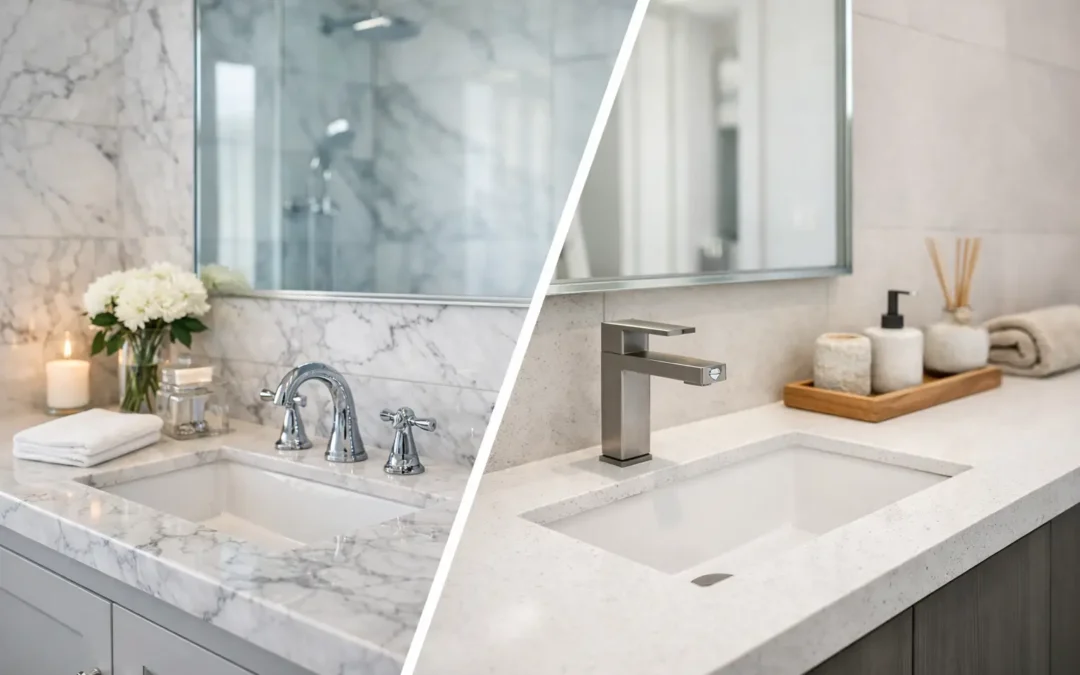
A bathroom can look finished on paper and still feel unresolved once you start choosing surfaces. That is especially true when the decision comes down to marble vs quartz bathrooms. Both can create a polished, high-end result, but they perform differently, age differently, and suit different priorities.
If you are planning a remodel or specifying materials for a client, this is not just a style decision. It affects maintenance, fabrication details, long-term appearance, and how confidently you can live with the finished space. The right choice depends less on trends and more on how the bathroom will actually be used.
Marble vs Quartz Bathrooms: The Core Difference
Marble is a natural stone. Every slab is unique, with movement, veining, and variation that cannot be exactly replicated. That is part of its appeal. It brings depth and character that many homeowners and designers still consider unmatched, especially in primary baths, furniture-style vanities, and spaces where softness and elegance matter.
Quartz is an engineered surface made from natural quartz combined with resins and pigments. Its main advantage is control. Color is more consistent, patterning is more predictable, and performance is easier to manage in day-to-day use. For busy households, guest baths, and projects where practicality matters as much as appearance, that control can be a major benefit.
Neither material is automatically better. Marble usually wins on natural beauty and uniqueness. Quartz usually wins on ease and predictability. The best specification comes from understanding where each one fits.
The Look and Feel of Each Material
Marble has a visual softness that works beautifully in bathrooms. Light reflects differently off natural stone than off many manufactured materials, and the veining often gives the room a layered, architectural feel. If the design direction leans classic, European, organic, or quietly luxurious, marble tends to support that vision with very little effort.
It also develops a lived-in quality over time. Some clients love that. A marble vanity top or shower bench can gain subtle patina, and in the right setting that aging feels authentic rather than worn. The trade-off is that marble rarely stays in pristine condition forever.
Quartz offers a cleaner and often more controlled aesthetic. It can mimic marble looks convincingly in many cases, especially from a distance, but the effect is different when viewed up close. Depending on the design, that can be a positive. In contemporary bathrooms, minimal spaces, or projects where uniformity matters across multiple surfaces, quartz often feels more tailored.
For designers and builders, quartz can also make it easier to hold a visual standard across several bathrooms in the same home. If consistency is important, engineered surfaces remove some of the variability that comes with natural stone.
Daily Performance in a Bathroom
Bathrooms are gentler environments than kitchens in some ways, but surfaces still deal with water, soap, cosmetics, hair products, toothpaste, and frequent cleaning. This is where the marble versus quartz decision becomes more practical.
Marble is porous and softer than quartz. It can etch from acidic products and stain if spills sit too long. In bathrooms, common culprits include skincare products, makeup, perfume, and certain cleaners. Sealing helps, but sealing does not make marble maintenance-free. It simply gives you more time to wipe up moisture and residue before they penetrate the surface.
Quartz is nonporous, which makes it easier to live with. It resists staining better, does not require sealing, and generally handles routine bathroom products with less risk. For a family bathroom that gets heavy use, that difference can be significant. If the goal is to reduce upkeep and avoid callbacks or client frustration, quartz is often the simpler answer.
That said, bathrooms usually expose surfaces to less aggressive wear than kitchens. A homeowner who wants marble and understands the maintenance may find it performs perfectly well in a vanity application. The key is honest alignment between expectations and material behavior.
Marble vs Quartz Bathrooms in Wet Areas
The most important distinction often comes down to where the material will be used. A vanity top is one decision. A shower wall, tub deck, or full wet-room installation is another.
Marble can be beautiful in showers, but it requires more care and more informed detailing. Water itself is not the main problem. Soap residue, body products, and cleaning habits usually cause more visible issues. On polished marble, etching and dull spots can become noticeable over time. Honed finishes can make this aging less obvious, which is one reason they are often preferred in bath applications.
Quartz can be an excellent choice for vanity tops and wall applications, but it is not automatically right for every wet area. Product specifications matter. Some quartz products are better suited to certain applications than others, and fabrication details around seams, edges, and transitions need to be handled carefully. This is where working with a knowledgeable fabricator matters as much as choosing the material itself.
In premium bathroom projects, the best outcome usually comes from matching the surface to the exact location rather than trying to force one material into every application.
Maintenance and Cleaning Expectations
If low maintenance is a top priority, quartz has the edge. It does not need periodic sealing, routine cleaning is straightforward, and homeowners tend to feel more relaxed using the space. For many people, that peace of mind is worth more than the difference in material origin.
Marble asks for a bit more attention. That does not mean it is impractical. It means the owner should be comfortable with using stone-safe cleaners, wiping products up promptly, and accepting that natural stone may change subtly over time. Some clients see that as part of the charm. Others experience it as stress.
This is often the deciding factor in real projects. A client may love marble visually but dislike the idea of monitoring every lotion bottle or cosmetic spill. In that case, quartz can preserve the overall design intent while making the bathroom easier to enjoy.
Cost, Value, and Project Planning
Cost is rarely as simple as comparing price per square foot. Marble can range significantly depending on the species, origin, slab quality, and level of selection. Quartz also varies by brand, design complexity, and thickness. Fabrication can shift costs further, especially if the design includes integrated details, wall cladding, niche work, or bookmatched stone.
Marble may carry a higher perceived luxury because it is natural and unique. In the right home, that can support resale appeal and elevate the overall design story. Quartz, however, often delivers strong value because it combines a premium appearance with easier ownership.
From a planning standpoint, quartz can be more predictable. Color matching is simpler, replacement can be easier if needed, and the finished result is often more consistent from slab to slab. Marble requires more active selection. That is not a drawback when the material is curated well, but it does mean the selection process deserves time and attention.
When Marble Is the Better Choice
Marble is often the better fit when the bathroom is design-led and the client truly values natural material. It suits primary suites, powder rooms, and statement vanities where beauty and individuality matter most. It is also a strong choice when the homeowner understands maintenance and sees natural variation as a feature rather than a flaw.
A curated showroom process makes a difference here because marble is not a one-slab-fits-all category. Background tone, veining scale, finish, and edge profile all influence the final result. Done well, marble can make a bathroom feel timeless rather than simply expensive.
When Quartz Is the Better Choice
Quartz is often the stronger option for high-traffic bathrooms, family homes, investment properties, and clients who want a refined look with fewer maintenance demands. It works especially well when the design calls for a bright, clean aesthetic or when consistency across multiple rooms is important.
It is also a practical solution when the bathroom is part of a broader renovation schedule and predictability matters. With the right fabrication and material guidance, quartz can still feel elevated and custom rather than standard.
At Stonhaus Design, this is often where expert guidance adds real value – not by pushing one surface over another, but by narrowing the choice based on how the space will be used, how the client wants it to feel, and how much maintenance they are realistically willing to take on.
The Better Question to Ask
Instead of asking which material is best, ask which one fits the project best. If you want natural movement, one-of-a-kind character, and a bathroom that feels quietly luxurious, marble may be worth the extra care. If you want dependable performance, easier maintenance, and a polished look that holds up to everyday life, quartz may be the smarter fit.
The right bathroom surface should not just photograph well on install day. It should still feel like the right decision months and years later, when real life has had time to test it.