
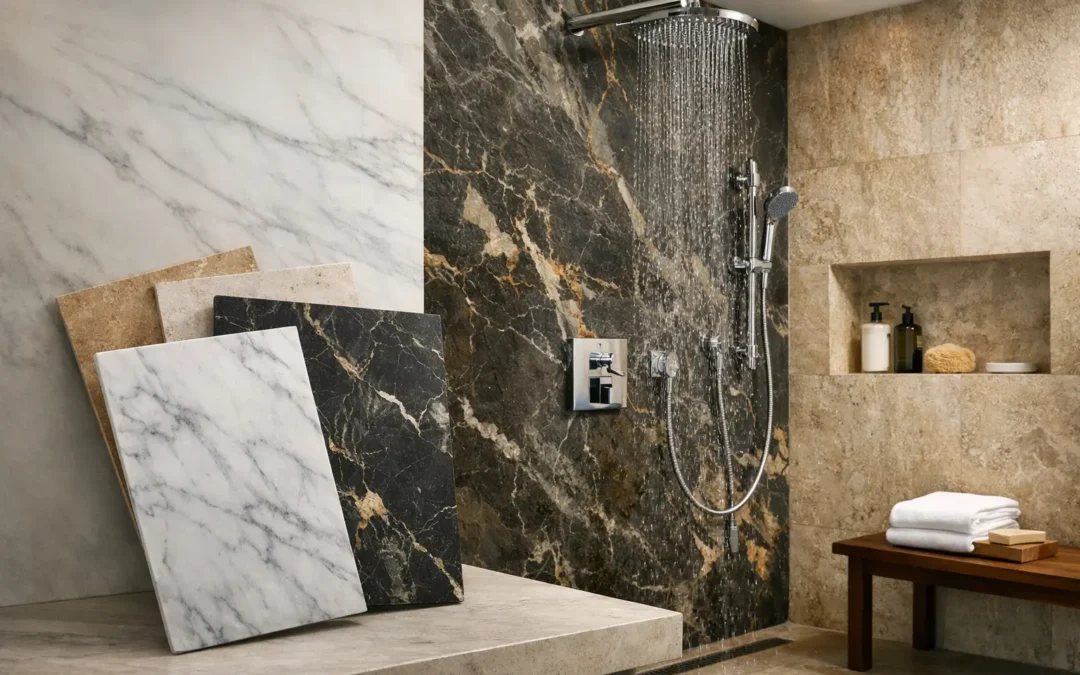
A shower can look finished on paper and still feel busy, cold, or hard to maintain once it is built. That is often where natural stone shower wall panels change the conversation. Instead of dozens of small tile joints, you get larger stone surfaces, stronger visual continuity, and a more tailored result that reads custom from the moment you walk in.
For homeowners planning a primary bath remodel, and for designers balancing beauty with long-term performance, that difference matters. Stone panels are not the right answer for every shower, but in the right project, they solve several problems at once – aesthetics, maintenance, and design cohesion.
Why natural stone shower wall panels stand out
The first reason is visual scale. Large-format stone panels make a shower feel calmer and more architectural because the eye is not stopping at grout lines every few inches. Veining can flow across a wall in a way tile rarely achieves, which gives the room a more intentional, high-end look.
The second reason is material authenticity. Natural stone has variation, depth, and movement that manufactured surfaces try to imitate but cannot fully replicate. Marble, quartzite, granite, and other premium stones each bring a different character. Some are soft and subtle. Others are dramatic and expressive. That range is part of the appeal.
There is also a practical advantage. Fewer seams usually mean less grout to maintain. That does not make stone maintenance-free, and it is better to be honest about that upfront. But for many clients, reducing grout lines is a meaningful upgrade in both appearance and day-to-day cleaning.
What counts as a shower wall panel?
In this context, a wall panel is a larger cut slab or fabricated section of stone installed on the shower walls in place of standard tile. Some showers use full-height panels on all walls. Others mix stone panels with a stone bench, curb, or niche to create a coordinated installation.
The exact panel size depends on the shower layout, slab dimensions, material behavior, and fabrication plan. This is where good guidance matters. A beautiful slab still needs to be translated into workable pieces that account for corners, plumbing penetrations, and the visual placement of veining.
Best stone options for shower wall panels
Not every stone performs the same way in a wet environment. The right choice depends on the look you want, your maintenance expectations, and how the shower will be used.
Marble
Marble is often chosen for its softness, elegance, and timeless appeal. It works especially well in bathrooms where the goal is a refined, light-filled feel. The trade-off is that marble is generally more sensitive than some other stones. It can etch, and certain varieties may require more careful maintenance. For clients who love the look and understand the care, it remains a strong design choice.
Quartzite
Quartzite is one of the most requested options for clients who want dramatic natural beauty with strong durability. Many quartzites offer the movement and visual richness people associate with marble, but with greater hardness. That said, quartzite is not one uniform category. Some slabs are denser and more suitable than others, so material selection should be based on the specific stone, not just the label.
Granite
Granite is a dependable option when durability is a top priority. It tends to resist wear well and comes in a broad range of colors and patterns. In showers, granite can work beautifully when the design calls for something grounded, polished, and practical without sacrificing authenticity.
Are natural stone shower wall panels easier to maintain?
Usually, yes – compared with showers that have many grout joints. With larger stone surfaces, there are simply fewer places for soap residue and mildew to collect. Cleaning routines can feel simpler, and the shower often keeps a cleaner visual appearance over time.
But easier does not mean effortless. Natural stone still needs appropriate care. Most installations benefit from sealing, depending on the stone selected. Cleaners should be stone-safe and non-acidic. Harsh products can damage the finish or affect the sealer. A well-made shower also depends on the substrate, waterproofing system, and installation quality behind the stone, not just the visible surface.
That is why the material conversation should never be separated from the fabrication and installation plan. A premium slab can underperform if the execution is careless.
Design decisions that make a big difference
When clients first consider natural stone shower wall panels, they often focus on the stone color. That matters, but it is only one part of the result. Panel layout, seam placement, finish, and edge details all have a major effect on the final look.
Vein direction and slab layout
A slab with strong movement should be planned carefully before fabrication begins. Vertical veining can make a shower feel taller. Horizontal movement can widen the room visually. In some projects, bookmatching or continuous flow from one panel to another creates a dramatic statement. In others, a quieter layout is the better choice.
Finish selection
Polished stone reflects more light and often feels more formal. Honed finishes can look softer and more understated. In a shower setting, the decision is usually aesthetic, but maintenance preferences may influence it too. Some clients prefer the crispness of polished stone, while others want a more natural, muted surface.
Niches, benches, and curbs
These details should be planned as part of the whole composition, not added as afterthoughts. A niche can either disappear into the design or interrupt it, depending on how it is aligned with seams and veining. The best results come from thinking through the full shower assembly early.
Cost: what drives the price
Stone shower panels are a premium solution, and the price reflects more than the slab alone. Material rarity, slab size, thickness, cut complexity, finish, edge work, and fabrication time all influence cost. So do field measurements, transport, and the labor required to install heavy panels safely and accurately.
This is one area where comparisons with tile can be misleading. Tile may appear less expensive at first glance, but the final cost equation changes when you factor in layout complexity, labor, maintenance expectations, and the visual value of a large-format natural surface. Sometimes the difference is substantial. Sometimes it is smaller than expected.
The key is to price the full system honestly. That means understanding the stone, fabrication scope, and installation requirements before making assumptions.
Who should choose natural stone shower wall panels?
They are a strong fit for homeowners who want a bathroom that feels custom and lasting, not pieced together from standard parts. They are also ideal for design professionals who need a focal material that can anchor the room and elevate surrounding finishes.
They may be less ideal if the project demands the lowest possible maintenance, a very tight budget, or a highly standardized construction approach. In those cases, another surface may be the better match. Good specification is not about pushing one answer for every client. It is about choosing the right material for the way the space will actually be used.
Why fabrication matters as much as the slab
A natural stone shower only looks effortless when the work behind it is precise. Field dimensions need to be accurate. Cutouts for valves and fixtures need to be exact. Seams should be planned with the design in mind, not left to jobsite improvisation.
That is where an integrated process adds real value. When material selection, slab review, fabrication, and project coordination are connected, there is less room for avoidable mistakes. At Stonhaus Design, that is a central part of how clients are guided through the process – helping them choose confidently, then translating that choice into a finished result with precision.
What to ask before you commit
Before selecting your stone, ask how the material performs in a wet application, what maintenance it will require, how the panels will be laid out, and where seams will fall. Ask to review the actual slab, not just a small sample. A sample can suggest color, but it cannot show full movement, pattern scale, or the sections that will be visible once fabricated.
It also helps to ask who is responsible for measurement, fabrication, and coordination. The smoother that chain is, the more predictable the result tends to be.
Natural stone shower wall panels are not just a finish choice. They are a design and fabrication decision that shapes how the room feels every day. When the material is selected carefully and executed well, the result is quieter, cleaner, and far more substantial than a standard shower assembly. If you are investing in a bathroom meant to hold its value and still feel special years from now, this is one of the few upgrades that changes both the look and the experience of the space.