
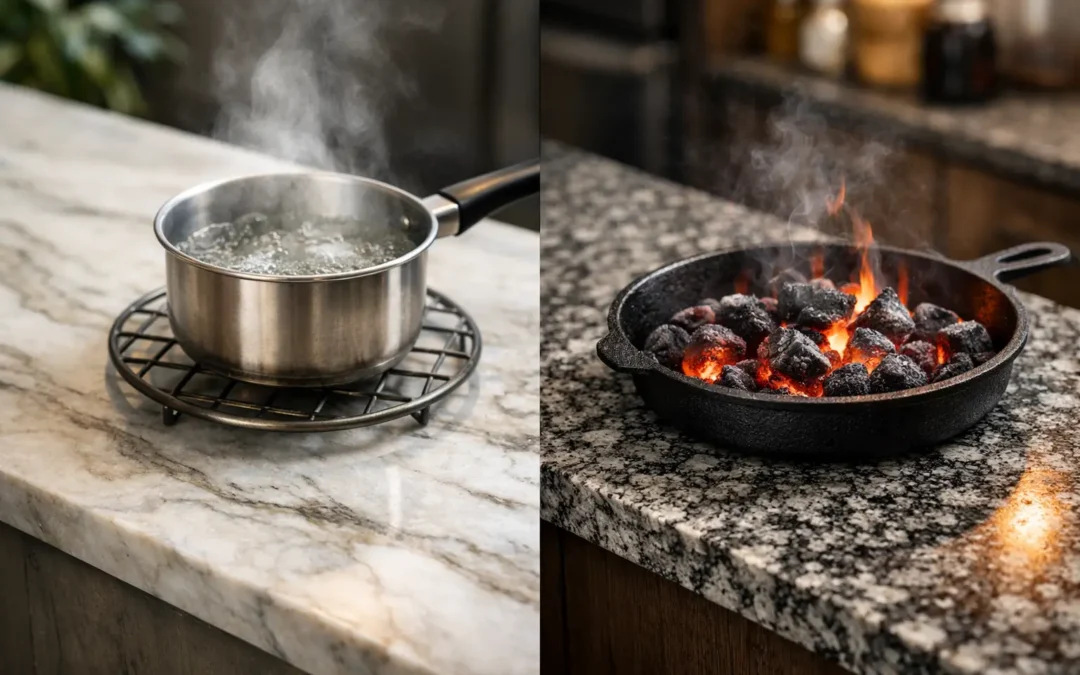
A quick way to ruin a beautiful surface is to assume every stone handles heat the same way. When clients ask abou Quartzite vs Granite: Which Is More Heat Resistant?, they are usually thinking about real-life moments – a hot Dutch oven on the island, a steaming sheet pan near the cooktop, or a fireplace surround that needs to look refined and perform well for years.
The good news is that both quartzite and granite are strong candidates for heat-exposed spaces. The better answer is not which one is “heat-proof,” but which one fits the way the space will actually be used, how the slab will be fabricated, and what level of care the homeowner expects to give it.
Quartzite vs Granite: Which Is More Heat Resistant? which handles heat better?
If we are talking strictly about natural heat tolerance, both materials perform very well. Granite has long been trusted in kitchens because it handles everyday cooking heat with confidence. Quartzite is also highly heat-resistant and, in many cases, performs just as well in practical residential applications.
That said, there is a nuance worth understanding. Heat resistance in stone is not only about the raw mineral itself. It also depends on slab thickness, finish, cutouts, support, seam placement, and the quality of installation. A strong stone can still run into trouble if a large unsupported overhang, a weak sink rail, or a poorly planned seam creates stress in the wrong place.
For most kitchens, both materials can tolerate brief contact with hot cookware better than many engineered surfaces. But “can tolerate” is different from “should be treated carelessly.” Trivets remain a smart habit, especially for preserving sealers and reducing thermal shock over time.
What heat resistance actually means in a home
Homeowners often hear that natural stone is heat-resistant and interpret that as total immunity. In practice, heat resistance means the material is less likely to scorch, melt, or deform under normal household heat exposure. It does not mean the surface is invincible.
A pot straight from a high-heat burner may not damage granite or quartzite itself, but repeated thermal stress can affect the sealer, and in rare cases it can expose weak points in the stone or fabrication. This matters most around cooktops, sink openings, narrow bridge sections, and mitered edges.
In other words, the stone is only one part of the performance story. The finished countertop is a system made of the slab, layout, edge detail, cutouts, support structure, and installation quality.
Granite and everyday cooking heat
Granite earned its reputation for a reason. It is dense, durable, and reliable in kitchens that see heavy daily use. For busy households or rental properties where surfaces need to be forgiving, granite is often one of the safest recommendations.
It typically handles hot pans and baking dishes well in real-world use. It is also less likely to make homeowners feel like they need to “baby” the countertop. That balance of strength and practicality is why granite remains such a strong choice even in high-end spaces.
Quartzite and high-performance design
Quartzite is often selected for its refined movement and elevated natural look, especially when clients want the elegance associated with marble but with stronger wear characteristics. On heat resistance, quartzite is also a serious performer.
True quartzite forms under intense heat and pressure in nature, which helps explain its durability. In kitchens and fireplace applications, it generally performs very well around heat. Where some hesitation comes in is not because quartzite is weak, but because the category is frequently confused in the market. Some stones labeled as quartzite are softer or more marble-like than expected, which can affect overall performance.
That is why material verification matters. A curated showroom and experienced fabrication team can help confirm whether a slab is true quartzite and how it is likely to behave in the intended application.
Quartzite vs granite for kitchens
For a kitchen, the heat question is usually tied to daily habits. Do you place hot pans directly on the counter? Do you cook often and move heavy cookware around quickly? Is the kitchen used gently, or is it the center of constant activity?
Granite is often the more straightforward answer for clients who prioritize resilience and low-stress ownership. It has a long track record, broad style range, and dependable performance near cooking zones.
Quartzite is often the better fit for clients who want a more elevated visual statement without stepping into a more delicate natural stone category. If the slab is properly selected and fabricated, it can absolutely succeed in a hardworking kitchen.
The choice usually comes down to how much weight should be given to visual character versus simplicity of ownership. Neither is wrong. The right material is the one that supports both the design intent and the way the household actually lives.
Quartzite vs Granite: Which Is More Heat Resistant? in fireplaces and wall applications
Heat performance matters beyond countertops. Fireplace surrounds, hearths, and feature walls also bring the Quartzite vs Granite: Which Is More Heat Resistant? question into focus.
Both materials can work well around fireplaces, especially gas fireplaces where surface temperatures are usually more controlled than in direct flame contact zones. Granite is a dependable option for hearths and surrounds because of its durability and established thermal performance. Quartzite also works beautifully in these applications, especially when a project calls for dramatic veining or a lighter, more architectural look.
The key is to match the stone to the actual installation conditions. Surface temperature, proximity to the firebox, substrate preparation, and expansion considerations all matter. In these settings, the design is important, but technical review is what protects the finish over time.
The trade-offs beyond heat
Heat resistance is important, but it should not be the only factor driving the decision.
Granite often offers more predictability. It is available in a wide range of patterns and colors, tends to be easier for clients to understand from a maintenance and durability standpoint, and usually delivers a very practical ownership experience.
Quartzite often offers a more curated, high-design look. Many homeowners and designers choose it because it brings movement, lightness, and a premium natural aesthetic that can transform a kitchen or bath. But because quartzite varies widely by source and composition, slab-specific evaluation matters more.
There is also the maintenance question. Both materials generally benefit from sealing, depending on the specific slab and finish. Heat itself may not be the issue, but preserving the sealer and keeping the surface performing well still requires a bit of care.
Why fabrication quality affects heat performance
A slab can be beautiful and inherently strong, but poor fabrication can create vulnerable areas. This is especially relevant near cooktops, sinks, corners, and thin-profile details.
Precision cutting, thoughtful seam placement, and proper support reduce stress points that can become problematic over time. The same is true for edge profiles and miter work. A premium material deserves equally disciplined fabrication if the goal is long-term performance, not just a good reveal on install day.
This is one reason clients value a process that combines material selection with fabrication guidance. It reduces the gap between what looks good in the showroom and what performs well in the home.
So which one should you choose?
If your priority is a surface that feels proven, practical, and comfortable in a busy kitchen, granite is often the easier yes. If your priority is a more elevated natural look with excellent real-world heat resistance, quartzite is a strong contender.
For many projects, the decision is not about declaring a universal winner. It is about selecting the right slab for the right use case, then fabricating and installing it properly. That is where expert guidance changes the outcome.
At Stonhaus Design, we often walk clients through this exact decision by looking at the actual slab, the room, the heat exposure, and the way the space will be used. That kind of hands-on review tends to produce better results than relying on broad material claims alone.
If you are choosing between quartzite and granite, treat heat resistance as one part of a bigger picture. The best surface is the one that still feels right after the install is complete, the kitchen is in full use, and the material proves it belongs there.