
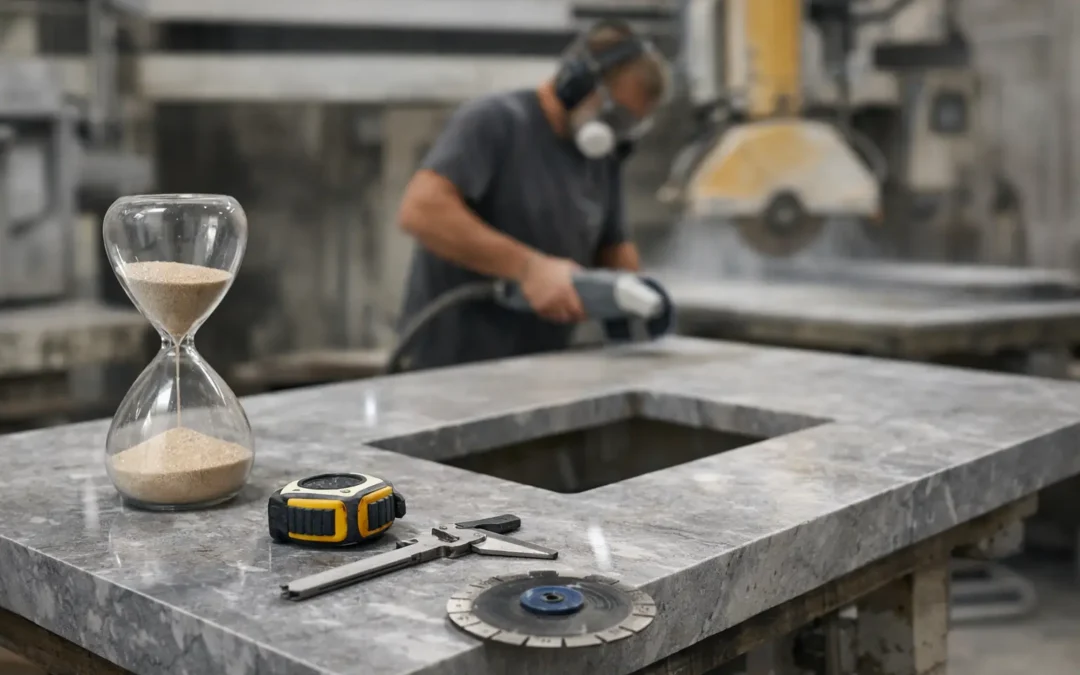
If you are planning a kitchen or bath upgrade, one of the first practical questions is usually this:
How Long Does Stone Countertop Fabrication Take?
The short answer is that most stone countertop projects take about 1 to 3 weeks from final template to installation. The longer, more useful answer is that the timeline depends on material availability, edge details, cutout complexity, and whether every decision is locked before fabrication begins.
That distinction matters because clients often count from the day they choose the slab, while fabricators count from the day the project is ready to build. Those are not the same thing. If cabinets are not installed, plumbing locations are still shifting, or the slab has not been reserved, the clock has not really started yet.
How long does it take to fabricate a stone countertop?
In a well-managed project, fabrication itself is usually not the slowest part. Once the final measurements are approved and the slab is on hand, many jobs move through production in a few business days. Installation then follows based on shop scheduling and site readiness.
For a straightforward kitchen with one sink cutout and a standard eased edge, the process may look like this: templating happens after cabinets are level and secured, fabrication takes several days, and installation is scheduled shortly after. In many cases, that lands the full post-template timeline at roughly 7 to 14 business days.
Custom work takes longer. If you are using a dramatic bookmatched slab, waterfall panels, an integrated backsplash, mitered edges, multiple seams, or unusual appliance cutouts, expect more coordination and more shop time. Premium results usually come from careful sequencing, not speed for its own sake.
What actually determines the timeline
The biggest factor is readiness. Stone can only be fabricated accurately when the dimensions are final. That means base cabinets must be fully installed and secured, support requirements must be known, and sink or cooktop specs should be confirmed.
Material choice also affects timing. A stocked quartz color may be ready quickly. A natural stone slab that needs to be sourced, transferred from another warehouse, or specially approved for veining layout can add days or sometimes longer. Exotic materials are worth the wait for many projects, but they rarely behave like off-the-shelf products.
Edge profile and finish matter too. A simple polished edge is faster than a complex laminated or mitered detail. Leathered or honed finishes may require additional attention depending on the slab and the look being refined in the shop.
Then there is the layout itself. Large islands, delicate corners, multiple faucet holes, apron-front sinks, cooktop cutouts, and full-height backsplash sections all add labor. None of these are problems, but they do affect how long fabrication takes.
A realistic project timeline, start to finish
If you want a more accurate answer to How Long Does Stone Countertop Fabrication Take?, it helps to break the process into stages.
1. Material selection and slab approval
This can happen in a day, or it can take a few weeks if you are comparing options. Homeowners often move faster when they can see full slabs in person rather than choosing from small samples. Designers and contractors also tend to make better decisions when they can review movement, tone variation, and finish under real lighting.
2. Site readiness before template
This is where many timelines stretch. Cabinets need to be installed, level, and fixed in place. If the project includes farmhouse sinks, custom supports, or appliance panels, those details should be resolved before measurement. Templating too early often creates rework, which costs more time than waiting a day or two for the site to be truly ready.
3. Digital template or field measurement
Most fabricators complete this in one visit. The appointment itself is usually quick, but scheduling depends on workload and whether the jobsite is ready. Once template data is captured, final fabrication drawings can be reviewed and approved if needed.
4. Fabrication in the shop
This stage includes slab layout, cutting, edge work, polishing, cutouts, reinforcement where needed, and final finishing. For simpler jobs, this may take just a few business days. For more detailed work, it can take a week or a bit more.
5. Installation
Most residential installs are completed in one day. Larger kitchens, multi-room projects, or installations involving complex seam placement may take longer. If backsplash pieces are separate from the countertop install, that can require a second visit.
Why some stone tops are faster than others
Quartz is often more predictable because the pattern is controlled and slab supply is usually more standardized. Granite can also move quickly when it is in stock and the layout is simple. Marble and quartzite often require more care in slab selection and handling, especially when visual continuity matters.
Natural stone brings character that engineered surfaces cannot fully replicate, but it also asks for more judgment. Veining direction, movement, and slab-to-slab variation can change how pieces are cut and matched. That is part of what makes the result feel custom, and part of what can add time.
This is also why a premium fabrication partner is valuable. The goal is not just getting the countertop installed quickly. The goal is getting the right sections of the slab in the right places, with clean details and a layout that respects the design.
Common reasons projects get delayed
Most countertop delays are not caused by cutting stone. They usually come from decisions or conditions upstream.
The most common issue is cabinet readiness. If cabinets shift after template, measurements are no longer reliable. The next issue is missing fixture information. A sink model that changes late in the process can affect cutouts, reveal, and support details. Appliance changes can do the same.
Material approval is another frequent pause point. With natural stone, clients sometimes want to reserve more time to confirm slab selection or discuss where prominent veining should fall. That conversation is worth having, but it should happen before the shop is expected to cut.
Scheduling also matters. During busy renovation seasons, template and install calendars fill up quickly. Even when fabrication is efficient, the queue around it can add a few days.
How to keep your countertop project on schedule
The fastest projects are usually the best organized ones. Choose your stone early, confirm your sink and appliance specs before template, and make sure cabinets are fully installed and level. If you want a statement island or a waterfall edge, discuss slab layout upfront rather than after production starts.
It also helps to work with one team that can guide material selection, fabrication, and installation in a coordinated way. That reduces handoff errors and gives you a clearer answer on timing because the same partner can see the project from slab to final fit. At Stonhaus Design, that integrated approach is often what helps clients avoid the stop-and-start rhythm that slows down custom work.
Ask one practical question at the beginning: when does the shop consider my project fabrication-ready? That single question clears up a lot of confusion and gives you a timeline based on reality, not hope.
How long should you plan for, safely?
If you are trying to build a renovation schedule, a safe planning window is about 2 weeks after final template for a standard project, and closer to 3 weeks for custom or design-heavy work. Some jobs finish faster. Some should take longer because the detailing deserves it.
That may sound conservative, but realistic scheduling protects the rest of your project. It gives your contractor room to coordinate plumbing, tile, paint, and appliance delivery without stacking trades too tightly around one installation date.
And if your project is on a hard deadline, the right move is not to assume every step will compress. It is to confirm material availability early, finalize decisions sooner, and work with a fabricator who is transparent about both lead times and constraints.
So, How Long Does Stone Countertop Fabrication Take? Usually less time than people fear once the job is actually ready, and more time than people expect if key decisions are still moving. When the material is selected, the site is prepared, and the fabrication team has what they need, the process tends to feel much simpler than it looks on paper.
A good countertop project is not just about speed. It is about getting to installation day with confidence that the fit, finish, and stone selection were worth the wait.