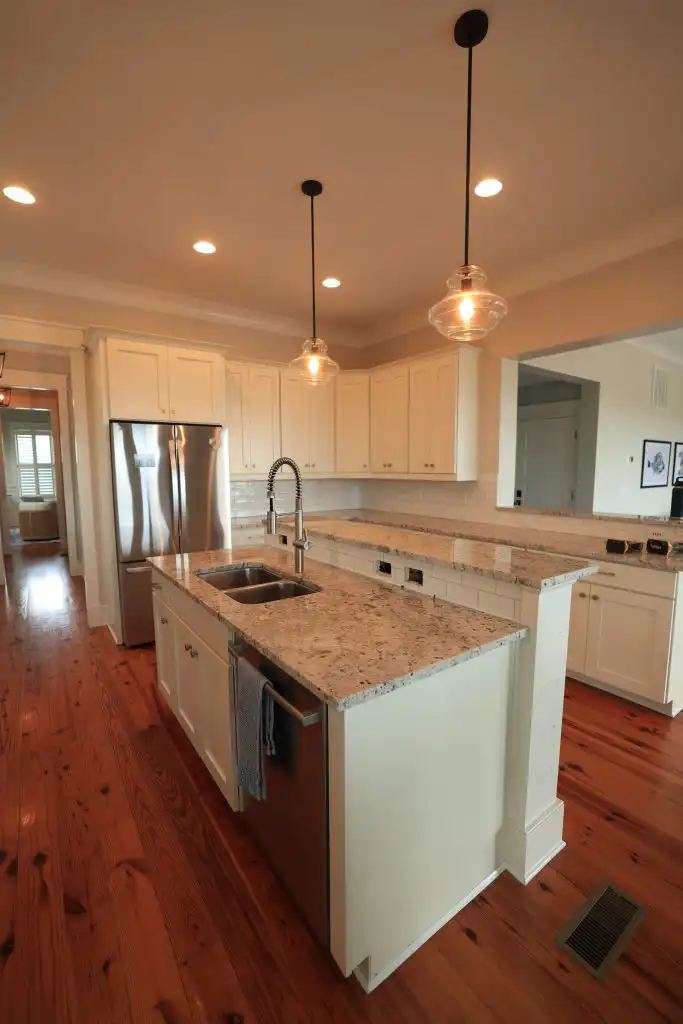
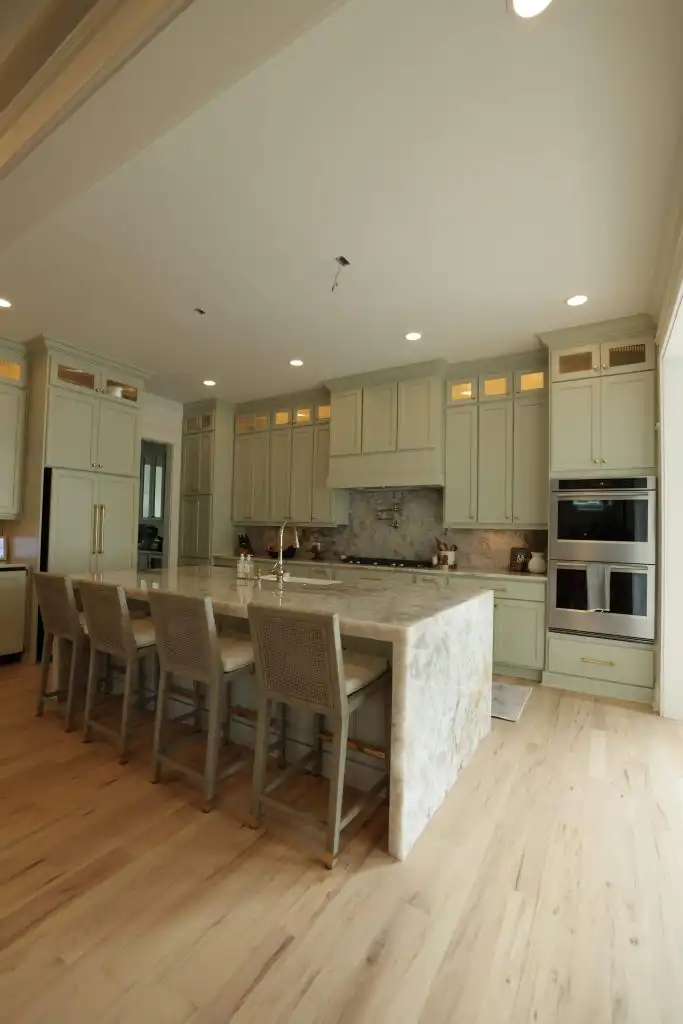
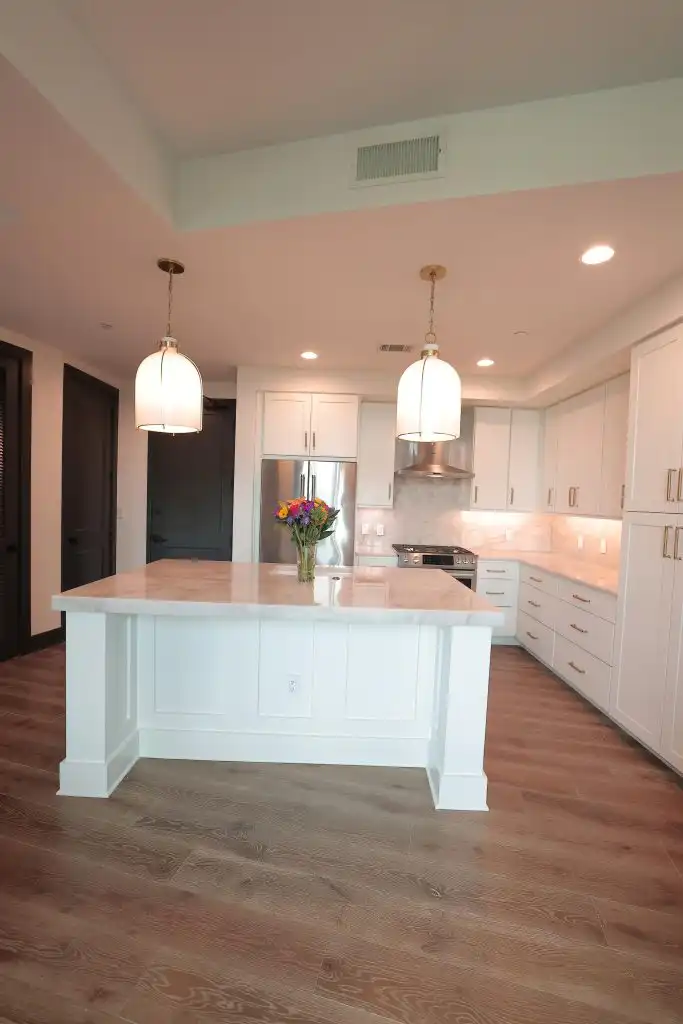
For a busy kitchen, quartzite and granite are the most forgiving natural stones: hard enough to shrug off knives and grit, and more tolerant of a warm pan than resin-bound quartz. Engineered quartz resists stains best and never needs sealing, but asks for a trivet every time. Marble belongs in a busy kitchen only if you welcome etch marks.
So the best countertop material for a busy kitchen depends on which kind of busy yours is: hot pans, constant chopping, spills that sit, or no time for upkeep. If quartzite is already on your list, our page on quartzite countertops in Charleston covers the stone in depth.
How each surface takes four kinds of wear
Consumer Reports, which put 14 countertop materials through lab tests, rates them on stains, abrasion, cutting, heat and impact. The table uses the same lenses for the four surfaces most busy kitchens choose between, with the source behind each point.
| Surface | Hot pans | Knives and grit | Spills that sit | Upkeep |
|---|---|---|---|---|
| Quartzite | Takes a warm pan; a trivet still protects the finish | Mostly quartz, 7 on the Mohs scale: harder than a steel knife | Varies by slab; some need sealing | Mild soap and water; reseal if water darkens it |
| Granite | Takes a warm pan; a trivet still protects the finish | Quartz and feldspar grains, roughly 6 to 7 on the Mohs scale | Porosity varies by color and slab | Sealing as the slab needs it |
| Engineered quartz | Not heat-proof, its makers say; always a trivet or hot pad | Resists daily wear; marks show more on solid colors | Nonporous, resists stains | Never sealed; warm water and mild soap |
| Marble | Acids worry it far more than heat | Calcite, 3 on the Mohs scale: a knife can mark it | Etches with acids; sealing does not stop etching | Seal it, and accept a patina or choose a honed finish |
Hardness figures are from Geology.com’s Mohs scale reference; quartz care points from Cambria’s and MSI’s product care pages; marble points from the Natural Stone Institute.
Heat: where engineered quartz needs help
The resin that binds engineered quartz is its weak spot. Cambria states that its product is not heat-proof and recommends a closed-weave hot pad or solid trivet under pans, slow cookers, griddles and air fryers. MSI warns that sudden or sustained heat near edges and cutouts can crack a top through thermal expansion.
Granite and quartzite take a warm pan better, but the same physics applies near an edge, so a trivet under anything that stays hot for hours is cheap insurance on any surface. We look at the details in how much heat engineered quartz really takes.
Knives, grit and dropped pans
The Mohs scale ranks minerals by what scratches what. On Geology.com’s reference, quartz rates 7 and calcite 3, while a steel knife blade sits between 5 and 6.5. That is the whole story in three numbers: a knife cannot scratch a quartz-rich stone, and it can scratch marble.
Granite, made largely of quartz and feldspar, sits close behind quartzite. Resin-bound quartz resists everyday scratching, though Cambria notes that no stone surface is scratch-proof and marks show more on single-color designs. A cutting board protects the counter, and your knives, on every one of them.
Dropped pans are a different test. Chips start at edges, not in the middle of a top, and Cambria names the edges near sinks and dishwashers as the usual spots. A softly rounded profile helps there; our comparison of edge profiles by daily wear shows which ones.
Spills that sit: stains and etch marks
A stain is something the stone absorbed; an etch is a dull spot where an acid ate into the polish. Engineered quartz is nonporous, so Cambria says it resists stains and needs no sealing. Granite and quartzite range from dense to fairly absorbent, which is why the slab matters more than the name.
Marble is the one that etches. The Natural Stone Institute is clear that marble etches more easily when exposed to acids and that sealing will not prevent it. In a busy kitchen, that means lemon, vinegar, tomato and wine leave a mark, whatever the sealer.
Color plays a part too. Our Black Forest page warns that a dark stone puts smudges and fingerprints on display more readily than a pale one, worth knowing for any dark polished top in a kitchen full of hands.
The most durable kitchen countertop stones, in order
- Quartzite, provided it is true quartzite. Some stones sold under quartzite names behave like marble, so ask how the slab was identified.
- Granite: nearly as hard, with porosity that varies from slab to slab.
- Engineered quartz: the best on stains and upkeep, the weakest on heat.
- Marble: the softest and the one that etches, best where patina is welcome.
Torn between the first and third? We weigh quartzite or engineered quartz for your kitchen in a separate comparison. Porcelain slabs are another hard-wearing option, and we cover how porcelain compares with quartzite as well.
Splitting a busy kitchen by zone
A kitchen does not need one surface everywhere. Put the toughest stone where the work happens, along the range and the sink, and let the island carry the stone you love most if it is mostly for gathering. Matching each surface to its job is often better than compromising on one stone for the whole room.
If you might sell within a few years, buyer expectations count as well; we look at which choices help a kitchen at resale.
The mistake to avoid: choosing by hardness alone
Hardness wins the knife test and nothing else. A porous slab left unsealed can take an oil ring overnight; a resin-bound top can crack under a slow cooker left running. The surface that fails in a busy kitchen is usually the one whose weak spot matches a habit you already have.
Name your habit first, then pick the stone whose weak spot you will never test. To see candidates side by side, begin with our quartzite slabs in Charleston and ask to see granite in the same visit.