“What is the best stone for kitchen islands when designing a high-traffic luxury kitchen?” That question, typed into Google word for word, is one of the searches that brings readers to this page. For a waterfall island, our answer is usually a quartzite with strong, directional veining.
Quartzite is hard enough for daily use, far less reactive than marble, and patterned so the veins can be carried over the edge and down to the floor.
Granite with real movement comes next. Marble suits a lower-use showpiece, quartz suits a calm and predictable look, and porcelain or sintered slabs fit a thin, modern profile, with caveats at the edges.
What is the best material for a waterfall island?
Rank the candidates by what a waterfall does to a slab: it puts a long, exposed corner at hip height and shows the stone edge-on from across the room. In that light:
- True quartzite, for hardness, low reactivity to acids and veining that reads well when it turns the corner.
- Granite with movement. Speckled, granular patterns make the fold less obvious, so the waterfall reads as a box rather than a cascade.
- Engineered quartz, when you want a consistent pattern and no sealing.
- Marble, for a showpiece island that is not the main prep zone.
- Porcelain or sintered slabs, for a very thin, contemporary look, chosen with the edge cautions below in mind.
Most of the quartzites on our materials pages list islands among their best uses, from Taj Mahal to Mont Blanc. The quartzite slabs we fabricate in our North Charleston shop are on our page for quartzite countertops in Charleston.
Before you buy any slab sold as quartzite, check that it is not a marble or dolomite under another name; we explain how to tell true quartzite from a look-alike.
Why does the edge matter more than the top?
On a flat island, the edge is a profile. On a waterfall island it is a mitered seam running the full height of each end, and the vertical faces take knocks from stools, feet, bags and vacuum cleaners. A chip at that corner sits at eye level for anyone walking into the kitchen.
The pattern has to survive the fold too.
The Natural Stone Institute’s article on bookmatching explains that waterfalls usually use vein-matching, where the veins are lined up to flow across the seam, rather than a mirror-image bookmatch. Caesarstone’s fabrication guide gives the same advice for patterned quartz: cut the slab exactly where the miter will fall so the design continues around it.
The stone and the layout have to be chosen together. A directional quartzite laid with its veins running toward the ends will cascade; the same slab turned the other way will stop dead at the corner.
How much more stone does a waterfall island use?
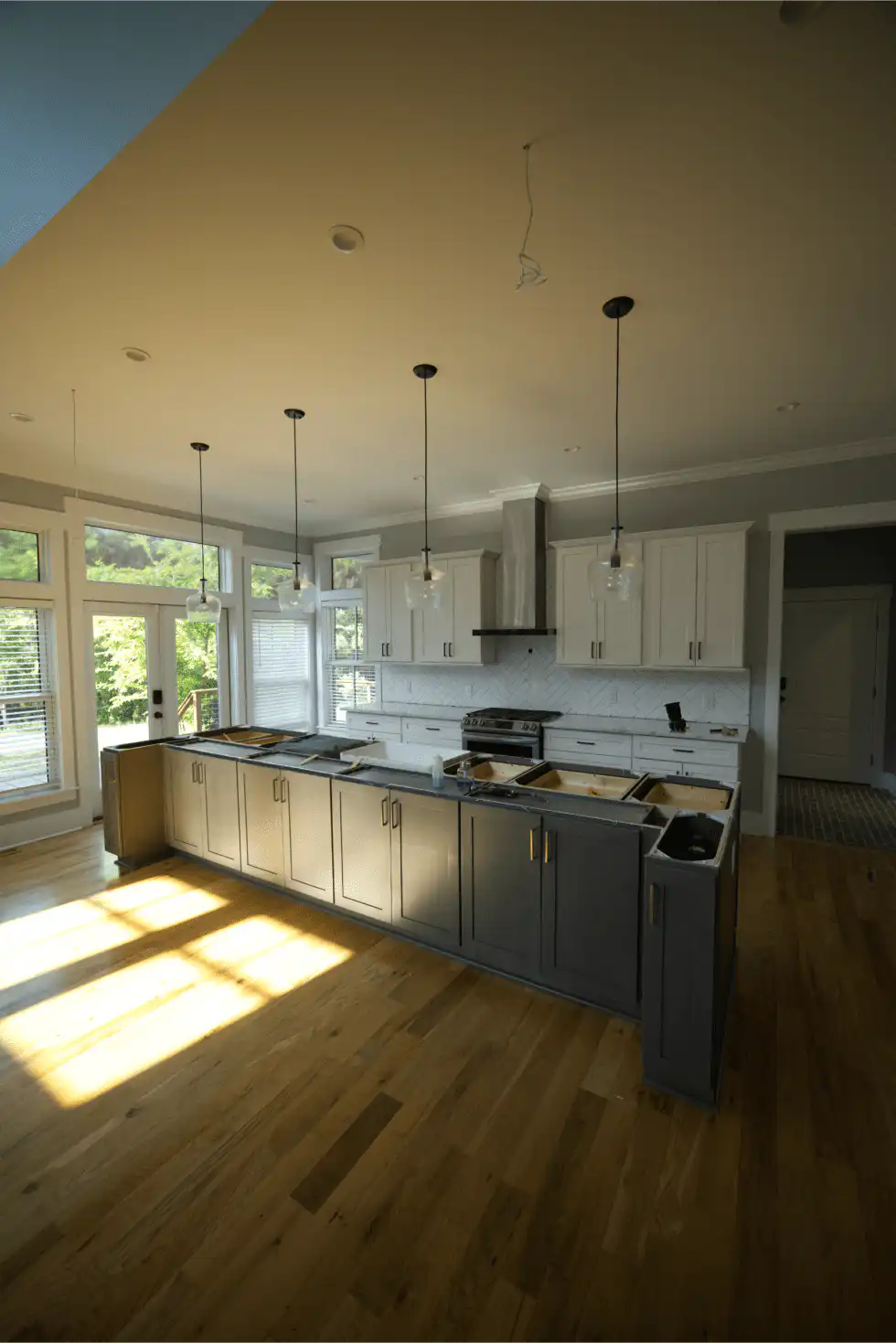
The island above, from our Moncks Corner kitchen project gallery, was photographed before its top went on. Its two end panels are exactly where waterfall legs would go, which makes it a good picture of the decision you are facing.
We are not saying this island got a waterfall; the photo is here to show where the extra stone goes.
Run the numbers on an example island 96 inches long, 42 inches deep and 36 inches high. The top is 96 × 42 inches. Each leg is about 36 × 42 inches, so the two legs add three-quarters as much stone again as the top.
Whether the top and both legs can come from one slab, so the veins run unbroken over both corners, depends on the size of the actual slab.
Slab sizes vary by stone and quarry, so measure the slab you are considering rather than a catalog figure. If it takes two slabs, ask for consecutive slabs from the same block.
For a high-traffic luxury kitchen, what is the best island stone?
With or without a waterfall, a busy island needs a surface that shrugs off lemon juice, wine and hot pans.
True quartzite and most granites handle that best among natural stones: they are hard and do not etch the way marble does. Our listings rate the island quartzites, such as Mont Blanc and Sea Pearl, as very high in scratch resistance.
Engineered quartz resists stains and needs no sealing, but its makers warn about direct heat: Cambria’s FAQ advises a hot pad or trivet under pans, slow cookers and similar appliances. On an island used for serving and baking, that is a habit to keep.
Choosing the specific slab for a statement island is its own process, covered in our notes on choosing a quartzite slab for an island.
Is marble a good idea on a waterfall island?
It can be, with clear expectations. Marble is a calcium-based stone: acidic food and drink etch its surface and it needs sealing on a regular schedule, so a marble waterfall will develop a patina over time.
The legs see almost no spills, so a marble waterfall works best where the top is used for serving and gathering, while chopping and juicing happen on the perimeter.
Porcelain and sintered stone on a waterfall island
Large porcelain and sintered slabs, the category that includes ultra-compact surfaces, are thin, dense and made to resist stains and heat. Two details decide whether they work as a waterfall.
First, on most slabs the stone pattern is printed on the surface, so a cut edge shows the plain body. A mitered corner hides it; a square edge does not. Some makers now produce through-body designs; ask which kind you are looking at.
Second, the Natural Stone Institute notes that sintered surfaces carry an increased risk of chipping because of their density and hardness, that edges are especially vulnerable to impact, and that chips can be difficult to repair.
So for the porcelain slab question, the best options are through-body designs, at a thickness the fabricator is comfortable mitering, with eased corners. Our published collection is natural stone and quartz; for a full comparison, read how porcelain slabs compare with quartzite.
Is a waterfall worth it in the first place?
That depends on the room more than on the stone: a waterfall adds stone and fabrication, protects the cabinet ends, and makes the island the focal point of the kitchen. We weigh those trade-offs in a separate article on the pros and cons of the waterfall edge.
When to bring a fabricator in before you choose
Some signs mean the slab decision should be made with the fabricator, not after it:
- The island plus two legs looks larger than the slabs you have seen.
- You want the veins to run unbroken over both ends.
- The slab you love shows fissures or bold veins near where a miter would land.
- An outlet, a seating overhang or cabinet doors sit on an end panel.
- The floor under the island is not level, so the legs need to be scribed to it.
If any of these apply, bring your island drawing to our North Charleston showroom before you commit, and we will lay the top and legs out on the actual slab with you. Start with the quartzite countertops we fabricate, then ask to see the slabs with the strongest direction.