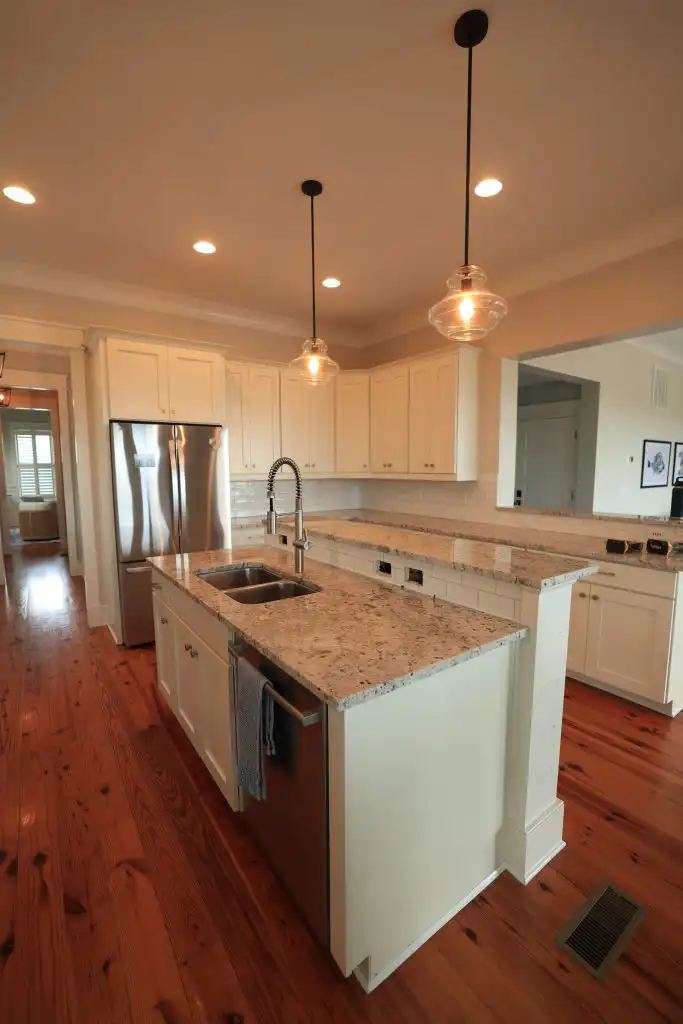
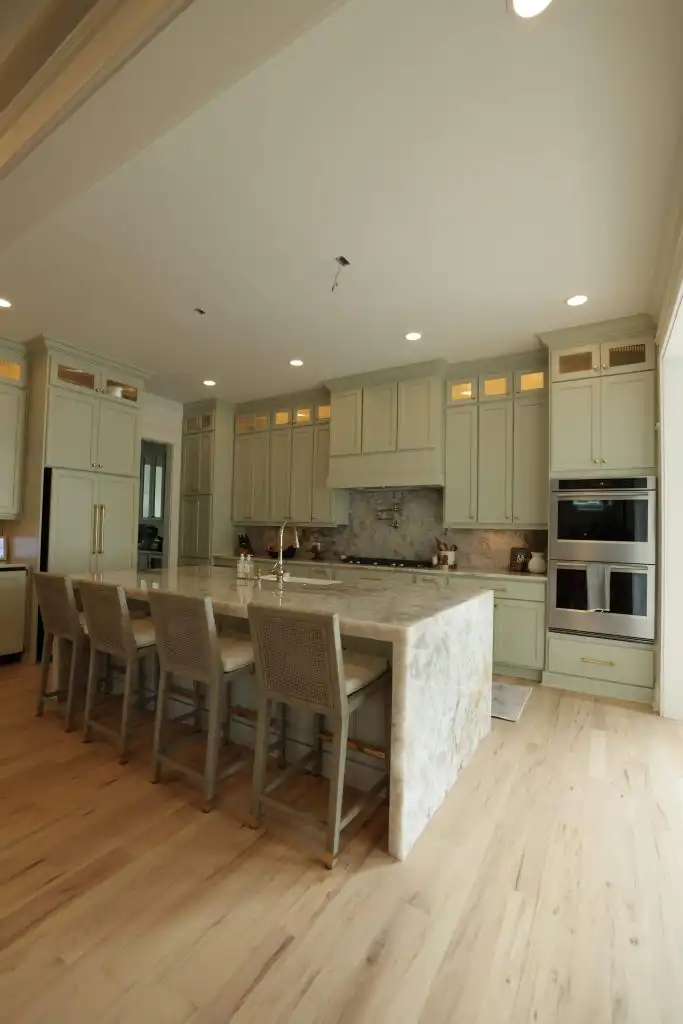
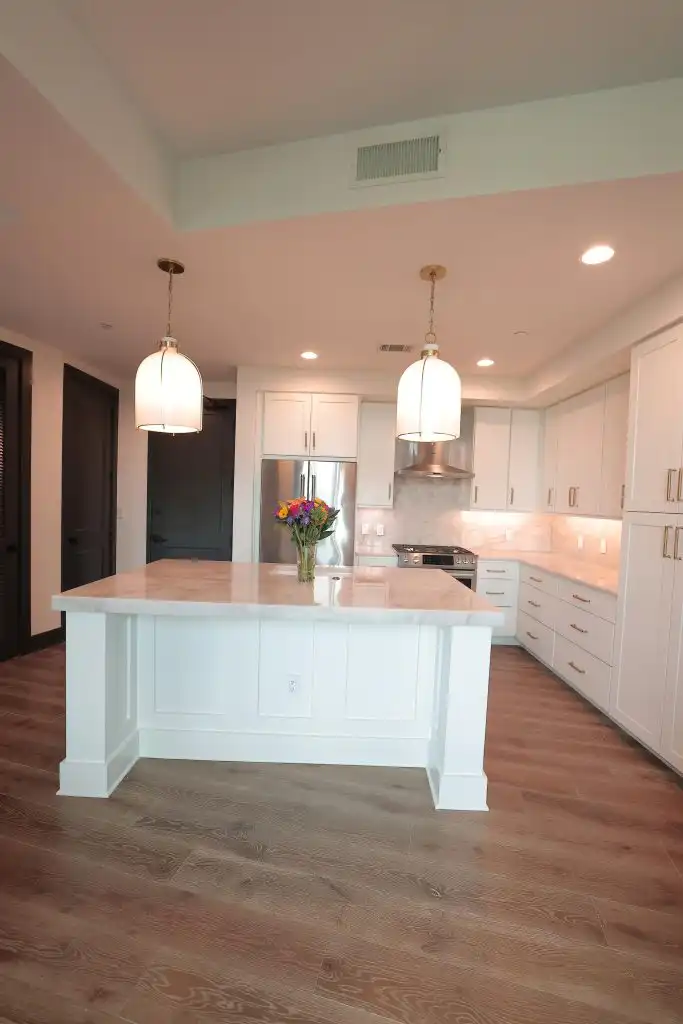
Quartzite is a natural metamorphic rock made almost entirely of quartz: sandstone that was buried, heated and squeezed until its sand grains fused into one interlocking mass. That quartz makes it hard (about 7 on the Mohs scale) and unaffected by everyday kitchen acids, and it is usually white to light gray, with other colors from traces of other minerals.
What follows is a reference: the rock from beach sand to slab, what gives each stone its look, and the words you will hear in a slab yard, each with its source.
How sandstone becomes quartzite
The story starts with loose quartz sand on a beach, a dune or a riverbed. Buried under more layers, the grains are pressed together and glued by minerals carried in groundwater. At that stage the rock is sandstone.
Quartzite needs much more. Most of it forms where tectonic plates collide and build mountains, according to geologist Hobart King’s quartzite page on geology.com: the collision folds the rocks and pushes sandstone deep into the crust. There, the heat and pressure recrystallize both the sand grains and the cement between them.
The Natural Stone Institute (NSI) puts numbers on it in a 2019 article by geologist Karin Kirk: 800° to 3000° F and at least 40,000 pounds per square inch, over millions of years. It is not melted sandstone: the grains lose their separate outlines and lock into a dense fabric of quartz crystals.
You can see the difference where the rock breaks. The University of Auckland’s rock reference explains that a fresh break in quartzite runs straight across the quartz grains, while sandstone breaks around them. That is the toughness a countertop inherits.
Mountains wear down, but quartzite tends to stay. Geology.com calls it “one of the most physically durable and chemically resistant rocks” at Earth’s surface, which is why it so often caps ridges. Medicine Bow Peak in Wyoming, pictured in NSI’s 2019 article, is white quartzite more than a billion years old.
Are there different types of quartzite?
Geologically there is one rock, but it forms along a sliding scale. NSI describes a continuum from sandstone to “intermediate” quartzite, where some sand grains are still visible, to crystalline quartzite, glassy and with no visible grains at all. There is no exact moment when one becomes the other.
NSI also describes “mixed-stone” quartzites that blend in schist or gneiss; they tend to be darker, with swirls of different rock. In a showroom, “types” usually means trade names, and the geology tells you how a given name is likely to behave.
What quartzite is made of
Mostly one mineral. The University of Auckland’s reference puts quartzite at generally more than 90% quartz, with some examples reaching 99%, which it calls the largest and purest concentrations of silica in the Earth’s crust. NSI’s 2019 article describes every quartzite as 100% minerals, with quartz as the main ingredient.
The remaining few percent do most of the decorating. Pure quartz sand is light colored, so a nearly pure quartzite is white, cream or pale gray. Color and pattern come from what else got caught up in the rock:
| What is in the stone | What you see on the slab | Source |
|---|---|---|
| Almost pure quartz | White, cream or light gray; NSI names Taj Mahal and Sea Pearl as examples | NSI, 2019 |
| Iron staining | Pink, red or purple tones | geology.com |
| Hematite (an iron oxide) | Vivid orange accents | NSI, 2019 |
| Thin ribbons of muscovite or biotite mica | Marble-like gray swirls and layers in white stones | NSI, 2019 |
| Fuchsite, a chromium-rich mica | Green color, sometimes a glittering sparkle | geology.com |
| Dumortierite | Blue | NSI, 2019; geology.com |
| Other impurities | Yellow, orange, brown or green | geology.com |
One practical consequence: every slab records its own mix of minerals, so two slabs sold under one name can differ in color and movement. That is why the choice of the actual slab matters more with quartzite than with a manufactured surface.
Reading two slabs from our warehouse
Here is the same idea on real stone. The first photo is a polished Taj Mahal slab on a rack in our North Charleston warehouse.
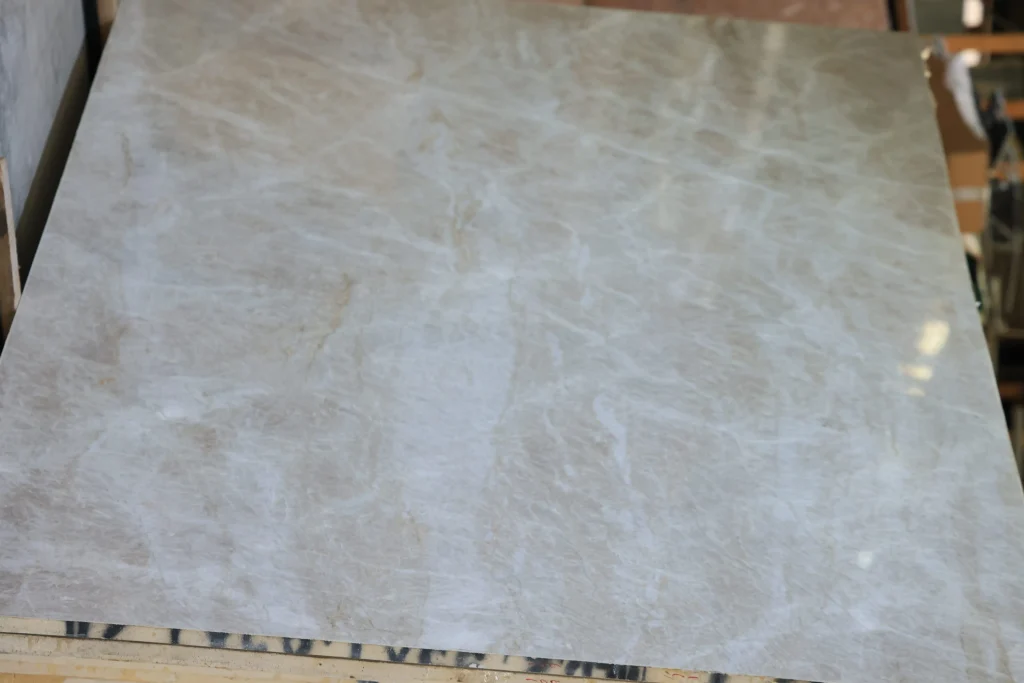
Notice what is missing: the salt-and-pepper speckle. NSI explains that granite shows distinct darker flecks, while quartzite has no dark colors or only soft, flowing ones. The palette stays in a narrow band of beiges and whites, consistent with NSI listing Taj Mahal among the quartzites close to pure quartz.
NSI also used Taj Mahal in its water test: a sample left standing in water barely looked wet, the low porosity expected from a crystalline quartzite. Our page on Taj Mahal quartzite describes its creamy, champagne background and beige, gold and pale gray veining.
The second photo is a close view of another polished slab, with a milky white body crossed by a thin amber vein.
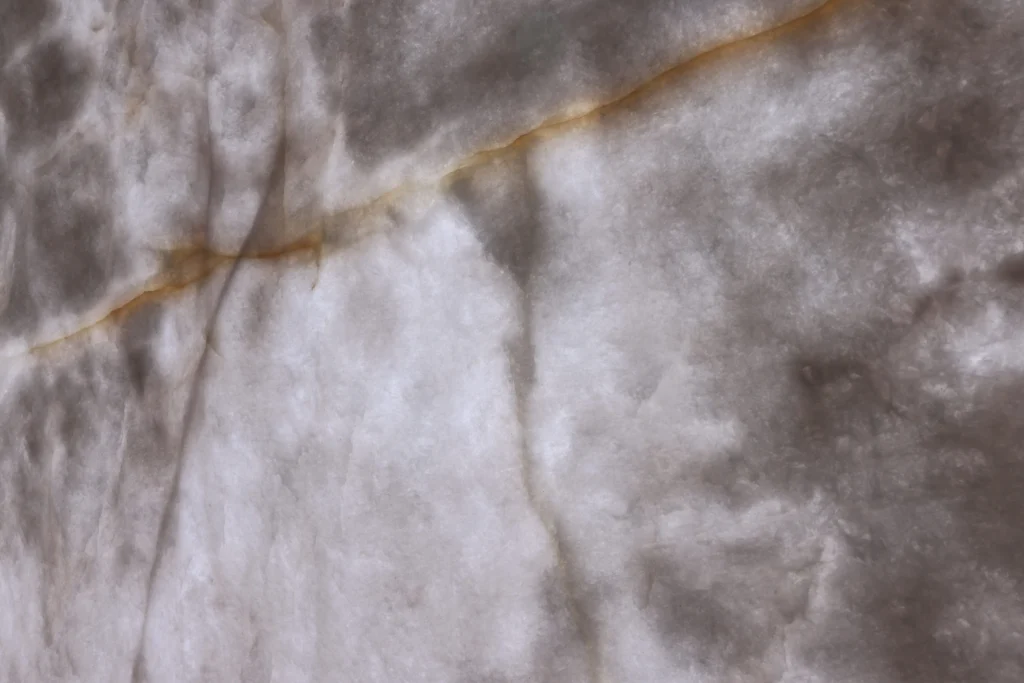
The milky, slightly see-through body is quartz showing its glassy side: geology.com notes that some quartzite is semitransparent to translucent. The warm vein is the kind of color that impurities such as iron minerals bring. It is the kind of milky body and amber veining our Crystallo quartzite page describes, in a stone that can be backlit.
The rest of our quartzites show the range. Mont Blanc quartzite is a clean white with gray, charcoal and occasional lilac veining. Sea Pearl quartzite runs from cool gray to soft sage, and NSI names it among the highly metamorphosed, tightly bonded quartzites. Sequoia Brown quartzite carries strong linear bands of charcoal, taupe and brown.
“Quartzite” at a stone yard versus in a geology lab
For most geologists today, quartzite means a metamorphic rock made almost entirely of quartz. Geology.com notes an older usage, in which a very quartz-rich sedimentary rock was also called quartzite; the cleaner name for that rock is quartz arenite, and the line between the two can be hard to draw.
The stone trade uses names more loosely. Geology.com observes that some quartzite is sold as “granite,” since the dimension stone industry often calls any hard silicate rock granite. The more costly mix-up runs the other way: NSI warns that marble or dolomitic marble is sometimes sold as quartzite, and that some sandstones are too.
NSI is clear that the country of origin, the price and the name are not reliable clues. Two simple checks with a glass tile and lemon juice are, and they are laid out on our page about quartzite countertops in Charleston, SC.
Words you will hear at the slab rack
Each of these terms comes up when you choose a natural stone. The middle column is the plain meaning; the right column is what it changes for a countertop.
| Term | What it means | Why it matters on a countertop |
|---|---|---|
| Metamorphic | A rock changed by heat and pressure without melting. Quartzite started as sandstone. | It explains the density: the grains were fused, not just glued. |
| Non-foliated | Its grains are not lined up in layers. Geology.com classifies quartzite as a nonfoliated metamorphic rock. | Veins and bands in a slab come from the minor minerals in the table above. |
| Mohs hardness | A 1-to-10 scratch scale set out by mineralogist Friedrich Mohs in 1812, from talc (1) to diamond (10). Quartz is 7. | Geology.com lists glass at 4 to 7 and a knife blade at 5 to 6.5; NSI’s care article calls quartzite harder than both. |
| Etching | A dull mark where an acid has chemically eaten into the surface. It is not a stain. | NSI says quartzite does not etch from kitchen acids like lemon juice or vinegar, though strong acids such as rust removers can etch even granite and quartzite. |
| Porosity | How much open space between grains can take in liquid. | It varies by stone. NSI contrasts tight stones like Taj Mahal and Sea Pearl with more porous ones like White Macaubas. |
| Sealing | An impregnating product that fills surface pores. | Needed or not depending on porosity; see our guide to sealing marble and quartzite. |
| Polished | A glossy, reflective surface. | The norm for countertops in the US, according to a designer quoted in NSI’s 2021 article on finishes. |
| Honed | A smooth matte surface with no shine. | The same article calls it the original matte-type surface. |
| Leathered | A textured surface with a soft sheen you can feel. | A matte-type option the same article names next to honed. |
| Engineered quartz | A factory product of crushed quartz bound with resin and pigments. | A different material despite the name; see quartzite vs quartz. |
Where countertop quartzite comes from
Quartzite has formed all around the planet, but the best-known quarries are in Brazil, NSI’s 2019 article says, with the stone also quarried in the United States, Sweden, Canada, Norway, India and Italy. Our Taj Mahal page, for one, identifies that stone as Brazilian.
At Stonhaus Design we bring in slabs from suppliers in Brazil, Italy and China, and keep more than 200 slabs in stock across materials. Because each quarry block is different, we ask clients to choose the actual slab, not a small sample.
What quartzite is used for
Inside a home, quartzite goes on kitchen countertops and islands, bathroom vanities and shower walls, floors and fireplaces. NSI adds outdoor kitchens and exterior cladding, noting that harsh weather and UV light won’t affect the stone. Geology.com points to stair treads and floor tiles, where it stands up to abrasion.
Industry uses it too. Crushed quartzite makes tough aggregate, and a 2016 NSI article mentions railway ballast. Deposits above 98% silica are mined to make glass and silicon metal, geology.com reports, and people were shaping quartzite tools more than a million years ago.
What it means for a kitchen
The geology translates into a short list. Quartzite is hard enough that a stone professional quoted in NSI’s care guide warns it can dull knives, so use a cutting board for the blades’ sake. It does not etch from everyday acids. Its porosity depends on the slab, which is why sealing is a slab-by-slab question.
For day-to-day cleaning, NSI’s care guide suggests a gentle cleanser, water and a soft cloth, wiping spills promptly. The main downsides are mislabeled stone, slab-to-slab variation and the need to check porosity; the full pros and cons are in our article on whether quartzite is good for kitchen countertops.
If you are weighing it against other surfaces, start with the comparison that matches your question: granite vs quartzite for everyday wear, is quartzite heat resistant for hot pans, and porcelain vs quartzite for a manufactured option.
Seeing quartzite in person
Translucency, the depth of a vein and the way a polished face catches light show up best on a full slab. Our page on quartzite countertops in Charleston, SC explains how we help you choose one. To compare our quartzites side by side, visit the North Charleston showroom, Monday to Friday, 8 am to 5 pm.
About the sources: geology and composition come from geology.com (Hobart M. King, PhD) and the University of Auckland’s rock reference; porosity, origin and care come from Natural Stone Institute articles on usenaturalstone.org. This article was prepared by the Stonhaus Design team, and we do not publish prices because they change with the slab and the job.