
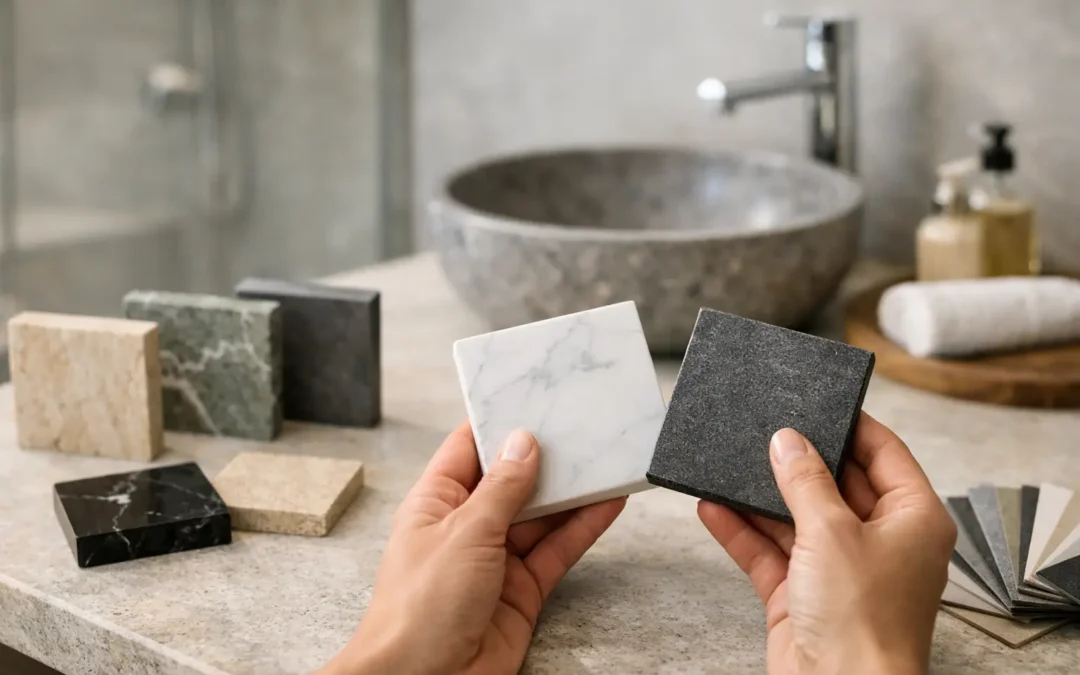
A bathroom can look finished on paper and still feel unresolved the moment materials start going in. That usually happens when the stone is chosen too late, or chosen only by color. If you are researching How to Choose the Right Stone for Your Bathroom, the real goal is not simply finding a beautiful slab. It is choosing a surface that fits how the room is used, how much maintenance you want, and what kind of result you expect years from now.
In a bathroom, stone works hard. It deals with humidity, soap residue, cosmetics, heat changes, and daily cleaning. The best choice is rarely about what is most expensive or what is trending. It is about matching the right material, finish, and fabrication details to the space.
How to think about stone in a bathroom
Bathrooms ask for a different kind of performance than kitchens. The main concerns are moisture, cleaning habits, and visual continuity in a smaller footprint. A dramatic marble may be perfect for a powder room vanity that sees light use, but less practical in a busy family bathroom where toothpaste, hair products, and frequent wipe-downs are part of the routine.
This is why choosing stone should start with function before style. Ask where the material will go. A vanity top, shower wall, tub surround, flooring, and feature wall all place different demands on the stone. The same slab may perform beautifully in one application and be a poor fit in another.
How to Choose the Right Stone for Your Bathroom by application
The first decision is where the stone will be installed, because that shapes everything that follows.
Vanity tops
For vanity tops, durability and easy maintenance are usually the priority. Quartz is often a strong fit here because it is non-porous, consistent in appearance, and simple to clean. It works especially well in primary bathrooms and shared baths where convenience matters.
Natural stones can also be excellent vanity materials, but they need a more deliberate selection. Granite offers strong resistance to wear and moisture. Quartzite brings a high-end natural look with impressive durability, though each slab behaves a bit differently. Marble remains one of the most elegant options, but it is more sensitive to etching and staining, especially around acidic skincare products and cosmetics.
Shower walls and surrounds
For shower walls, the conversation shifts toward water exposure, soap buildup, and grout management. Large-format stone can create a clean, elevated look with fewer visual interruptions. In this setting, finish matters just as much as material. Highly polished surfaces reflect light beautifully, but they may show water spots more readily. Honed surfaces feel softer and often hide day-to-day marks better.
Natural stone in showers can work very well when properly specified, fabricated, and sealed. The key is understanding the upkeep and choosing a material suited to a wet environment.
Bathroom flooring
Flooring introduces another variable – slip resistance. A polished stone floor may look refined, but it is not always the safest choice in a wet room. Textured, leathered, or honed finishes often make more sense underfoot. This is one of those moments where the best design decision is also a practical one.
Choosing the right material
There is no single best bathroom stone. There is only the best option for your priorities.
Marble
Marble has a depth and movement that few materials can match. It brings softness, luxury, and a timeless quality that works across traditional and modern interiors. It is especially compelling in powder rooms, feature walls, and primary bathrooms where the design brief leans more expressive.
The trade-off is maintenance. Marble is softer and more reactive than many alternatives. It can etch from acidic products and may develop patina over time. For some homeowners and designers, that aging is part of the appeal. For others, it feels like damage. Being honest about that difference upfront avoids disappointment later.
Granite
Granite is a practical natural stone for bathrooms because it is dense, durable, and generally low maintenance once sealed. It handles daily use well and offers a broad range of colors and movement. If you want natural character without as much sensitivity as marble, granite is often a smart middle ground.
Quartzite
Quartzite is frequently chosen by clients who want the look of marble with greater durability. It can offer striking veining and a premium, natural appearance, but it is not identical from slab to slab. Some quartzites are more straightforward to maintain than others, so expert review matters. This is not a category to buy by label alone.
Quartz
Quartz is engineered rather than quarried in slab form, but for many bathrooms it is one of the most efficient choices. It is non-porous, consistent, and easy to live with. If your project calls for clean lines, predictable patterning, and minimal maintenance, quartz is hard to ignore.
Its main trade-off is aesthetic preference. Some clients want the authenticity and variation of natural stone, and quartz does not replicate that in the same way. Others prefer the control and consistency. Neither is wrong. It depends on the look you want and how much variation you are comfortable with.
Finish matters more than many people expect
Once the material is chosen, the finish changes both the appearance and the day-to-day experience.
A polished finish delivers clarity, color depth, and reflectivity. It tends to feel crisp and formal. In smaller bathrooms, it can help bounce light and make the room feel brighter. At the same time, polished surfaces may show water marks, fingerprints, and product residue more easily.
A honed finish is softer and more understated. It often suits bathrooms that aim for a quieter, spa-like atmosphere. It can also be more forgiving visually, especially in spaces used by children or guests.
Textured finishes can be useful for floors or feature applications where traction or tactile quality matters. Not every stone is ideal in every finish, so this is where fabrication guidance becomes valuable.
What to look for in the slab itself
When clients ask how to choose bathroom stone, they often focus on the type of stone but overlook the slab. That is where many of the design decisions really happen.
Look at movement, veining, and color variation in person whenever possible. Bathrooms may use smaller cuts than kitchens, which means the exact placement of pattern matters. A slab with bold movement can look stunning on a feature wall and less convincing on a compact vanity if the best portion is lost in fabrication.
Also pay attention to consistency if the bathroom connects visually to other spaces. If you are using stone in multiple areas, think about how the tones relate across flooring, tile, cabinetry, and paint. The right slab should feel intentional in the room, not just beautiful on its own.
Fabrication details affect the final result
Good stone selection can still fall short if the fabrication details are treated as an afterthought. Edge profile, sink cutout, backsplash height, seam placement, and drainage considerations all influence how finished the bathroom feels.
In bathrooms especially, precision matters because the visual field is closer and more intimate. You notice transitions, corners, and alignment quickly. Clean fabrication helps the stone feel architectural rather than decorative.
This is one reason many homeowners and design professionals prefer a partner that can guide material selection and execute fabrication under the same roof. It reduces handoff issues and makes the outcome more predictable.
Common mistakes to avoid
One common mistake is choosing stone based only on a small sample. Samples are useful, but they rarely tell the full story of a natural slab. Another is assuming all white stones perform the same way. They do not. Two materials may look similar in a photo and behave very differently in a real bathroom.
It is also easy to overestimate maintenance tolerance. Many clients love the idea of a delicate stone until they imagine daily use, shared routines, and the cleaning habits of everyone in the home. A realistic choice is usually the better luxury.
Finally, do not separate design from installation logic. If your sink style, faucet placement, wall condition, or shower detailing creates constraints, those should shape the stone decision early, not after purchase.
A better way to choose with confidence
The most successful bathroom projects balance three things well: appearance, performance, and execution. If one of those gets ignored, the result often feels compromised. A premium bathroom should not just photograph well on day one. It should still feel right after months of steam, cleaning, and everyday use.
At Stonhaus Design, that is why the process starts with the material in front of you and the project around it. The best choice is rarely the flashiest option. It is the one that suits the room, supports the design, and is fabricated with the level of precision the space deserves.
If you are deciding now, start with how the bathroom will actually be used, then choose the stone that makes that use feel easy. Beauty matters, but in a room like this, confidence in the choice matters just as much.