
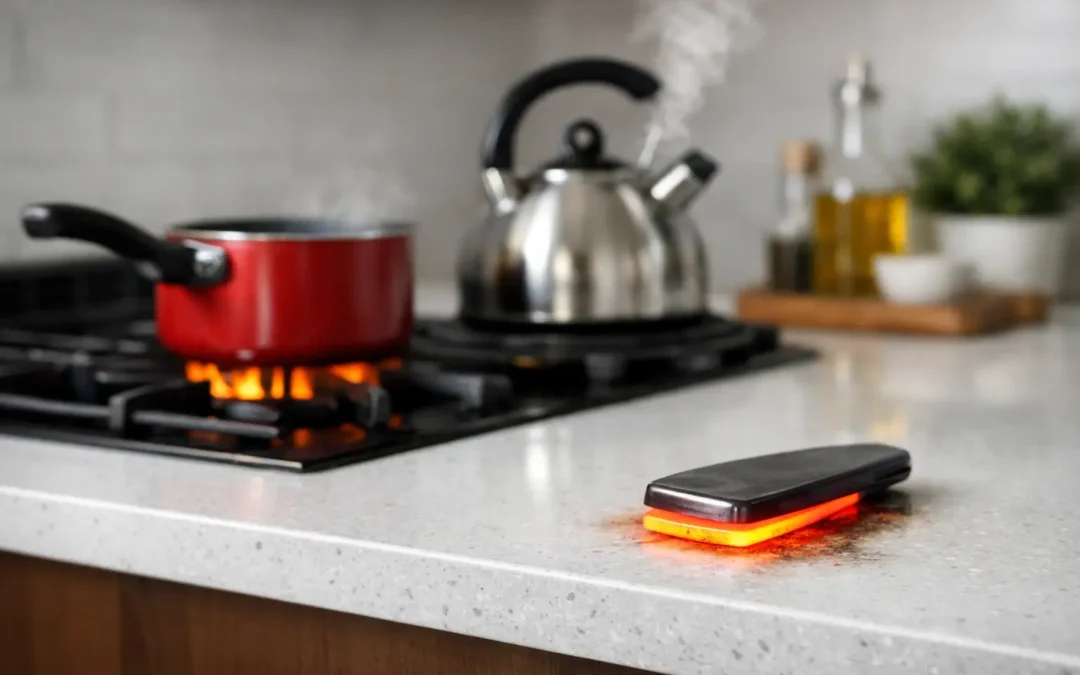
A hot Dutch oven lands on the counter for just a minute. Nothing dramatic happens at first, which is exactly why quartz gets misunderstood.
Many homeowners assume quartz is nearly heatproof because it feels dense, hard, and premium. It is durable. It performs very well in busy kitchens. But quartz countertop heat resistance has a clear limit, and that limit matters when you are choosing materials for a kitchen that sees real cooking.
If you want a surface that looks refined and handles daily life well, quartz is still a strong option. The key is understanding what it does well, where it is vulnerable, and whether those trade-offs fit the way you cook.
What quartz countertop heat resistance really means
Quartz countertops are engineered surfaces made from natural quartz combined with resins and pigments. That blend is what gives quartz its consistent pattern, low porosity, and easy maintenance. It is also the reason heat performance is different from many natural stones.
The quartz mineral itself can tolerate significant heat. The issue is not the stone particle alone. The issue is the resin binders that hold the slab together. When exposed to high temperatures or sudden temperature shifts, those resins can discolor, weaken, or crack.
So when clients ask whether quartz is heat resistant, the honest answer is yes, to a point. Quartz can handle normal kitchen conditions, warm plates, and brief contact with mildly hot items better than many people think. What it should not be asked to do is serve as a landing zone for cookware straight from the oven or a pan pulled off a high burner.
Is quartz heat resistant enough for a busy kitchen?
For many households, yes. For some cooking styles, maybe not.
If your kitchen routine is mostly meal prep, occasional stovetop cooking, and standard everyday use, quartz performs well. It resists staining, does not require sealing, and offers a polished, predictable look that works beautifully in both modern and transitional spaces.
But if your kitchen runs hard, with cast iron skillets, sheet pans rotating in and out of the oven, and frequent hot cookware set down in a hurry, quartz requires more discipline. A trivet is not optional. It is part of owning the material well.
That does not make quartz a poor choice. It simply means the best material depends on how the space will actually be used, not just how it looks in a sample.
How much heat can quartz countertops handle?
There is no single universal temperature rating that applies to every quartz brand, color, or slab composition. Manufacturers vary, and performance can differ depending on resin content and fabrication details. That said, most professionals treat quartz as moderately heat resistant, not high heat resistant.
In practical terms, quartz is usually fine with ambient kitchen warmth and everyday temperature exposure. Trouble starts with direct heat from cookware that may be several hundred degrees. A pot fresh from the oven can exceed what the resin system comfortably tolerates, especially if it sits in one place long enough to concentrate heat.
Thermal shock is another concern. Even when the slab does not scorch, rapid temperature change can stress the surface. That can lead to hairline cracking or subtle damage that becomes more visible over time.
This is why careful fabricators and stone consultants tend to give conservative advice. It is better to treat quartz as a surface that benefits from protection than to test its upper limit in a finished kitchen.
What heat damage on quartz looks like
Heat damage is not always dramatic, but it is usually permanent.
The most common issue is discoloration. A white or light quartz surface may develop a yellow or brown mark where a hot pan sat. Dark colors can show a dull patch or faded ring. In some cases, the finish changes before the color does, leaving a spot that looks flatter or less refined than the surrounding surface.
Cracking can also happen, especially near cutouts, seams, or thinner areas around cooktops and sinks. These are naturally more vulnerable zones because the slab has less uninterrupted mass there. If high heat or sudden temperature change hits those areas, stress can show up faster.
Once resin damage occurs, it usually cannot be polished out the way a superficial mark on natural stone sometimes can. Repair may be limited, and full replacement is sometimes the only way to restore the appearance completely.
Quartz vs. granite vs. quartzite for heat
This is where material selection gets more practical.
Quartz is often chosen for its consistency, easy maintenance, and broad design range. Those are meaningful advantages. But in pure heat performance, many natural stones have the edge.
Granite generally handles heat better than quartz. Quartzite, when properly identified and fabricated, also tends to offer stronger heat resistance. That does not mean you should place red-hot cookware directly on either one as a habit, but they are typically more forgiving than engineered quartz.
Marble can also tolerate heat reasonably well, though it brings other considerations like etching and softness. So the right question is not simply which material resists heat best. It is which material balances heat tolerance, maintenance, visual preference, and overall kitchen use.
For a client who wants a low-maintenance surface and is comfortable using trivets consistently, quartz may still be the best fit. For someone designing a serious cooking kitchen where hot cookware hits the perimeter constantly, granite or quartzite may be a more natural match.
Smart ways to protect quartz countertops from heat
Living well with quartz is straightforward once expectations are clear.
Use trivets, silicone pads, or heat-safe landing areas near the range and oven. This matters most in the work zones where hot cookware naturally moves. If you cook often, planning those landing spots into the kitchen layout makes daily use easier and more intuitive.
It also helps to avoid portable appliances that trap heat underneath, such as slow cookers, toaster ovens, and air fryers, unless they are set on a protective surface and have proper ventilation. Prolonged heat exposure from underneath can be just as problematic as a hot pan from above.
For larger remodels, this is one reason expert material guidance matters. A thoughtful fabrication plan can align the material with the room’s real demands, rather than relying on generic assumptions. At Stonhaus Design, that conversation often starts in the showroom, where clients can compare materials side by side and choose with a clearer view of both performance and finish.
When quartz is still the right choice
Quartz remains one of the most popular countertop materials for good reason.
It offers excellent day-to-day durability, a controlled and consistent look, and low maintenance that appeals to busy households and design professionals alike. In bathroom projects, bar areas, laundry rooms, and many family kitchens, it can be an ideal solution.
It is especially compelling when the design calls for clean movement, soft veining, or a refined contemporary palette that would be harder to source consistently in natural stone. The predictability of quartz can make coordination easier across larger projects, especially when matching multiple slabs or repeat applications.
The only mistake is choosing quartz under the assumption that it behaves like an indestructible heat shield. It does not. If you understand that from the start, quartz can perform exactly as expected.
The better question to ask before you choose
Instead of asking whether quartz can take heat, ask how your kitchen actually works.
Do you cook fast and set pans down wherever there is space? Do you want the lowest-maintenance surface possible? Is visual consistency more important than maximum heat tolerance? Are there young kids, frequent guests, or multiple cooks moving through the room at once?
Those questions usually reveal the right material faster than any spec sheet. A beautiful surface should support the way you live, not create small frustrations every day.
Quartz is a strong, premium countertop option, but quartz countertop heat resistance is best understood as moderate, not absolute. If that fits your habits, it can be an excellent investment. If your kitchen sees heavier heat exposure, another stone may serve you better in the long run.
The best countertop choice is rarely about one feature alone. It is about selecting a surface that looks right, performs honestly, and lets you use your kitchen with confidence.