
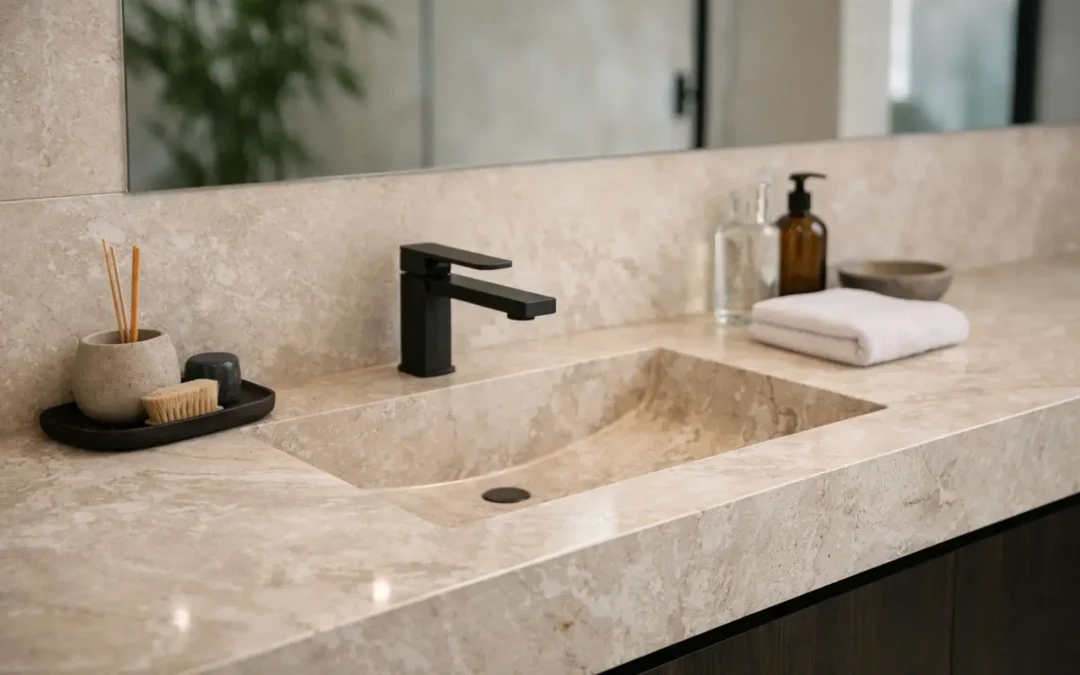
A vanity or kitchen surface can look expensive and still create daily frustration if the sink area is poorly planned. That is why interest in a bancada com cuba integrada em pedra natural keeps growing among homeowners and design professionals who want a cleaner look, fewer visual interruptions, and a result that feels custom from every angle.
Integrated stone sink designs are not only about aesthetics. They affect maintenance, fabrication complexity, edge detailing, drainage, and long-term durability. When specified well, they bring a calm, architectural finish to bathrooms, powder rooms, and select kitchen applications. When specified poorly, they can become one of the most expensive places to correct a mistake.
What a bancada com cuba integrada em pedra natural actually means
In practical terms, this refers to a countertop and sink area fabricated as one coordinated stone piece, or as a stone assembly designed to read as one continuous element. Instead of dropping in a separate porcelain or stainless sink, the basin is built into the composition using natural stone.
The visual advantage is immediate. You get continuity in color, veining, and finish, which creates a tailored look that works especially well in elevated bathrooms and statement powder rooms. For design professionals, it also gives tighter control over proportions, reveal lines, and the relationship between the sink, wall, faucet, and cabinetry.
That said, integrated does not always mean a single carved block. Depending on the material and application, the basin may be fabricated from mitered stone components with carefully finished interior transitions. The final effect is still cohesive, but the fabrication method matters for performance and price.
Where this design works best
A bancada com cuba integrada em pedra natural is usually strongest in bathrooms, where the sink sees regular use but less impact than a kitchen. Master baths benefit from the quiet, monolithic look. Powder rooms benefit from the visual impact, especially when you want the vanity to feel like a furniture piece rather than a standard cabinet-and-sink combination.
In kitchens, integrated natural stone sinks can be beautiful, but the decision needs more caution. Kitchens bring heavier cookware, more acidic spills, more heat exposure, and more frequent abrasion. Some natural stones handle that environment better than others, and some clients are simply better candidates for the maintenance that comes with it.
For many households, a stone-integrated sink in a bathroom delivers the design payoff with fewer compromises.
Choosing the right stone for an integrated sink
Not every natural stone performs the same way once it becomes a working basin. This is where design intent and real-life use need to meet.
Marble
Marble is often the first choice for luxury visuals. It brings softness, movement, and a refined surface that works beautifully in formal baths and powder rooms. The trade-off is that marble is more porous and more prone to etching from acidic products. Toothpaste, skincare, soap residue, and cleaning products can all affect the finish over time.
If the goal is a timeless, elegant vanity in a lower-abuse setting, marble can be an excellent fit. If the client expects a spotless, low-intervention surface, it may not be the right answer.
Quartzite
Quartzite is often a strong middle ground for clients who want the beauty of natural movement with better durability. Many quartzites offer high hardness and better resistance to wear than marble, making them attractive for bathrooms and some kitchen applications.
Still, quartzite is not one universal material category in performance terms. Some slabs are denser and more forgiving than others, so selection should happen with actual slab review and fabrication input, not just a stone name on a sample label.
Granite
Granite remains one of the most practical natural stones for hardworking spaces. It typically offers strong durability, good resistance to wear, and broad design flexibility. For integrated sink projects, granite can be a smart choice when function matters as much as appearance.
Its aesthetic is often more active or granular than marble, which may or may not align with the design direction. In the right project, that is a strength rather than a limitation.
Design details that matter more than people expect
Most problems with integrated stone sinks do not start with the slab. They start with the details.
Basin depth, interior slope, drain placement, edge thickness, and faucet reach all influence how the sink performs. A basin that looks sharp in a rendering can splash too much in daily use. A dramatic flat-bottom design can hold water if the pitch is not resolved correctly. A beautiful stone with bold veining can lose its best character if seam planning is treated as an afterthought.
This is why fabrication expertise matters as much as material selection. Integrated stone work asks for precision in templating, cut planning, finishing, and installation. Small deviations become very visible when the entire sink area is one sculpted focal point.
Maintenance is simpler in some ways, stricter in others
People are often drawn to integrated sinks because they eliminate the rim where grime tends to collect around drop-in or undermount sink edges. That part is true. Cleaning the countertop into the basin can feel easier and more visually tidy.
But natural stone still needs proper care. Sealing may be required depending on the stone. Harsh cleaners should be avoided. Standing water should not be left for long periods, especially on stones that are more sensitive to absorption or mineral deposits. Beauty products can also be surprisingly aggressive on some finishes.
A good rule is simple: the more organic and authentic the material, the more it benefits from informed care. That does not make it impractical. It just means expectations should be honest from the start.
Budget and fabrication realities
An integrated stone sink is a premium fabrication, not a standard countertop add-on. The price reflects more than material square footage. It includes engineering, shop time, finishing labor, and a higher level of coordination from template to installation.
That added cost is often worth it in the right room because the sink area becomes a feature, not just a utility. It can elevate a vanity from ordinary to custom and create a stronger architectural identity in the space.
Still, this is one of those choices where it depends on priorities. If the room is highly design-led and the vanity is meant to carry visual weight, integrated stone often makes sense. If budget discipline is the main driver and the room is more functional than expressive, a separate sink may be the smarter allocation.
What to ask before moving forward
Before approving a slab and sink design, it helps to answer a few practical questions. Is this for a primary bath, a guest bath, or a kitchen? How much maintenance is realistic for the household? Does the chosen stone suit the user behavior in that room? Has the fabricator shown how the basin will be built, sloped, and drained?
These are not minor details. They are the difference between a result that photographs well and a result that works well for years.
For clients who want both confidence and design clarity, the best process is one where material selection, fabrication guidance, and installation planning happen together. That is where a curated showroom and in-house technical support create real value. At Stonhaus Design, that kind of coordination helps reduce guesswork before expensive decisions get locked in.
When it is the right choice
A bancada com cuba integrada em pedra natural is the right choice when the project calls for visual continuity, custom character, and a stronger design statement than an off-the-shelf sink can provide. It is especially compelling in bathrooms where the vanity is meant to feel architectural, calm, and carefully finished.
It is less about following a trend and more about matching the material, fabrication, and user expectations correctly. Done well, it feels effortless. Getting there takes expertise.
If you are considering one for your project, start with the room, the lifestyle, and the stone itself. The best result is not just beautiful on install day. It is a surface you still feel good about using every morning.