
If you have granite in your kitchen, you have probably heard two very different claims. One is that granite must be sealed regularly or it will stain. The other is that modern granite barely needs any maintenance at all. Both statements can be true, depending on the slab.
That is the real answer to the question do you need to seal granite countertops: sometimes yes, sometimes no, and often less often than people think. The right approach depends on how porous your specific granite is, how it is finished, and how you use the space every day.
Do you need to seal granite countertops?
Granite is a natural stone, and natural stone is not uniform. Some granites are dense and absorb very little. Others are more porous and can take in moisture, oil, or pigments if left unprotected. A sealer does not make granite waterproof or damage-proof, but it can slow absorption enough to help prevent staining.
So, do you need to seal granite countertops in every case? No. But many granite countertops benefit from sealing, especially in active kitchens where olive oil, red wine, coffee, citrus, and sauces show up regularly. In bathrooms, the risk is usually lower, but cosmetics and soap residue can still affect the surface over time.
The most accurate answer comes from testing the actual slab, not from assuming all granite behaves the same way.
Why some granite needs sealing and some does not
Granite is an igneous stone made of interlocking minerals. That structure often makes it quite durable, but durability and porosity are not the same thing. A slab can be hard enough to handle daily wear and still be absorbent enough to stain.
Color alone is not a reliable guide, though people often assume lighter granite needs more protection than darker granite. Sometimes that is true, but not always. Mineral composition, quarry source, and finishing method all affect how the stone performs.
Polished granite generally resists absorption better than honed granite because the polished surface is more closed. Honed finishes can be beautiful and design-forward, but they may show oils or darkening more readily and often benefit from more attentive care.
This is one reason a showroom-led selection process matters. When you can evaluate real slabs and ask practical questions about porosity, finish, and maintenance, you make a more confident choice before fabrication begins.
How to tell if your granite countertop needs sealing
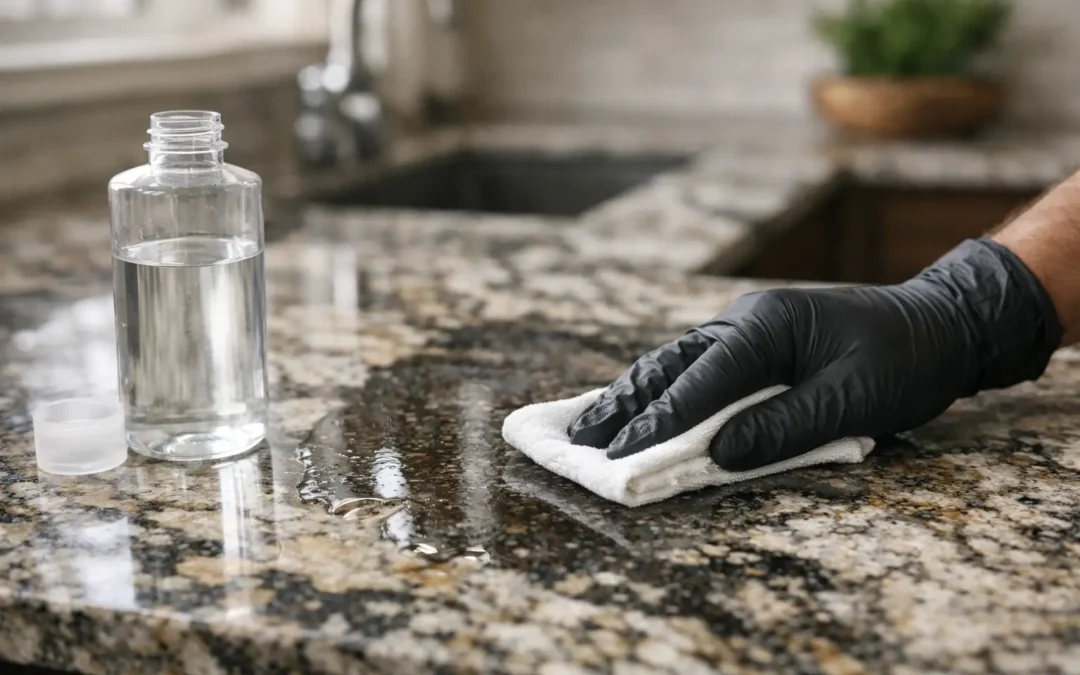
The simplest method is a water test. Place a few drops of water on a clean, dry section of the countertop and let it sit for about 10 to 15 minutes. If the water remains beaded on the surface, the granite is probably still adequately protected. If the stone darkens beneath the water, it is absorbing moisture and may need sealer.
You can do the same test with a small drop of cooking oil in an inconspicuous area, especially if your main concern is kitchen staining. Oil penetrates differently than water, so this can reveal vulnerabilities that a water test misses.
A few signs your granite may need attention include dark spots that appear quickly when wet, lingering marks from cooking oils, or areas around the sink that seem to absorb splashes faster than the rest of the surface. If those signs are present, sealing is worth considering.
What a granite sealer actually does
A sealer is not a topcoat like polyurethane. It does not sit on top of the stone and create a thick barrier. Most quality granite sealers are penetrating products that move into the pores of the stone and reduce how quickly liquids can soak in.
That distinction matters because sealing does not prevent etching, scratching, or heat damage. Granite is more resistant than many surfaces, but no countertop is immune to every form of wear. Sealers are mainly about stain resistance and a little extra reaction time when spills happen.
This is also why overpromising creates frustration. If someone believes sealing makes granite maintenance-free, they may be disappointed when oil leaves a mark after sitting overnight or when acidic residue dulls a neighboring natural stone. Good guidance starts with realistic expectations.
How often granite countertops should be sealed
There is no universal schedule. Some countertops need sealing every year. Others can go several years between applications. Some dense granites may barely need it at all after the initial installation.
Heavy kitchen use changes the equation. A household that cooks daily, entertains often, and uses the island as a true work surface will usually need more maintenance than a guest bathroom vanity or a secondary prep area.
As a general rule, rely on performance, not a fixed calendar. If the countertop passes a water test, resealing may not be necessary yet. If it fails, it is time. Sealing too often is not usually catastrophic, but it can create residue or haze if the product is misapplied or allowed to dry on the surface.
DIY sealing versus professional guidance
Many homeowners can seal granite successfully on their own, as long as they use the right product and follow directions carefully. The process is usually straightforward: clean the surface thoroughly, let it dry fully, apply the sealer evenly, allow proper dwell time, and buff away all excess before it cures.
Where problems happen is in the details. Using a generic cleaner beforehand can leave residue that interferes with absorption. Applying too much sealer can create a sticky or cloudy finish. Choosing a product based on marketing rather than the stone’s actual needs can lead to uneven results.
For a premium kitchen or a newly installed surface, it helps to ask the fabricator or stone specialist what was used initially and what they recommend for maintenance. That advice is often more useful than broad online rules because it is tied to your actual slab and finish. At Stonhaus Design, this kind of practical guidance is part of helping clients choose with confidence and care for the result properly after installation.
Common mistakes people make with sealed granite
The first is assuming sealing replaces cleaning. It does not. Oils, pigments, and food residue should still be wiped up promptly, especially around sinks, cooktops, and prep zones.
The second is using harsh or acidic cleaners. Granite does best with pH-balanced stone cleaners or mild soap and water. Strong degreasers, vinegar-based cleaners, bleach-heavy products, and abrasive pads can dull the finish or break down sealer over time.
The third is sealing because of habit rather than need. More product is not automatically better. If the stone is already well protected, extra applications may not improve performance.
The fourth is treating all dark spots as stains. Sometimes moisture temporarily darkens granite and then evaporates. Other marks are oil-based and need a different response. Knowing what caused the change helps you choose the right fix.
If you are choosing granite now, ask these questions first
If your countertop has not been fabricated yet, sealing becomes part of a bigger material decision. Ask whether the slab is known to be porous, whether a polished or honed finish will affect maintenance, and whether the fabricator applies sealer before handoff.
It is also worth asking how the stone fits your lifestyle. A dramatic natural slab may be exactly right aesthetically, but if you want the lowest-maintenance kitchen possible, another granite or even another material category may suit you better. There is no one perfect surface, only the right fit for your priorities.
That is especially true in high-value kitchens and baths where design, durability, and maintenance all matter. Honest material guidance up front prevents costly disappointment later.
The practical answer most homeowners need
Granite is durable, beautiful, and often easier to live with than people fear. But it is still natural stone, and natural stone performs best when cared for with a little attention rather than guesswork.
If you are wondering whether your countertop needs sealer, skip the myths and test the surface. If it absorbs water or oil quickly, sealing is a smart step. If it does not, leave it alone and keep up with sensible daily care. The goal is not to do more maintenance. It is to do the right maintenance, at the right time, so your countertop keeps the look that made you choose it in the first place.