
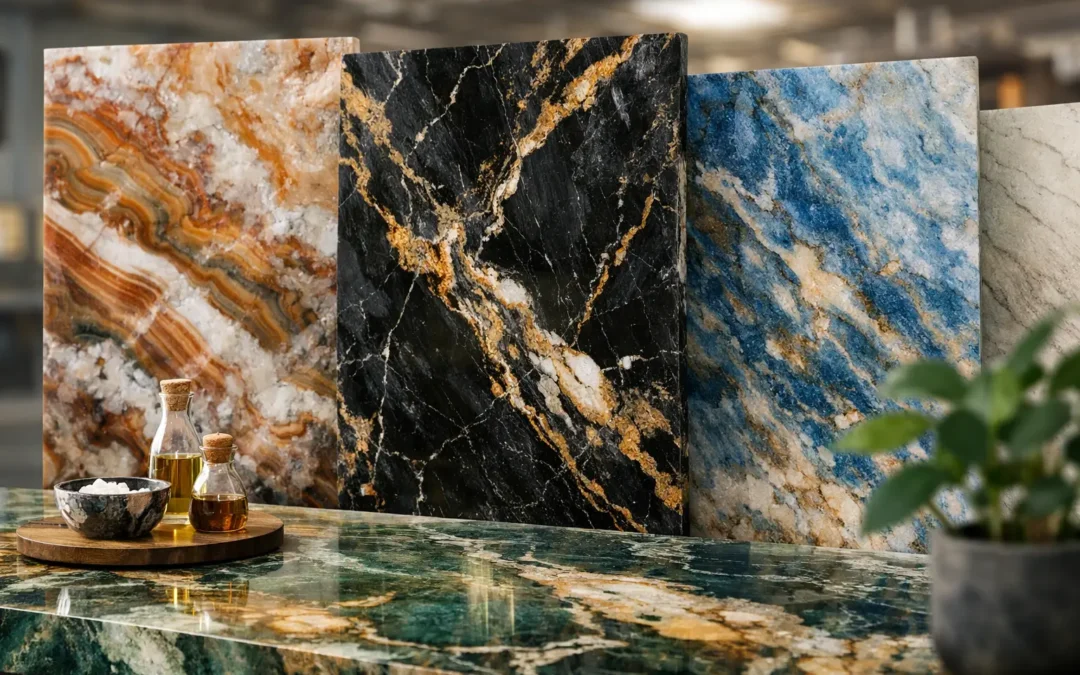
Some countertops are meant to blend in. Others set the direction for the entire room. Exotic stone slabs for countertops fall into the second category – they bring movement, depth, and character that standard surfaces rarely match.
For homeowners planning a standout kitchen or bath, and for designers specifying a material that has to carry the space, the appeal is obvious. What matters more is choosing the right slab for how the room will actually be used. A dramatic surface can be a great investment, but only if the stone, finish, layout, and fabrication details all work together.
What makes a stone slab “exotic”?
In most projects, “exotic” does not simply mean expensive or imported. It usually refers to stone with unusual veining, rare background color, high visual movement, or a pattern that feels more artistic than uniform. Many of these materials are quartzites, marbles, granites, and specialty stones sourced from regions known for distinctive geology, including Brazil and Italy.
What sets them apart is individuality. An exotic slab often has sweeping mineral ribbons, dramatic contrast, crystalline structures, or saturated tones that cannot be replicated consistently from one piece to the next. That uniqueness is the draw, but it also means selection should happen in person whenever possible. Photos can flatten color, miss translucency, and hide the direction of movement that will matter once the slab is cut.
Exotic stone slabs for countertops: where they work best
The best use of exotic stone slabs for countertops depends on what role the surface needs to play in the room. In a quiet, architectural kitchen, a bold slab can become the focal point and reduce the need for layered finishes elsewhere. In a primary bath, a more fluid, elegant stone can add luxury without making the space feel busy.
Kitchens tend to demand the most balance between performance and appearance. If the countertop will see constant cooking, entertaining, and cleanup, the material has to be selected with wear in mind, not just looks. Bathrooms, powder rooms, bars, fireplace surrounds, and statement islands often allow more flexibility because the surface may face less daily impact.
This is where context matters. A highly expressive slab can be perfect for an island and too visually intense for every perimeter surface. In many projects, the strongest result comes from using the exotic stone strategically – placing it where it can be appreciated fully and pairing it with quieter supporting finishes.
Not all exotic stones perform the same
One of the most common mistakes is treating all natural stone as if it behaves the same way. It does not. The visual category may be similar, but day-to-day performance can vary significantly.
Quartzite
Quartzite is often the first recommendation when clients want bold natural beauty with strong durability. Many exotic quartzites offer dramatic veining and rich color while standing up well to scratching and heat. That said, not every material sold as quartzite performs like a true quartzite. Some softer stones are mislabeled in the market, which is why experienced guidance matters.
Marble
Marble remains unmatched for certain looks – soft veining, depth, and a classic elegance that designers continue to specify for a reason. But marble is more vulnerable to etching and scratching, especially in busy kitchens. For some clients, that patina is part of the charm. For others, it becomes a source of frustration. The right choice depends on tolerance for change over time.
Granite
Granite can absolutely fall into the exotic category, especially when it features unusual movement, mineral variation, or striking color. It tends to be a practical option for kitchens because it is generally durable and more forgiving than marble. The range is wide, though, so each slab still needs to be evaluated on its own merits.
Specialty stones
Some exotic materials push further into the artistic end of the spectrum. These can be breathtaking, but they may require more thoughtful application, edge planning, sealing, or maintenance. They are often best chosen with full awareness of their trade-offs rather than assumptions based on appearance alone.
The real decision is not just color
Clients often start with color – white, black, green, blue, warm neutrals – but that is only one part of the decision. A more useful way to evaluate an exotic slab is to ask how it behaves visually across a full surface.
Large-scale movement creates drama, but it can also dominate a small room. High contrast makes a statement, but it may compete with busy cabinetry or patterned tile. Crystalline structures can add depth, yet they may read very differently in morning light than they do under evening fixtures.
This is why slab layout matters so much. The same material can feel calm or chaotic depending on where seams fall, how the veining is oriented, and whether the fabrication preserves or interrupts the natural flow. A strong showroom and fabrication process helps translate the full slab into the finished room, rather than leaving the outcome to chance.
Why in-person slab selection matters
Exotic stone is not a category that should be chosen from a small sample alone. Samples are useful for narrowing direction, but they rarely tell the whole story.
A sample may show a beautiful tone without revealing that the full slab has much more movement than expected. It may also miss areas of translucency, mineral pockets, or directional veining that become central once the slab is installed. For a statement surface, those details are not minor. They are the design.
Seeing the actual slab also helps with practical planning. You can assess consistency, decide which areas should be featured, and understand whether one slab is enough or whether a bookmatch or additional selection will be required. For clients investing at a premium level, this is where confidence comes from.
Fabrication quality changes the final result
Even the most beautiful slab can lose impact if the fabrication is careless. With exotic materials, precision matters more because the stone itself is doing so much visual work.
Cut planning should account for seam placement, pattern continuity, sink and cooktop cutouts, edge profiles, and where the eye naturally lands in the room. On waterfall islands, for example, the veining transition can either feel intentional or visibly broken. On full-height backsplashes, the relationship between countertop and vertical slab can make the room feel custom or disconnected.
This is also where integrated service becomes valuable. When selection, measurement, and fabrication are handled with close coordination, there is less room for avoidable surprises. That matters for homeowners who want a smooth process and for designers who need the finished installation to reflect the original concept.
Maintenance expectations should be honest
Premium does not always mean low-maintenance. Some exotic stones are remarkably practical. Others require a little more awareness.
Sealing may be recommended depending on the material. Acid sensitivity can be an issue for certain stones. Highly polished finishes can show etching or use patterns faster than textured finishes in some applications. None of that makes a material wrong – it simply means the right stone depends on how you live and what level of maintenance feels reasonable.
An honest conversation at the start usually prevents disappointment later. If a client wants a countertop that stays visually consistent with minimal upkeep, one set of materials rises to the top. If the priority is a singular natural look and a little evolution over time is acceptable, the field opens up.
Who should choose an exotic countertop?
Exotic stone is usually the right fit for clients who want the countertop to be more than a work surface. It suits projects where materiality matters, where resale value benefits from a memorable finish, and where the design calls for something less expected than a standard pattern.
It is especially effective in kitchens with clean cabinet lines, in baths that need warmth and depth, and in custom spaces where one slab can anchor the entire palette. It is less ideal when every finish in the room is already competing for attention or when the project demands total visual uniformity.
For many homeowners and trade professionals, the smartest path is to compare several real slabs side by side and let performance guide the shortlist. At Stonhaus Design, that curatorial approach tends to save time and reduce second-guessing because the conversation stays grounded in actual material, actual use, and actual fabrication possibilities.
The right exotic slab should feel exciting on day one and still make sense years later. When the stone fits the room, the lifestyle, and the level of craftsmanship behind it, the result does not just look premium – it feels resolved.