
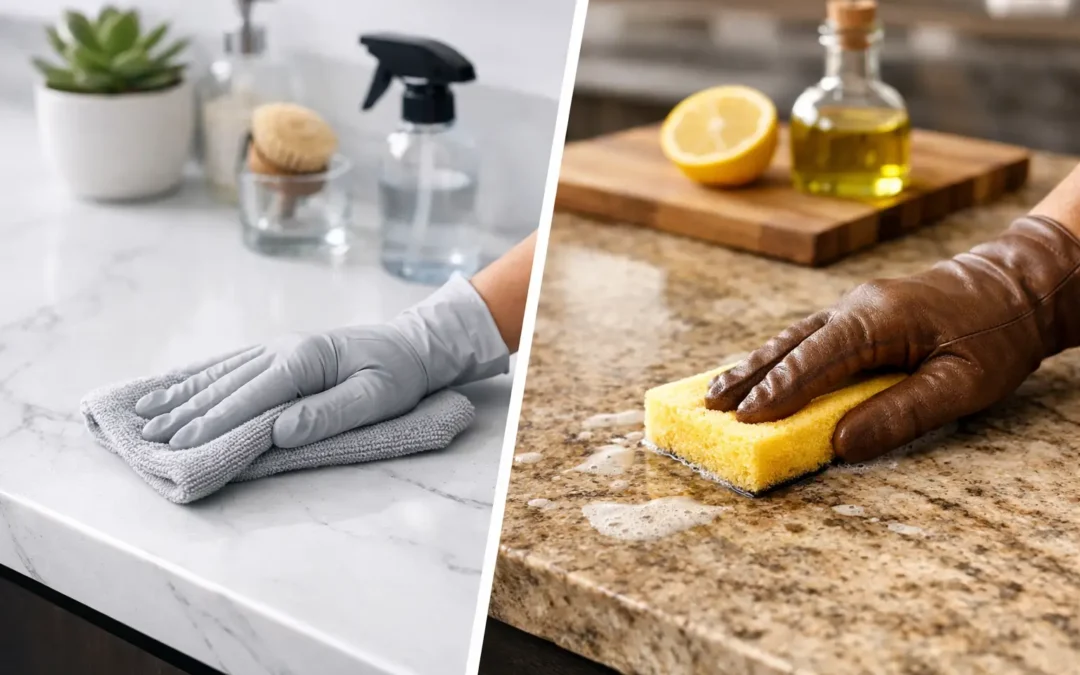
A question we hear early in the selection process is not just which surface looks better, but which one will be easier to live with. When clients ask about
Quartz vs Natural Stone: Real-World Maintenance Comparison, they are usually trying to avoid a beautiful mistake – something that photographs well on day one but becomes frustrating in a busy kitchen or bath.
The honest answer is that maintenance depends less on marketing claims and more on the specific material, the finish, and how the space is used. Quartz is often chosen for predictability. Natural stone is often chosen for character. Neither is automatically the right answer for every project.
Quartz vs Natural Stone: Real-World Maintenance Comparison what actually changes day to day
If you want the shortest version, quartz usually asks for less routine care. Most quartz surfaces are nonporous, which means they do not need sealing and are generally more resistant to everyday staining from coffee, oil, makeup, or soap residue. For many households, that translates into simpler upkeep with mild soap, water, and a soft cloth.
Natural stone is a broader category, and that is where confusion starts. Marble, granite, quartzite, soapstone, and other stones do not behave the same way. Some are more porous, some are denser, and some are more sensitive to acids, heat, or scratching. Saying “natural stone” is low maintenance or high maintenance without naming the stone is usually too vague to be useful.
For a family kitchen that sees constant cooking, spills, and school-day traffic, quartz can feel easier because it removes one variable – sealing. For a powder room vanity or a bar area where design impact matters more than heavy-duty use, natural stone may be the better fit even if it asks for a little more attention.
Cleaning: simple for both, but not identical
Quartz is straightforward to clean. A pH-neutral cleaner or mild dish soap is usually enough for routine care. Because the surface is engineered and nonporous, residue tends to stay on the surface instead of sinking in. That makes everyday cleanup fast.
Natural stone also cleans well, but it benefits from the right products. Stone-safe cleaners are the safest choice, especially on marble and other acid-sensitive surfaces. Harsh chemicals and acidic products can dull the finish or damage the sealer over time. In practical terms, the cleaning routine is not difficult – it is just less forgiving if the wrong cleaner is used repeatedly.
This is one reason expert guidance matters during selection. A dramatic marble vanity may be a great choice in the right setting, but it should come with clear expectations about cleaners, cosmetics, and water spots. Good design decisions do not happen in isolation from maintenance realities.
What about stains and etching?
This is where many buyers mix up two different issues. Staining happens when a substance penetrates the surface. Etching is a surface reaction, often caused by acids like lemon juice, vinegar, or some bathroom products.
Quartz is generally more stain resistant because it is nonporous. It also does not etch the way marble does. That makes it attractive for clients who want a bright, light surface without the anxiety that comes with acidic spills.
Natural stone varies. Granite and quartzite are often more stain resistant than marble once properly sealed, but they are not identical. Marble is especially prone to etching, which is not a defect – it is part of the material’s chemistry. Some homeowners love that lived-in patina. Others find it stressful. The right choice depends on your tolerance for change over time.
Sealing: the biggest maintenance difference
If your goal is the least possible upkeep, sealing is the main dividing line in
Quartz vs Natural Stone:
Quartz does not need sealing. That alone is enough to sway many clients, especially in large kitchens or investment-minded remodels where simplicity matters.
Most natural stone does benefit from sealing, but the frequency depends on the stone and the use. Some granites may need very little attention. Some marbles and quartzites may need more regular checking, particularly in high-use kitchens. Sealing is not difficult, but it is another maintenance step that should be factored into the decision.
A common mistake is assuming sealing makes stone maintenance-free. It does not. Sealer helps buy time against absorption, but it does not make a porous or acid-sensitive stone behave like quartz. That distinction saves a lot of disappointment later.
Heat, scratches, and wear over time
Maintenance is not only about cleaning. It is also about how a surface ages under normal use.
Quartz performs well in many kitchens, but it is not the best choice for direct heat. Hot pans can damage the resins used in engineered quartz, so trivets and pads are important. In homes where cookware frequently moves straight from stove to countertop, that habit matters.
Natural stone often has the advantage with heat tolerance. Granite and quartzite, in particular, tend to handle heat better in real-world kitchen conditions. Marble can also tolerate heat, though it has its own vulnerabilities. If your cooking style is intense and practical, natural stone may be more forgiving in this area.
Scratch resistance also depends on the material. Quartz is durable, but not immune to scratches. Granite and quartzite are generally very hard. Marble is softer and more likely to show wear. Honed finishes can disguise some marks better than polished ones, which is why finish selection should be part of the maintenance conversation, not an afterthought.
Finish matters more than many people expect
A polished surface reflects light and often looks cleaner at a glance, but it can also reveal etching or water spots more clearly on some stones. A honed finish feels softer and can make wear less obvious, especially on marble. Leathered and textured finishes can also help camouflage fingerprints or minor residue in certain applications.
That does not mean one finish is better across the board. It means maintenance should be considered together with visual goals. The best-performing surface on paper can still be the wrong choice if it fights the aesthetic you want.
Kitchens, bathrooms, and custom applications
In kitchens, quartz is often the practical winner for clients who want low routine maintenance, consistent patterning, and strong stain resistance. It is especially appealing in busy family homes, rental properties, or projects where the homeowner wants a premium look with fewer ongoing concerns.
Natural stone often wins when authenticity, movement, and uniqueness are the priority. No engineered surface fully replaces the depth and variation of a beautiful slab of marble, quartzite, or granite. In a design-led kitchen, that difference is not small. It is often the entire point.
In bathrooms, the decision can shift. Vanities usually see less heat and heavy impact than kitchens, so marble and other softer stones become more realistic options. That said, cosmetics, hair products, and standing water still matter. If the user wants a very easy-care bath, quartz remains a strong choice.
For fireplace surrounds, feature walls, and custom built-ins, maintenance may matter less than visual effect because the surface is not seeing the same daily wear. In those applications, natural stone can offer exceptional value through texture, variation, and architectural presence.
So which one is better?
If by better you mean simpler, quartz usually wins. It is easier to clean, does not need sealing, and offers a more predictable ownership experience. For many households, especially those balancing design goals with everyday convenience, that predictability is worth a great deal.
If by better you mean more distinctive, natural stone often wins. It brings variation, depth, and individuality that engineered materials cannot fully replicate. The trade-off is that maintenance can require more attention, and the exact expectations depend on the specific stone.
This is why slab selection should never be reduced to a yes-or-no material debate. A white marble-look quartz and a dramatic quartzite may both be beautiful, but they serve different clients in different ways. The best choice is the one that fits your habits as well as your design direction.
At Stonhaus Design, that is often where the most useful conversations happen – not around abstract pros and cons, but around how the surface will actually be used, cleaned, and lived with.
If you are choosing between quartz and natural stone, ask a practical question before a stylistic one: what kind of maintenance will feel easy to you six months after installation? That answer tends to lead to the right material more reliably than trends ever will.