
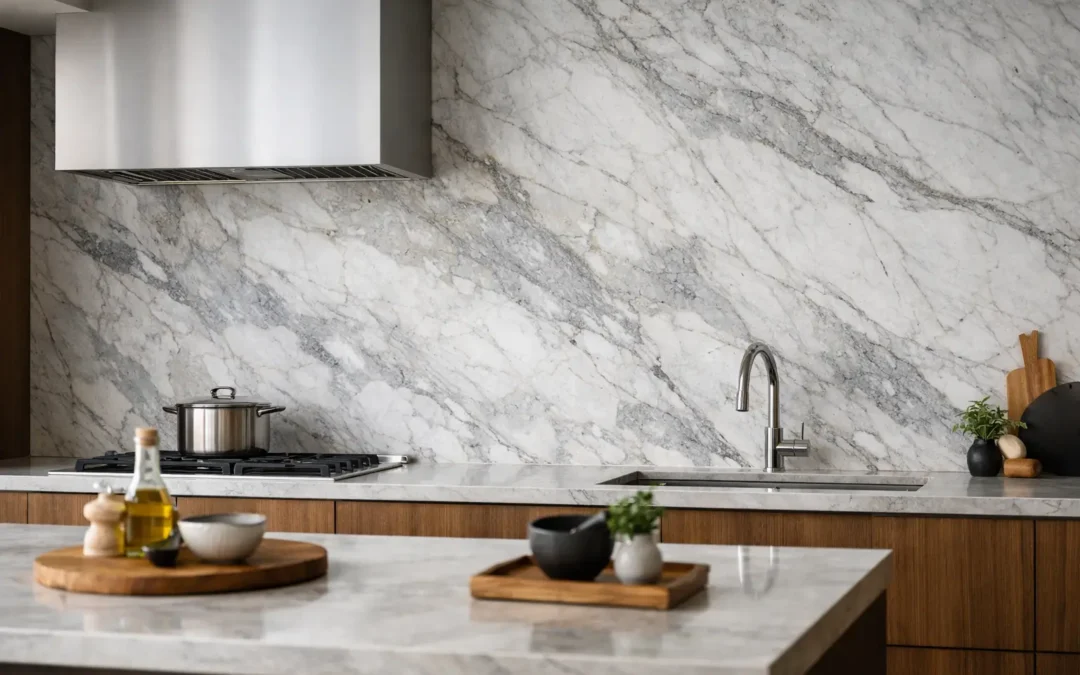
A kitchen can look finished on paper and still feel visually cut off once the hard surfaces go in. That is often the moment homeowners and designers start reconsidering the backsplash. A stone backsplash full height installation changes that equation. Instead of stopping at a short strip above the counter, the material runs continuously to the upper cabinets, range hood, or ceiling, creating a cleaner and more architectural result.
This choice is popular for good reason, but it is not automatically the right one for every project. Full-height stone adds visual impact, reduces grout lines, and can make a kitchen feel more custom. It also asks for better planning, more slab coordination, and careful fabrication around outlets, windows, and transitions. The value is real, but the details matter.
Why a stone backsplash full height changes the room
The biggest difference is continuity. When the same slab or coordinating stone moves from countertop up the wall, the kitchen feels more intentional and less pieced together. You are not reading a horizontal line at 18 inches and then switching to paint or tile. Your eye moves across one surface, which often makes the room feel taller, calmer, and more refined.
That effect is especially strong with marble, quartzite, and other materials with visible movement. Veining can become a design feature instead of background texture. In more minimal kitchens, a full-height backsplash can replace the need for decorative tile entirely. In more layered spaces, it can balance painted cabinetry, wood accents, and metal finishes without adding visual noise.
There is also a practical side. Stone slabs have far fewer joints than tile, which means easier day-to-day cleaning. Behind a cooktop or prep area, that matters. Grease, splatter, and dust are easier to wipe from a continuous stone surface than from multiple grout lines.
Where full-height stone makes the most sense
Not every wall needs the same treatment. In many kitchens, the strongest application is the main range wall or the area between countertop and upper cabinets. Around a statement hood, full-height stone helps anchor the focal point and gives the wall more presence.
It also works well in kitchens with open shelving or no upper cabinets. In those layouts, a short backsplash can look unfinished because there is so much exposed wall above it. Running stone higher creates a better transition and gives the space more visual weight.
In smaller kitchens, this choice can go either way. If the slab is light and the cabinetry is simple, full-height stone can make the room feel larger and less chopped up. If the material is very busy and the space already has a lot happening, it can feel heavy. That is why scale, lighting, and cabinet color all need to be considered together.
Choosing the right material for a full-height backsplash
This is where aesthetics and performance need to meet. The best stone for a full-height backsplash is not just the one that looks beautiful in a sample. It is the one that makes sense for the way the kitchen is used, the amount of natural light in the room, and the level of maintenance the client is comfortable with.
Marble delivers elegance and unmistakable character, but it is softer and more reactive than some alternatives. In a low-splash area or a kitchen where natural patina is welcome, it can be a strong design choice. Quartzite offers a similar sense of movement with greater durability in many cases, making it a favorite for homeowners who want natural stone with stronger everyday performance.
Granite can work extremely well when the goal is durability and visual depth. Some granites read more traditional, while others feel surprisingly modern depending on pattern and finish. Quartz is another common option for a stone-look full-height backsplash, particularly when clients want consistency, lower maintenance, and tighter control over pattern.
The finish matters too. A polished surface reflects more light and can sharpen the drama of the slab. A honed finish softens the look and can feel more understated. Neither is universally better. It depends on the style of the kitchen and how much contrast the design needs.
The trade-offs homeowners should understand
A full-height backsplash usually costs more than a standard tile backsplash, and not only because of material quantity. Fabrication is more involved. Template accuracy becomes critical. Cutouts for outlets and switches need to be clean and well placed. Vein matching may require additional slab planning, especially if the countertop and wall are cut from the same material.
This is also not the place to make decisions too late. Appliance specs, hood dimensions, cabinet spacing, and outlet locations affect the final layout. If those details shift after fabrication, the cost and complexity can increase quickly.
There is a design trade-off as well. A striking slab can become the star of the room, which is exactly the point for some projects. For others, it may compete with a heavily detailed hood, bold cabinet color, or patterned floor. Full-height stone tends to work best when the rest of the design gives it room to breathe.
Planning details that make or break the result
A beautiful slab alone does not guarantee a beautiful backsplash. The best outcomes come from thinking through layout early.
Vein direction is one of the first considerations. Some stones look best when the movement flows horizontally across the wall, while others benefit from a vertical orientation that emphasizes height. If the stone is continuing from the countertop, the transition line between horizontal and vertical surfaces should be intentional.
Outlet placement is another major detail. On a tile backsplash, outlets tend to blend into the rhythm of grout lines and smaller cuts. On a slab backsplash, every outlet interrupts the surface. Designers and fabricators often work together to minimize visual disruption by consolidating placements where possible or aligning them thoughtfully.
Edge conditions matter too. Where does the stone stop at the end of a run? Does it return around a corner? Meet a window trim? Terminate under cabinetry? These sound like small questions, but they shape whether the installation feels tailored or abrupt.
For clients in the Charleston area, this is where working with a showroom and fabrication partner under one roof can simplify the process. Material selection, measuring, slab layout, and finish details are easier to coordinate when the same team is tracking the design from start to install.
Stone backsplash full height vs. tile
Tile still has a place, and in many kitchens it is the better fit. It can introduce color, texture, and pattern at a lower price point. It is also more forgiving in spaces with many interruptions, because the format naturally accommodates outlets, corners, and small areas.
But tile creates a different look. It feels more modular and decorative. A stone backsplash full height feels more monolithic and integrated. That distinction matters when the goal is a premium, custom appearance.
Maintenance is part of the comparison too. Tile adds grout, and grout requires more attention over time. Stone slabs reduce that maintenance burden, though the surface itself may need sealing depending on the material selected. Again, it depends on the stone and on how the kitchen will be used.
Common questions before making the call
One of the most common concerns is whether full-height stone will make the kitchen too busy. The answer usually comes down to slab selection. A heavily dramatic stone paired with ornate cabinetry can overwhelm the room. A quieter slab, or a bold slab balanced by simple millwork, can feel sophisticated rather than loud.
Another question is whether the backsplash has to match the countertop exactly. Not always. Matching creates a strong sense of continuity, but a coordinating stone can also work, especially when clients want contrast without introducing tile.
Clients also ask if full-height stone is only for modern kitchens. It is not. The look can read modern, transitional, or classic depending on the material, edge profile, hood design, and surrounding finishes. The concept is less about style category and more about visual continuity.
Is it worth it?
If the goal is to make the kitchen feel more custom, more architectural, and easier to maintain, full-height stone often earns its place. It is one of those upgrades that changes how complete the room feels. You notice it in photos, but even more in person, where the scale and natural variation of the slab have room to register.
It is worth it most when the installation is planned carefully, the material suits the project, and the fabrication is precise. That combination is what turns a nice idea into a finished result that still feels right years later.
If you are considering a stone backsplash full height design, start by looking at the full room rather than the backsplash in isolation. The best choice is the one that supports how the space works, how it will be used, and how you want it to feel every time you walk in.