
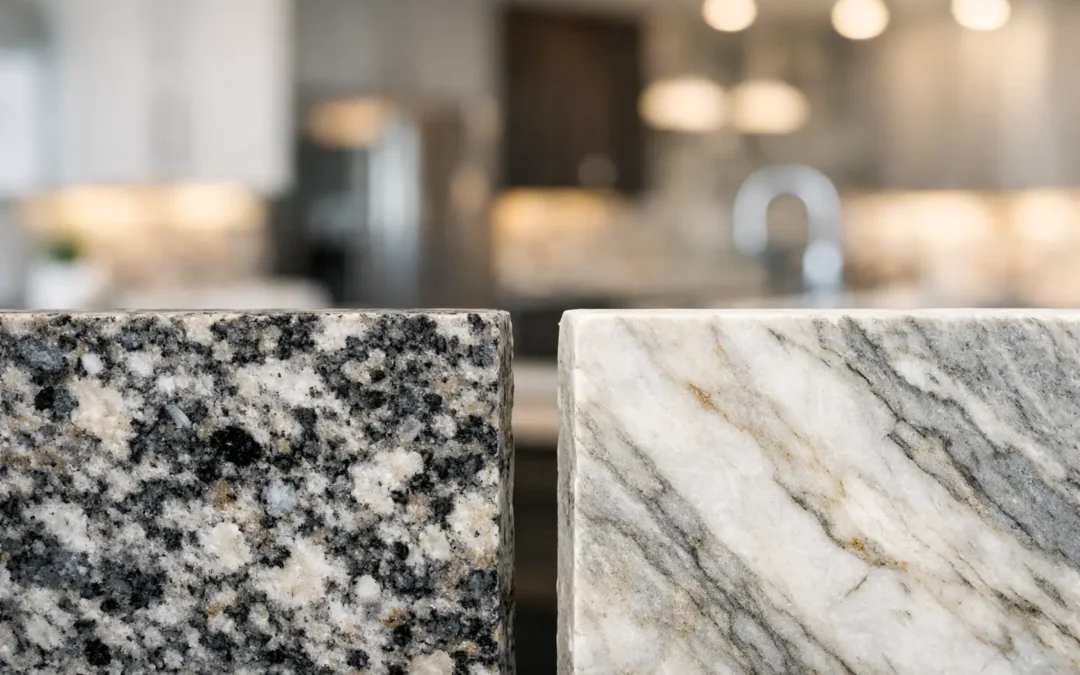
A slab can look perfect under showroom lighting and still be the wrong choice for how you actually live. When clients ask about granite vs quartzite durability, they are usually not asking for a geology lesson. They want to know what will hold up to weeknight cooking, spilled coffee, hot pans, kids leaning on an island, and years of daily use without becoming a maintenance project.
That is the right question to ask. Durability is not one trait. It is a combination of scratch resistance, heat tolerance, stain resistance, chip risk, and how forgiving the material is over time. Granite and quartzite are both strong natural stones, but they do not perform in exactly the same way, and the better choice depends on the room, the finish, and how the slab will be used.
Granite vs quartzite durability in real life
For most kitchens and bathrooms, both granite and quartzite can perform extremely well when they are properly selected, fabricated, and sealed. The difference is in where each stone tends to shine.
Granite has long been a reliable choice for hardworking spaces because it is dense, durable, and generally very resistant to everyday wear. It handles heat well, resists scratching in normal use, and often requires less worry than softer natural stones. If you want a surface that feels proven and practical without giving up natural beauty, granite remains a strong option.
Quartzite is also highly durable and, in many cases, even harder than granite. That hardness is a real advantage when scratch resistance matters. It is one reason quartzite is so popular for busy kitchens that still need a lighter, more refined look. Many homeowners are drawn to quartzite because it can offer the movement and elegance people love in marble, with better day-to-day performance.
The trade-off is that not every quartzite slab behaves the same way. Some are very dense and low absorption. Others are more porous than clients expect and need more attention to sealing. This is where material expertise matters. Two stones may look similar, but their performance can be different.
Scratch resistance and surface wear
If scratch resistance is your top priority, quartzite often has the edge. It is formed under intense heat and pressure, creating a very hard stone that stands up well to abrasion. In a kitchen where counters see frequent prep work, quartzite can be an excellent performer.
Granite is also highly scratch resistant and more than durable enough for most residential applications. In practical terms, both materials will hold up well to normal use when you use cutting boards and basic care. The difference usually becomes more relevant in heavy-use kitchens or in projects where the owner wants the strongest possible natural stone surface.
Finish matters here too. A polished surface tends to show the least day-to-day wear. Honed finishes can be beautiful and more understated, but they may reveal marks or oils more easily depending on the color and pattern. Durability is not only about the stone itself. It is also about how the finish behaves with your routine.
Heat resistance in kitchens
Both granite and quartzite perform well around heat, which is one reason they remain favorites for kitchen countertops and fireplace surrounds. Compared with many engineered materials, natural stone generally offers better heat tolerance.
Granite has an excellent reputation for handling hot cookware without damage under normal conditions. Quartzite is also very heat resistant, making it a strong fit for serious cooks and frequently used kitchens.
That said, no countertop should be treated carelessly. Sudden thermal shock, weak spots near seams or cutouts, and improper installation can all create problems that have less to do with the material category and more to do with execution. Trivets are still a smart habit, especially in premium kitchens where protecting the finish matters just as much as protecting the slab.
Stain resistance is where the conversation gets more specific
This is often the part clients overlook. A stone can be hard and still be vulnerable to staining if it is more porous.
Granite is typically quite forgiving, especially darker and denser varieties. Many granites resist staining well once sealed, and some are naturally less absorbent than expected. For homeowners who want a lower-fuss natural stone, that can be a meaningful advantage.
Quartzite varies more from slab to slab. Some quartzites are very dense and perform beautifully. Others need more consistent sealing to prevent oils, wine, or acidic foods from leaving marks. This does not make quartzite fragile. It simply means that durability should be evaluated beyond hardness alone.
This is one reason a showroom-guided selection process is so valuable. Looking at a label is not enough. Understanding the specific slab, its absorption, finish, and best use helps prevent expensive surprises later.
Chipping, edges, and fabrication details
When people think about durability, they often picture the top surface. But edge performance matters too, especially on islands, bathroom vanities, and custom applications.
Because quartzite is very hard, it can sometimes be a bit less forgiving during fabrication if the slab has natural fissures or movement that needs to be respected. Granite is also strong, but some varieties can be easier to fabricate cleanly depending on the design and edge profile.
Neither stone is immune to chipping at exposed edges or around sinks if something heavy strikes the same point hard enough. This is where professional templating, precision cutting, and thoughtful edge selection make a real difference. A delicate profile may suit the design, but a slightly eased edge can be the better choice for a family kitchen that sees constant use.
Durability is never just about the quarry. It is also about fabrication quality and installation discipline.
Which is better for kitchens?
For kitchens, both are excellent choices, but the right answer depends on your priorities.
If you want strong overall performance, broad style options, and a material with a long track record in active homes, granite is hard to beat. It is especially appealing for households that want durability with minimal anxiety.
If you want a premium natural look with dramatic veining or a lighter palette, and you are willing to be a little more intentional about sealing and slab selection, quartzite can be the better fit. In many high-end kitchens, it offers the balance clients want between refined design and strong performance.
For designers and homeowners choosing between the two, the smartest approach is not asking which material wins in the abstract. It is asking which specific slab fits the project’s use, aesthetic, and maintenance expectations.
Granite vs quartzite durability for bathrooms and vertical surfaces
Bathrooms are generally less demanding than kitchens when it comes to heat and abrasion, so both materials perform well there. Quartzite can be especially compelling on vanity tops, shower surrounds, and feature walls where design impact matters. Granite also works beautifully in bathrooms, particularly where ease of care is a priority.
On vertical applications such as fireplace surrounds or statement walls, the durability discussion shifts slightly. Surface wear becomes less of a concern, and visual impact takes the lead. In those cases, the choice often comes down to the slab’s pattern, weight considerations, and fabrication requirements rather than pure hardness.
The most practical way to choose
If your household is busy, you cook often, and you want a stone that feels durable and straightforward, granite is often the safer default. If your project calls for a brighter, more elevated natural look and you are working with an experienced fabricator who can guide you to the right slab, quartzite may be worth the extra attention.
The key is not to buy based on category alone. Ask how the exact slab performs. Ask about sealing. Ask how the finish will look after daily use. Ask whether the edge profile suits the way the space will function. Those questions lead to better outcomes than marketing labels ever will.
At Stonhaus Design, that is where the conversation usually becomes most useful – not in choosing a winner on paper, but in matching the right stone to the way the space will actually be lived in.
A beautiful surface should do more than photograph well. It should feel right ten years from now, on an ordinary Tuesday, when the kitchen is busy and the countertop still looks like it belongs there.