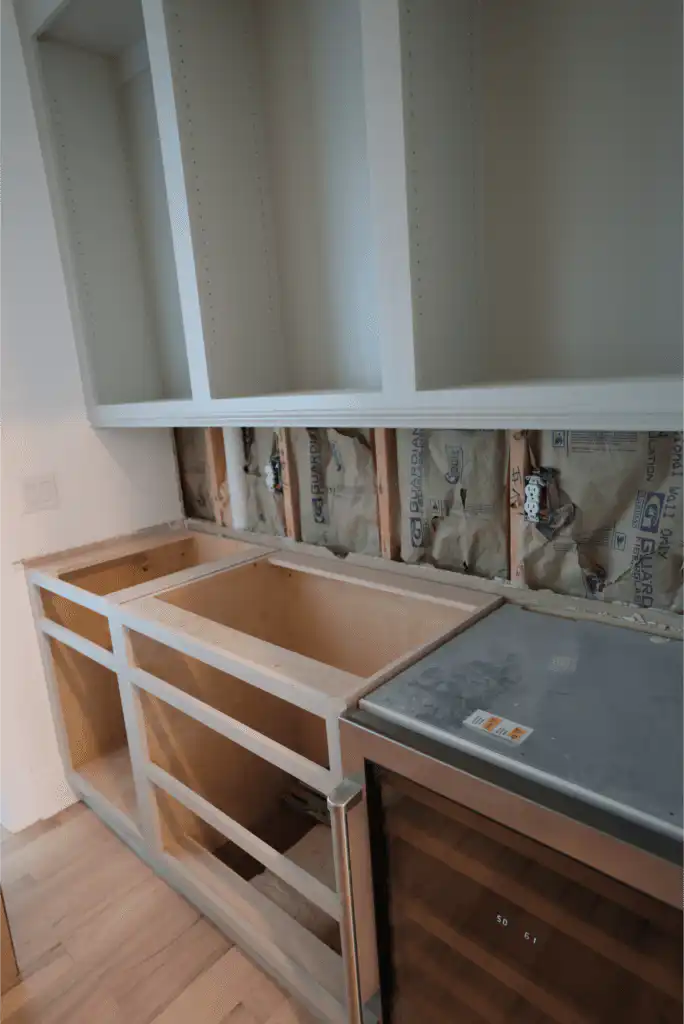
The most common misunderstanding about stone shower wall panels is that the stone keeps the water out. It does not. The panels are the finish: large pieces cut from full slabs of natural stone or engineered quartz, fitted to each wall in place of tile, so the shower has a few seams instead of hundreds of grout lines.
The water stops at a waterproof membrane behind them. Get that layer, the panel thickness and the seam layout right, and a slab shower is one of the calmest surfaces in a house. The checklist below follows the order in which those decisions are made.
What a slab panel is, and what it replaces
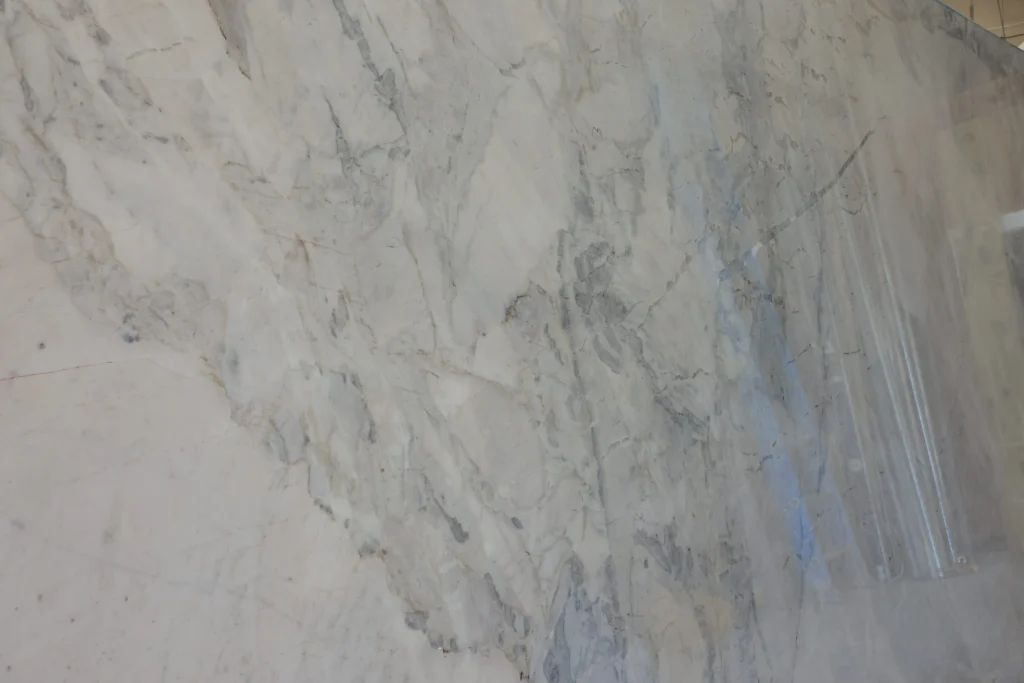
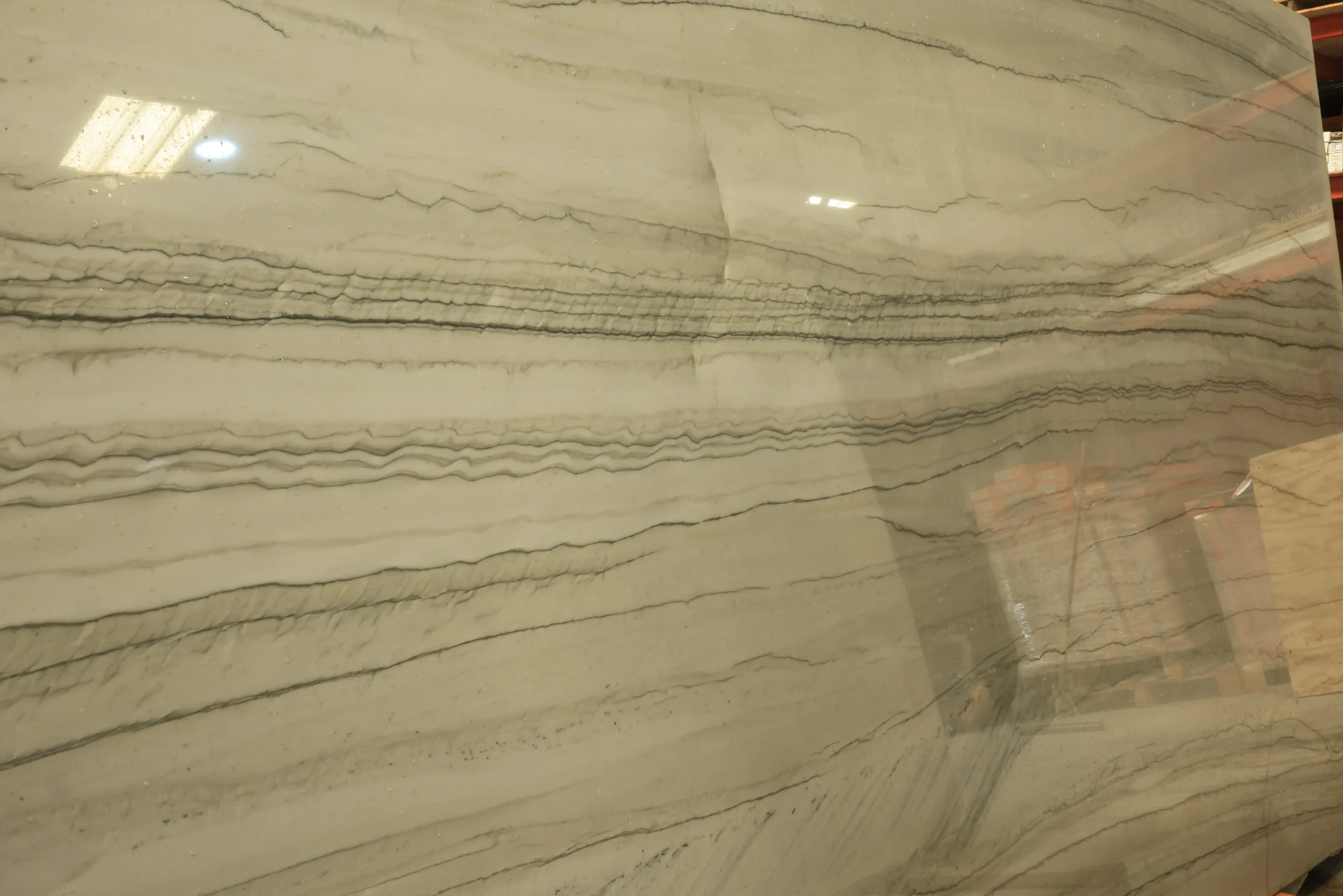
A panel starts as a full slab like the one above, photographed in our warehouse. The fabricator templates each wall, then cuts the slab so the veining continues from one panel to the next. Curbs, benches, niche shelves and thresholds are usually cut from the same stone, so the whole enclosure reads as one material.
Because the panels come from specific slabs, the slab you choose is the shower you get. You can browse the slabs in our showroom to see how much movement each stone carries before you settle on a direction.
Natural slab, engineered quartz, porcelain or veneer
Four different products are sold as stone shower walls, and they behave differently:
- Natural stone slabs (marble, quartzite, granite) carry real veining through their thickness. Marble is the most sensitive in water: the Natural Stone Institute notes that marbles with more veins and inclusions are more vulnerable when moisture gets in, and that granites are less reactive to acids.
- Engineered quartz is a manufactured slab of quartz with binders and pigments. Cambria, for example, makes 1 cm quartz slabs specifically for shower walls and describes them as nonporous and lighter to install.
- Porcelain slabs are fired ceramic that absorbs almost no water; on most of them the stone look is a surface decoration. Our comparison of how porcelain slabs compare with quartzite covers that material in depth.
- Thin stone veneer is real stone cut thin, typically between 3/4 inch and 1 1/2 inches according to the Natural Stone Institute, and is mostly used on walls and fireplaces. For a shower, ask the maker whether the product is rated for wet areas; a rough, stacked face also holds soap film.
Acrylic, PVC and solid-surface panels printed or molded to look like stone are a separate category. They are not stone, and they are installed differently.
Thickness and weight on a wall
Natural stone slabs are usually cut at 2 cm or 3 cm. For the same stone, a 3 cm piece carries 50% more stone per square foot than a 2 cm piece, as our guide to the difference between 2 cm and 3 cm slabs explains.
On a wall, that weight bears on the framing, the backer board and the bond.
That is why the thinner slab is the usual starting point for wall panels, and why some quartz makers offer 1 cm material for showers.
How the panels are held, by adhesive alone or with mechanical anchors, follows industry references such as the Marble Institute of America’s Dimension Stone Design Manual and should be settled with the installer before templating.
Seams: where they fall and how many
The number of seams depends on the width of each wall against the size of the slab, and on whether the veining has to continue around a corner.
A typical layout puts the joints at inside corners, keeps them away from the eye line and from the shower valve, and aligns any niche with a seam rather than cutting through a strong vein.
Valve, shower head, grab bar and niche locations must be fixed before templating; once a panel is cut, a moved valve means a new piece. Direction matters too: vertical veining makes a shower feel taller, horizontal veining makes it feel wider. Our notes on how we plan seam placement in stone apply here as well.
Waterproofing goes behind the stone
Stone and its joints are not a water barrier. In a shower, the barrier is a membrane on the wall and pan behind the panels. Specifications commonly call for membranes that meet ANSI A118.10, the American standard for load-bearing, bonded waterproof membranes under thin-set ceramic tile and dimension stone.
An article in The Construction Specifier adds two details worth asking about: the membrane should wrap the curb and extend past the jambs of the shower opening, and a steam shower needs its membrane’s vapor permeance specified, because steam drives moisture harder into the wall assembly than an ordinary shower does.
Ask who installs the membrane, who inspects it before the stone goes up, and how the joints between panels and at the pan are sealed.
Finish and care on a wet wall
A honed finish hides water spots better than a polish; a polish shows the veining more vividly and needs a squeegee to stay clear. Hard water leaves minerals on either one, so drying the walls after use is the single most useful habit.
Most natural stone in a daily-use shower benefits from a penetrating sealer; a restoration specialist quoted by the Natural Stone Institute recommends resealing once a year. Clean with a pH-neutral product, never vinegar. Our guide to telling when stone needs sealing shows the simple water test. Engineered quartz needs no sealer.
What to bring when you ask for a quote
We do not print prices, because a slab shower is priced on the slabs and the work, not by the square foot of a catalog.
The quote depends on how many slabs the walls need, the thickness, whether veins must match across panels, the number of cutouts, curb and bench pieces, removal of the old tile, and access to the bathroom. Bring:
- Wall widths and ceiling height, with a photo of each wall.
- A sketch of the shower with the valve, shower head, niche and bench positions.
- Whether it will be a steam shower.
- Who is handling demolition, plumbing and the waterproofing membrane.
- The stones you are considering, or slab numbers if you have already seen them.
- Your finish preference: polished, honed or textured.
- Notes on access: stairs, tight turns, a second-floor bath.
Still deciding which stone belongs on the walls and which on the vanity? Our zone-by-zone guide to bathroom stone lays that out, and our ideas for bookmatched and full-slab bathroom walls show the statement versions.
With those details in hand, the next step is concrete: send them to us and we will tell you how many slabs your walls need and which stones suit a wet wall. Ask for a slab shower quote, or call (843) 284-7866 to book time with the slabs at our North Charleston showroom.