
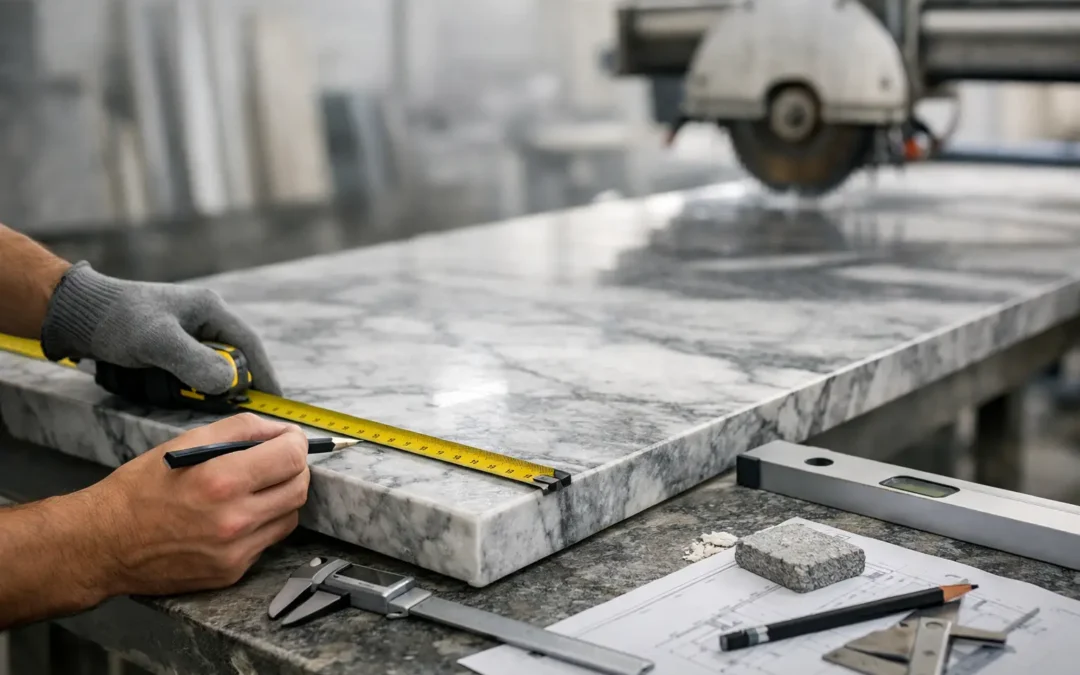
A countertop can look simple on paper – one long run, an island, a sink cutout – until a small measuring error turns into a visible gap, a bad seam, or a delayed install. If you are searching for como medir bancada para corte de pedra, what you usually want is not just dimensions. You want confidence that the slab will be cut correctly, fit cleanly, and support the design details that make the space feel finished.
This is where measurement shifts from basic math to fabrication planning. Stone is precise, but the room around it often is not. Walls bow. Cabinets vary slightly. Corners that look square rarely are. That is why good measuring is less about writing down length and width and more about understanding what the fabricator needs to produce a reliable result.
How to approach como medir bancada para corte de pedra
Start with a simple rule: measure the installed conditions, not the plan alone. Drawings are helpful, but fabrication should be based on what is physically in place. Cabinets should be installed and leveled before final field measurements are taken. If tile, wall cladding, or backsplash details affect the fit, those conditions should be clarified before the slab goes into production.
Use a steel tape measure, a notepad or printed layout, a level, and if possible, a digital angle finder. Measure in inches for US projects unless your fabricator requests otherwise. Record everything clearly and do not round casually. In stone work, a quarter inch can matter, and an eighth inch can matter even more.
Measure the cabinet footprint first
Begin with the base cabinets, since they define the support for the stone. Measure each run from end to end at the front, middle, and back. If those numbers differ, note all three. That tells the fabricator whether the wall is out of straight or whether the cabinet line drifts.
Then measure the cabinet depth in several locations. Standard depth is common, but not guaranteed. If there is a refrigerator panel, side gable, or custom end condition, include that as well. For islands and vanities, measure both overall size and any planned overhang. Do not assume both sides match without checking.
Add overhangs intentionally
Countertops are not usually cut flush to the cabinet face. Most designs include a front overhang, often around 1 inch to 1 1/2 inches, depending on style and door profile. On islands or seating areas, the overhang may be larger and may need support brackets if it extends beyond what the stone thickness and material can safely span.
This is one of the most common mistakes in early layouts. A homeowner measures only the cabinet box, but the finished stone size needs to include the reveal and any design-driven projection. For a premium installation, overhang should look balanced across all visible edges, not improvised at the last minute.
What to include before stone is cut
A useful stone template includes more than outside dimensions. It should show sink location, faucet holes, cooktop cutouts, seam placement, corner conditions, edge profile, and backsplash expectations. If any of those details are undecided, fabrication can stall or assumptions can create expensive revisions.
Sink and faucet measurements
For undermount sinks, the fabricator needs the exact sink model or the physical sink on site. The cutout depends on whether the reveal is positive, negative, or flush. Each choice changes the opening size and the visual line around the bowl.
Measure the sink base cabinet width, then confirm the sink dimensions, centered location, and front-to-back placement. Faucet holes also need planning. A faucet, soap dispenser, filtered water tap, and air switch can all compete for space behind the sink, especially in shallow countertops or when a window trim sits close to the back edge.
Appliance and specialty cutouts
Cooktops, ranges, pop-up outlets, and other accessories need manufacturer specifications. Do not measure the visible trim and assume that is the cut size. The cut opening usually follows a technical diagram with required clearances.
If the project includes a farmhouse sink, mitered apron, drain grooves, integrated backsplash, or waterfall leg, those details should be marked early. They affect how the slab is laid out and where the best material pattern should appear.
Walls, corners, and out-of-square conditions
This is where many do-it-yourself measurements go wrong. A wall may look straight and a corner may look like 90 degrees, but stone does not flex to hide framing inconsistencies. Measure wall-to-wall runs in multiple places and check corners with an angle finder if possible.
If the wall bows out, the countertop may need scribing. If the corner is out of square, the slab may need to be adjusted so the front overhang stays even while the back edge follows the wall. Good fabricators plan for this. Good measuring makes that planning possible.
How professionals reduce risk when measuring stone countertops
Professional templating often uses digital tools because they capture real-world conditions with more consistency than hand sketches alone. Even so, the principle stays the same: verify the room, verify the support, verify the details. Stone fabrication works best when nothing critical is left to assumption.
At this stage, the fabricator also considers slab size, veining direction, seam placement, and structural strength. A measurement may technically work, but it may not be the best fabrication choice if it creates a weak area around a sink or forces an awkward seam in the most visible part of the kitchen.
That is why the question is not only how to measure. It is how to measure for the finished result you actually want.
Common mistakes in como medir bancada para corte de pedra
The first mistake is measuring before cabinets are fully installed and leveled. If the supports move later, the stone dimensions may no longer match. The second is relying on builder plans instead of field conditions. Plans are useful for quoting and early design, but final fabrication needs site verification.
Another common issue is forgetting finished materials around the countertop. A side splash, paneling, wall tile, or trim detail can affect the final fit and reveal. So can the decision to paint or plaster after installation. Sequence matters more than many people expect.
There is also the problem of incomplete decision-making. If the sink is not selected, the edge profile is still open, and no one has approved the seam location, the measurements may be technically correct but not yet fabrication-ready. Precision requires complete information, not just a tape measure.
When rough measurements are enough – and when they are not
Rough measurements are useful for budgeting, slab selection, and early design conversations. If you want to compare quartz versus quartzite, estimate material quantities, or understand whether a full slab or remnant might work, approximate dimensions are often enough.
Final cutting is different. Once stone is fabricated, changes are limited. Natural stone and engineered surfaces can sometimes be adjusted slightly in the field, but no one wants a premium countertop to depend on field improvisation. Final measurements should be taken only when the project is truly ready.
For homeowners and design professionals who want fewer surprises, working with a team that handles material selection, templating, fabrication, and installation under one roof usually creates a smoother process. It reduces handoff errors and gives one team responsibility for how the slab looks and how it fits. That is a big reason clients come to Stonhaus Design for projects where finish quality matters as much as the measurement itself.
A practical measuring checklist before fabrication
Before approving a countertop for cutting, confirm that base cabinets are installed, secured, and level. Verify all overall dimensions, then check them again at the front and back. Confirm overhangs, sink model, faucet layout, appliance specs, edge profile, backsplash plan, seam locations, and any special details such as waterfall ends or mitered edges.
Also confirm access. Large stone pieces may fit the kitchen perfectly on paper but be difficult to bring through a narrow entry, stair turn, or tight hallway. Experienced fabricators think about installation path early because a beautiful slab still has to reach the room safely.
The real goal is predictability
If you are figuring out como medir bancada para corte de pedra, the best takeaway is simple: precise stone work starts before the saw. Careful measurement protects the material, the design, and the schedule. It also gives you better answers earlier – where seams should go, whether overhangs need support, and how to avoid the small fit issues that become obvious once the countertop is in place.
A well-measured project feels easier from that point forward, and that is usually the difference between a countertop that merely fits and one that looks like it was always meant to be there.