The easiest mistake with outdoor kitchen countertops is choosing them the way you would choose an indoor counter: by color, by what looks good in a sample, by what a friend has in their kitchen. Outside, the weather makes the decision with you.
For most Lowcountry patios, a dense natural stone such as granite or quartzite, in a honed or textured finish, sealed and at least as thick as an indoor top, is the safe choice. Resin-based surfaces belong under a roof or not at all. The checklist below shows why, using the weather this area actually gets.
What a year outside does to a countertop here
The National Oceanic and Atmospheric Administration publishes 30-year climate normals for Charleston International Airport. The 1991 to 2020 figures, read on October 9, 2026, describe the conditions an uncovered counter will live with:
- about 64 days a year with a high of 90 °F or more, and an average July high of 91.3 °F;
- 52.5 inches of rain a year, with June, July, August and September each averaging more than 6 inches;
- about 74 days a year with at least a tenth of an inch of rain;
- about 22 nights a year at or below freezing.
Long, hot, wet summers and a short run of freezing nights: that combination rewards stone that absorbs little water and does not care about sunlight. Each point below follows from it, and the table shows how the usual outdoor surfaces line up against those conditions.
| Surface | Sun and UV | Citrus, wine and marinades | What to plan for |
|---|---|---|---|
| Granite | No resin to fade; honed granite is a landscape architect’s outdoor pick in an NSI article | Does not etch (siliceous stone, NSI) | Penetrating sealer; color affects surface heat |
| Quartzite (tested, not just labeled) | Unaffected by weather and UV (NSI) | Does not etch (NSI) | Porosity varies by variety; seal the porous ones |
| Marble, limestone, travertine | Not the issue | Etch on contact (calcium-based, NSI) | Expect a patina outdoors |
| Engineered quartz, standard lines | Resin can yellow (NSI); some makers sell separate outdoor lines | No etching in an NSI test | Keep it under a roof unless the product is rated for outdoor use |
| Porcelain slabs | Strong UV and thermal-shock resistance (NSI, 2026) | Check the maker’s chemical-resistance data | Thin edges and the pattern’s depth |
| Concrete | Not covered by our sources | Etched by acid in an NSI test | Stained badly in the same test; strict sealing routine |
1. Map the sun before you pick a color
Stand where the counter will go at mid-afternoon in summer. If it gets full sun, color matters for comfort as much as for looks. A stone consultant interviewed by the Natural Stone Institute (NSI) points out that darker stone gets hotter on the surface in the sun than lighter stone.
A Chicago-area landscape architect quoted in another NSI article goes a step further and suggests placing the outdoor kitchen in a shadier spot to shield the stone from the elements. A pergola, a roof extension or simply the north side of the house can lower the surface temperature on those 90-degree afternoons.
2. Keep resin-based surfaces under a roof, or out
Engineered quartz is a mix of quartz particles and resin, and resin reacts to sunlight. A geologist writing for the NSI left several engineered quartz slabs outdoors for a few months and saw them turn yellow. Caesarstone, a major quartz maker, sells a separate Outdoor Collection described as UV resistant, instead of offering its standard line for outdoor use.
If a quartz product is on your list, read its warranty for outdoor and sun exposure before you commit. Our comparison of quartz vs granite countertops covers the other differences.
3. Choose a stone that shrugs off acid
Marinades, citrus, wine, sauces and fallen berries all land on an outdoor counter. The NSI explains that calcium-based stones such as limestone, marble, onyx and travertine react to acids and can etch, while siliceous stones such as granite, basalt and quartzite do not.
That makes granite the workhorse for grilling stations. An NSI article on outdoor kitchens quotes a landscape architect who favors honed granite because it holds up to the elements wherever the home is. You can compare granite countertops for Charleston homes in person at our North Charleston showroom.
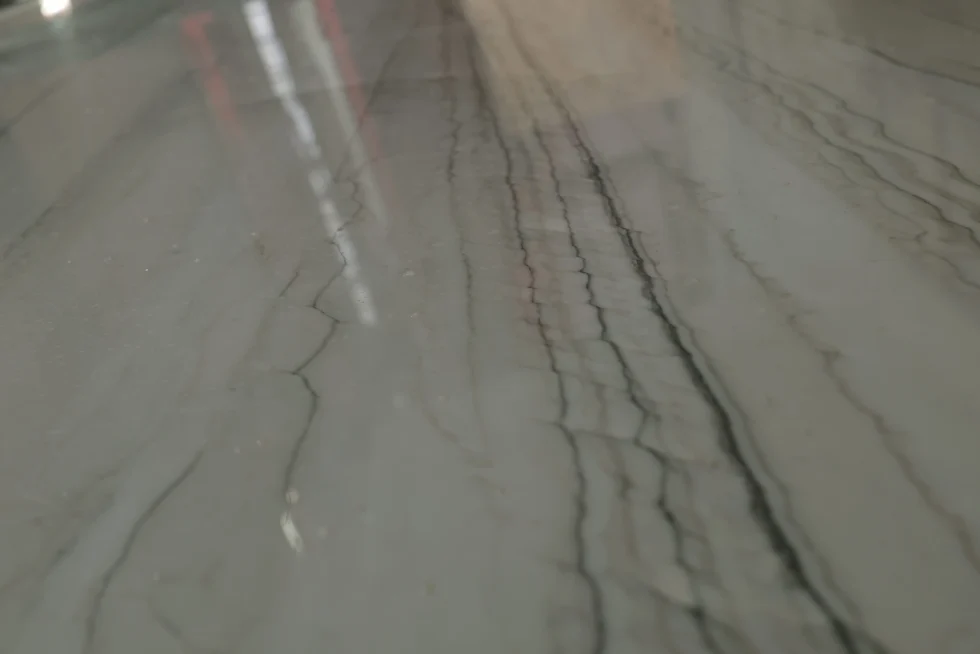
Quartzite is the other natural option. The NSI states that harsh weather and UV light do not affect natural quartzite, which holds only if the slab is real quartzite; our guide to fake quartzite explains the two checks.
Among the stones on our materials pages, Mont Blanc quartzite, shown above in our warehouse, and Sea Pearl are listed with outdoor use among their applications.
4. Plan for rain, pooled water and the odd freeze
With more than 50 inches of rain a year, how much water the stone absorbs matters more outside than in. A 2026 materials comparison published by the NSI links lower water absorption to better stain resistance and better freeze-thaw durability outdoors, and notes that granite and dense quartzites have naturally low absorption.
Freezes are infrequent here, but they happen. The NSI’s outdoor kitchen article warns that freeze-thaw cycles are hard on masonry and natural stone; water that soaks into a porous stone and freezes can open cracks. Around 22 freezing nights a year is a small risk for a dense stone and a larger one for a thirsty one.
Protect it with a penetrating sealer, which the NSI recommends outdoors against meat juices, wine, coffee, leaves and berries. Then borrow the institute’s home check: pour a small puddle of hot water on the top, wait 10 to 20 minutes and wipe. A darker patch means the stone is still drinking water and needs another coat.
5. Pick a finish for glare and grip
A mirror polish reflects sunlight back at the cook. According to the NSI’s guide to stone finishes, brushed surfaces are suitable for outdoor use, with some traction for wet surfaces, and calls a flamed finish, recommended for granite, ideal for outdoor kitchens.
Honed granite, matte and smooth, sits in between and is the finish the landscape architect above prefers. Whatever you choose, the finish is set at fabrication, so decide it with the stone.
6. Go thick, on a base built to carry it
A materials consultant quoted by the NSI notes that some distributors stock 2-inch slabs for outdoor counters, instead of the usual 1¼-inch (3 cm) indoor thickness, because they look and perform better outside. Ask what thicknesses are available in the stone you like.
Thicker stone is heavier, so the island under it, whatever it is built from, has to be level and strong before anyone measures for the top. Our guide to granite countertop thickness explains how thickness changes support and edges.
7. Bring the grill and sink specs to templating
Every built-in appliance needs its own cutout: grill head, side burner, sink, refrigerator drawers, trash pull-out. Have the exact models chosen and the installation sheets in hand before the stone is measured, the same rule our countertop template guide sets for indoor kitchens.
Think about the wind as well. A grill retailer quoted by the NSI warns that a grill built into a structure facing the prevailing wind can have trouble with its burners, and that people often forget outlets for blenders, speakers and phone chargers. Both are easier to fix on paper than in stone.
Those same choices shape the quote. The stone itself, its thickness, the finish, the number of appliance cutouts, the edge profile and how easily the slabs reach the patio all move the number.
The NSI lists thickness, certain finishes and cutouts among the items that affect fabrication pricing. We don’t publish prices, since they change with the stone and the job.
8. Put resealing on the calendar
Sun shortens the life of a sealer. A stone care expert quoted by the NSI lists oxidation from sunlight and air, along with harsh cleaners, as what breaks sealers down. Outside, check the counter with the hot-water test each spring and before you host a crowd.
For day-to-day care, a neutral stone cleaner is enough. Our guide to sealing marble and quartzite covers the routine. And if the counter is inside a home on the water rather than out on the patio, the checks in our piece on coastal kitchen countertops fit better.
Where porcelain, concrete and stainless fit
Porcelain slabs are a real outdoor option: the NSI’s 2026 comparison notes their strong resistance to thermal shock and UV exposure. Our article on porcelain vs quartzite compares edges, patterns and repairs.
Concrete is popular for its custom look, but in a side-by-side NSI test it was stained by turmeric and food dye and etched by acid, so it needs a diligent sealing routine.
Stainless steel and tile also show up in outdoor kitchens. We work in stone, so we leave those comparisons to the trades that install them; whichever surface you choose, run it past the same eight points.